
Every PhD scholar eventually reaches the same milestone: turning years of research into one final, polished thesis. It’s the document that decides whether your years of hard work get recognized — yet very few scholars are actually taught how to write one. Research training focuses on experiments, surveys, and data. Thesis writing is treated as something you’re expected to just “figure out.”
If you’re feeling stuck, overwhelmed, or unsure where to even begin, you’re not behind — you’ve just reached the part of the PhD that nobody prepares you for. Here’s a clear breakdown of how a strong thesis actually comes together, chapter by chapter.
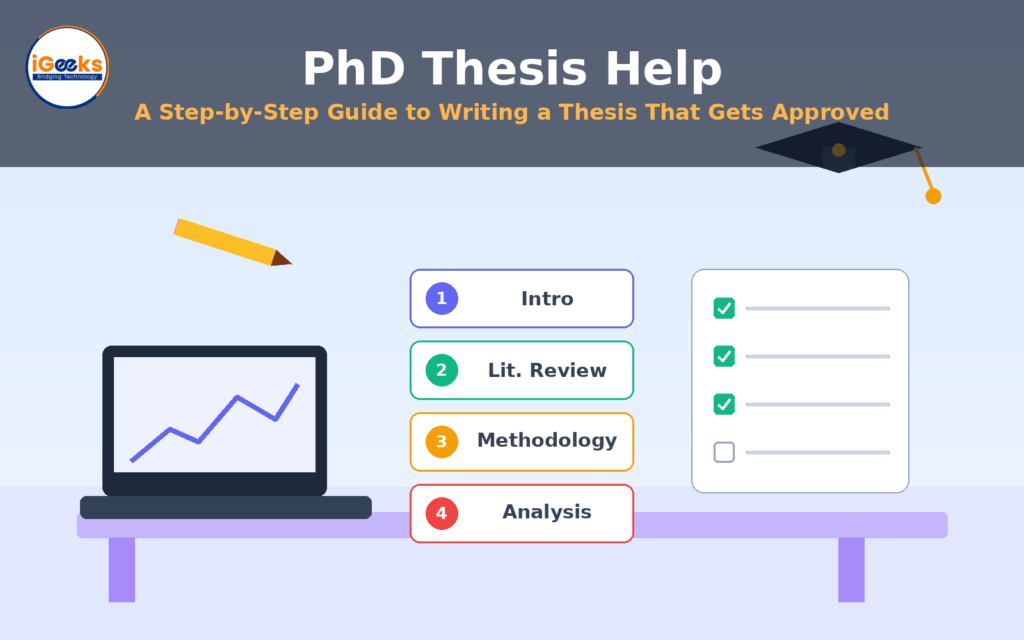
1. Start With a Tight Introduction Chapter
Your introduction sets the tone for the entire thesis. It should clearly establish:
- The research problem and why it matters
- Your research questions or hypotheses
- The scope and objectives of your study
- A brief roadmap of what each chapter covers
A common mistake here is trying to explain everything upfront. Keep it focused — the introduction should make a reader want to continue, not summarize your entire study in five pages.
2. Build a Literature Review That Shows the Gap
The literature review isn’t just a summary of papers you’ve read — it’s an argument. It should:
- Organize existing research thematically or chronologically
- Highlight where current knowledge falls short
- Clearly position your study as filling that gap
Scholars often spend months here simply because there’s so much to read. A useful approach is to summarize each source in one or two lines first, then group them by theme before writing full paragraphs.
3. Justify Your Methodology, Don’t Just Describe It
Your methodology chapter shouldn’t just state what you did — it should defend why you did it that way. Cover:
- Research design (qualitative, quantitative, or mixed methods)
- Sampling method and sample size justification
- Data collection tools and procedures
- Why this approach suits your specific research questions
Examiners often probe this chapter heavily during the viva, so clarity here pays off later.
4. Present Your Data Analysis With Interpretation, Not Just Numbers
This is where many scholars get stuck — not because they lack data, but because turning raw output (SPSS tables, regression results, thematic codes, etc.) into a readable narrative feels unfamiliar. Strong data chapters:
- Present results logically, aligned with your research questions
- Explain what each result means, not just what it shows
- Use tables and figures that support the text rather than replace it
If statistics or software output feels overwhelming, this is one of the most common areas scholars seek expert help with — and rightly so, since accuracy here matters enormously.
5. Write a Discussion That Connects Back to Existing Research
The discussion chapter is where your findings meet the literature you reviewed earlier. Ask:
- How do my results compare with previous studies?
- What do they confirm, contradict, or add to current understanding?
- What are the theoretical or practical implications?
This is often the most intellectually demanding chapter — and also the one that most impresses examiners when done well.
6. Close With a Clear, Honest Conclusion
Your conclusion should tie everything together without introducing new information. Include:
- A summary of key findings
- Contributions to the field
- Limitations of your study
- Recommendations for future research
Avoid overselling your findings — examiners value honesty about limitations more than inflated claims.
7. Don’t Underestimate Formatting and Referencing
A well-researched thesis can still lose marks over inconsistent formatting or referencing errors. Before submission, check:
- Your university’s specific formatting guidelines (font, spacing, headings)
- Consistent citation style throughout (APA, IEEE, MLA, etc.)
- A clean, accurate reference list with no missing citations
When It’s Time to Get Support
Struggling at any of these stages doesn’t mean you’re not capable — it usually just means you’re missing structured guidance at the right moment. Many scholars find it helpful to get support with:
- Structuring chapters and improving flow
- Statistical analysis and interpretation
- Academic language and plagiarism-free writing
- Formatting to university standards
- Preparing for the viva voce
Get PhD Thesis Help, Built Around Your Research
If you’d rather focus on your research while getting expert guidance on the writing, analysis, and formatting side, we’re here to help.
Explore our PhD Thesis Help services: 👉 www.makefinalyearproject.com/phd-thesis-help-bangalore.aspx
Have a question? Reach out directly on WhatsApp: 📲 +91 70192 80372
Your research is valuable — let’s make sure your thesis presents it that way.