

Time is the one resource every PhD scholar wishes they had more of. Unlike a job with fixed hours or a course with weekly deadlines, a PhD is largely self-paced — which sounds freeing until you realize how easy it is to lose months without a clear system. Whether you’re a full-time researcher or juggling your PhD alongside work and family, the difference between scholars who finish on time and those who stall for years often comes down to how they manage their time, not how hard they work.
Here’s a practical framework for managing a PhD timeline realistically.
Why PhD Time Management Is Different
Traditional productivity advice doesn’t always translate well to doctoral research, because:
- Tasks are often open-ended — “read literature” or “analyze data” don’t have a natural stopping point like a homework assignment
- Progress is invisible for long stretches — months of reading or data collection may show no visible output
- Motivation fluctuates — without external deadlines, it’s easy to lose momentum
- The finish line moves — research directions shift as findings emerge, unlike a fixed course syllabus
Because of this, PhD time management isn’t just about scheduling — it’s about creating structure where none is externally imposed.
1. Break Your PhD Into Milestones, Not Just Tasks
A 3-5 year PhD is too large a goal to plan around day-to-day. Instead, work backward from your expected submission date and break it into major milestones:
- Literature review completion
- Methodology finalization / ethics approval
- Data collection completion
- Data analysis completion
- First full draft
- Committee/supervisor review rounds
- Final submission
Each milestone should have a target date, even if approximate. This turns an overwhelming multi-year goal into a series of achievable checkpoints.
2. Use Weekly Planning, Not Just Daily To-Do Lists
Daily to-do lists work poorly for research because tasks like “analyze survey data” can take days, not hours. Instead:
- At the start of each week, identify 2-3 priority outcomes (not just tasks) — e.g., “complete coding of interview transcripts 1-10”
- Block specific days or half-days for deep work like writing or analysis, separate from admin tasks like emails or formatting
- Review progress every Friday and adjust the following week’s plan accordingly
3. Protect Deep Work Time
Writing, data analysis, and complex reading require sustained focus — something that’s easily fragmented by meetings, teaching duties, or notifications. Scholars who make consistent progress typically:
- Block 2-4 hour focus sessions for their most demanding work, ideally during their highest-energy hours
- Turn off notifications during these blocks
- Treat these blocks as non-negotiable appointments, the same as a class or meeting
4. Apply the “Good Enough Draft” Principle
Perfectionism is one of the biggest time drains in PhD writing. Many scholars rewrite the same paragraph repeatedly instead of moving forward. A more effective approach:
- Write a complete first draft of a section before going back to polish it
- Separate “writing mode” from “editing mode” — don’t do both simultaneously
- Remember that a rough but complete draft is far more useful than a perfect first paragraph and nothing else
5. Time-Block Data Analysis Realistically
Data analysis often takes longer than expected, especially if you’re learning a new statistical or qualitative method. Build in buffer time by:
- Estimating your first-attempt timeline, then adding 30-50% extra buffer
- Breaking analysis into stages (cleaning → coding/running tests → interpreting → writing up) rather than treating it as one large task
- Scheduling a “second pass” review before finalizing results, rather than assuming the first output is final
6. Manage PhD Alongside Work or Family Responsibilities
For part-time or working professional scholars, time isn’t just about discipline — it’s about realistic allocation:
- Identify your most consistent windows of availability (early mornings, weekends, specific weekday evenings) and protect them specifically for research
- Communicate your PhD schedule to family or colleagues so uninterrupted blocks are respected
- Set a realistic overall timeline based on actual available hours per week, not an idealized full-time pace
7. Build in Recovery, Not Just Output
Sustainable time management includes rest — not as an afterthought, but as part of the plan:
- Schedule short breaks between deep work sessions to avoid diminishing returns
- Take at least one full day off per week where possible
- Recognize that burnout typically slows research more than a planned day of rest ever would
8. Track Progress Visually
Seeing progress — even slow progress — helps maintain motivation over a multi-year project. Simple methods that help:
- A visual milestone tracker (chapters completed, data collected, papers submitted)
- A weekly log of what was accomplished, even briefly
- Regular check-ins with your supervisor to mark progress formally, not just informally
A Realistic Weekly Structure Example
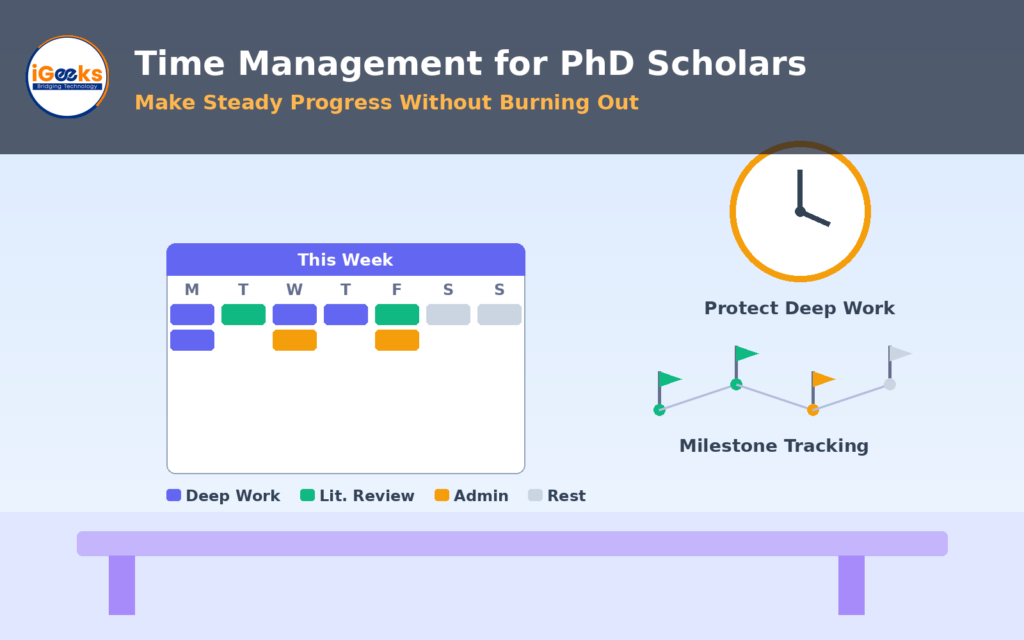
While every scholar’s situation differs, a general weekly structure might look like:
- 3-4 blocks of deep work (writing, analysis) — 2-4 hours each
- 1-2 blocks for reading/literature — 1-2 hours each
- Admin time — emails, formatting, scheduling — kept to short, defined windows
- 1 review session — assessing the week’s progress and planning the next
- Protected rest time — at least one full day off
You Don’t Have to Figure This Out Alone
Time management struggles are one of the most common — and most solvable — challenges in a PhD journey. If you’re finding it difficult to balance your research with writing, analysis, or submission deadlines, structured guidance can help you make consistent progress without burning out.
Explore our PhD Thesis Help services in Bangalore: 👉 www.makefinalyearproject.com/phd-thesis-help-bangalore.aspx
Have a question? Reach out directly on WhatsApp: 📲 +91 70192 80372
Steady, sustainable progress beats sporadic bursts of effort — let’s help you build a plan that actually works.