

f you’re starting a PhD — or you’re a few years in and wondering if anyone else feels this lost — this one’s for you. There’s no single “right way” to do a doctorate, but after supporting hundreds of research scholars through theirs, some pieces of advice come up again and again. Not textbook advice. The kind you usually only hear from someone a few years ahead of you.
Here’s what we’d tell every scholar starting — or in the middle of — their PhD.
1. Your First Topic Idea Will Probably Change. That’s Fine.
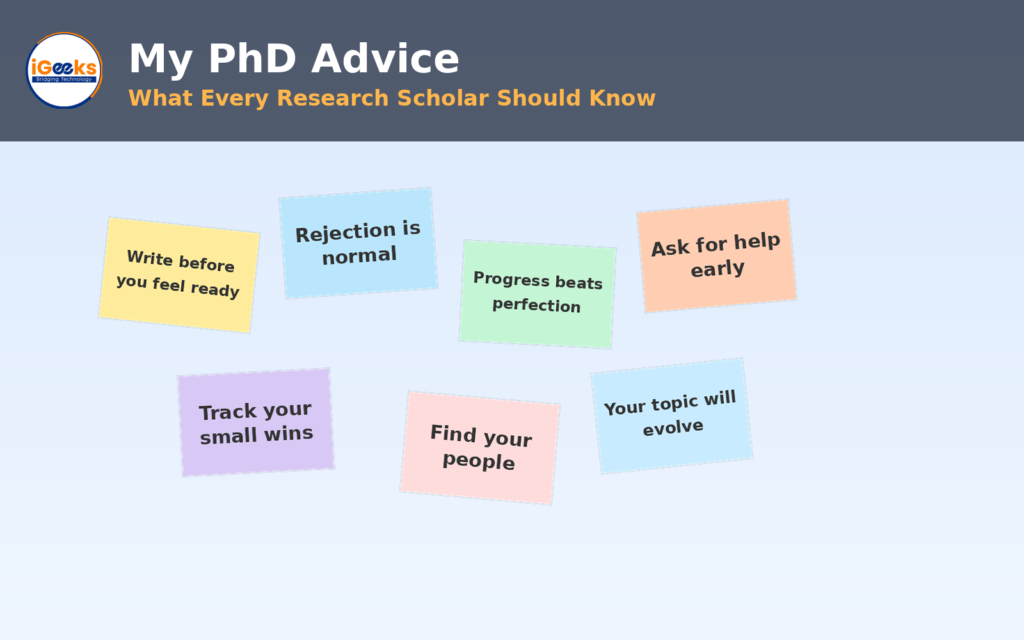
Almost nobody starts with the exact research question they finish with. Your topic sharpens as you read more, talk to your supervisor more, and understand the field more deeply. Treat your first idea as a direction, not a contract.
2. Read With a Purpose, Not Just to “Cover Everything”
You will never read everything in your field, and trying to is how literature reviews eat entire years. Read to answer a specific question: what’s already known, and what’s still missing? The moment you can clearly state the gap, you’ve read enough to start writing.
3. Write Before You Feel Ready
Nobody feels “ready” to write a chapter. The scholars who make progress write rough, incomplete drafts early — not because they’re confident, but because writing is how you figure out what you actually think. Editing a bad draft is infinitely easier than staring at a blank page.
4. Your Supervisor Is a Guide, Not a GPS
They won’t — and shouldn’t — tell you exactly what to do at every step. Come to meetings with questions, drafts, and opinions, not just updates. The more ownership you take, the more useful their feedback becomes.
5. Data Analysis Takes Longer Than You Think. Budget for That.
Whatever timeline you estimate for data cleaning, analysis, and interpretation — add more. Almost every scholar underestimates this stage, especially if they’re learning a new statistical tool alongside their actual research questions.
6. Rejection and Revisions Are Normal, Not a Verdict on You
A rejected paper. A “major revisions” decision. A tough round of viva questions. None of these mean you’re not good enough — they mean you’re doing what every researcher before you has done. The scholars who finish aren’t the ones who never get pushback. They’re the ones who keep going after it.
7. Isolation Is the Default. Fight It on Purpose.
Nobody schedules “make friends with other researchers” into their PhD plan, but it matters more than most people admit. Find your people — a peer group, a writing buddy, an online community. A PhD done entirely alone is harder than it needs to be.
8. Perfectionism Will Slow You Down More Than Mistakes Will
A finished, “good enough” chapter that gets feedback moves your thesis forward. A perfect paragraph you’ve rewritten fifteen times does not. Progress beats polish, especially in early drafts.
9. Track Small Wins — They’re Easy to Forget
A completed literature review section. A clean dataset. A successful pilot test. These don’t feel like milestones in the moment, but they are. Keep some record of progress, even informally — it helps on the days when the finish line feels impossibly far.
10. Plan Your Career Path Before Your Final Year
Don’t wait until your viva is scheduled to think about what’s next. Whether it’s academia, industry, or something else entirely, start reflecting, networking, and gaining relevant experience well before you need to have it figured out.
11. Ask for Help Before You’re Overwhelmed, Not After
Whether it’s your supervisor, a peer, a mental health resource, or expert support for a specific technical challenge — asking early is almost always easier than asking once you’re already behind. There’s no reward for struggling silently.
The One Piece of Advice That Matters Most
However hard a specific week, chapter, or setback feels — it is very rarely a reflection of whether you’re capable of finishing. Most of what feels uniquely difficult about your PhD is, in fact, exactly what every scholar before you has quietly gone through too.
We’re Here If You Need Support Along the Way
Whether you’re stuck on your topic, buried in data analysis, or trying to get a chapter across the finish line, having the right support can make a real difference.
Explore our PhD Thesis Help services in Bangalore: 👉 www.makefinalyearproject.com/phd-thesis-help-bangalore.aspx
Have a question? Reach out directly on WhatsApp: 📲 +91 70192 80372
You’ve got this — and you don’t have to do it entirely alone.