
Thesis” gets used loosely — for a Master’s project, a PhD dissertation, even sometimes a long assignment. But a Master’s thesis and a PhD thesis are genuinely different documents, with different purposes, different expectations, and different levels of original contribution required. Understanding exactly how they differ helps you know what you’re actually being asked to produce — and avoid under- or over-building for the level you’re at.
Here’s the simplest possible breakdown.
The One-Line Difference
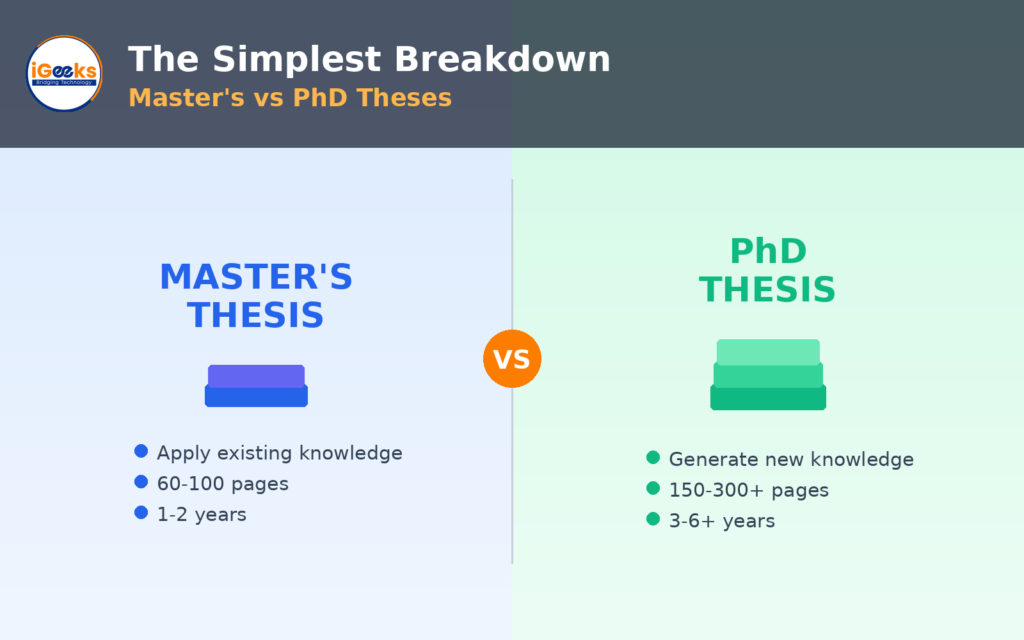
- A Master’s thesis demonstrates that you can competently apply existing research methods and knowledge to a defined problem.
- A PhD thesis demonstrates that you can generate new knowledge — a genuine, original contribution to your field that didn’t exist before.
Everything else follows from this core distinction.
Purpose
Master’s Thesis: The goal is to show you’ve mastered the tools, theories, and methods of your field well enough to apply them competently to a specific problem. You’re demonstrating capability, not necessarily breaking new ground.
PhD Thesis: The goal is to produce new knowledge — a genuine contribution that advances your field in some way, however incrementally. You’re not just applying existing methods well; you’re expected to identify a real gap and fill it.
Length and Scope
Master’s Thesis: Typically 60–100 pages, focused on a single, well-defined research question. The scope is intentionally narrower — deep enough to demonstrate competence, but not expected to be exhaustive.
PhD Thesis: Typically 150–300+ pages, often addressing multiple interconnected research questions or a broader research program. The scope needs to be substantial enough to represent years of sustained, original work.
Literature Review
Master’s Thesis: Demonstrates that you understand the key existing research relevant to your topic — showing you know the field well enough to situate your work within it.
PhD Thesis: Goes further — it must clearly identify a specific gap in current knowledge and build a compelling case for why that gap matters, setting up your original contribution.
Methodology
Master’s Thesis: Usually applies established, well-understood research methods to a new context or dataset. The methodology itself is rarely the innovation — it’s a tool for answering your specific question.
PhD Thesis: May also apply established methods, but often involves more methodological rigor, larger or more complex datasets, and sometimes methodological innovation itself as part of the contribution.
Original Contribution
Master’s Thesis: Original application of existing knowledge — using established theories or methods to explore a specific, defined problem. Genuinely new theoretical contributions aren’t typically expected.
PhD Thesis: This is the defining requirement. A PhD thesis must make a genuine, identifiable, original contribution to the field — new theory, new empirical findings, a new methodological approach, or new understanding that didn’t exist before your research.
Supervision and Timeline
Master’s Thesis: Usually completed within one to two years, often as part of a structured coursework-based program, with relatively frequent supervisor check-ins built into the program timeline.
PhD Thesis: Typically takes three to six years (longer for part-time scholars), with a much more independent, self-directed research process, and supervisor involvement that shifts over time from directive to increasingly collaborative.
Examination
Master’s Thesis: Usually evaluated through written assessment, sometimes with a shorter oral defense or presentation.
PhD Thesis: Requires a formal, often extensive viva voce — an oral examination where you must defend your entire research, methodology, findings, and contribution in detail before a committee of experts.
A Quick Side-by-Side
| Master’s Thesis | PhD Thesis | |
|---|---|---|
| Core goal | Apply existing knowledge competently | Generate new knowledge |
| Length | 60–100 pages | 150–300+ pages |
| Timeline | 1–2 years | 3–6+ years |
| Contribution | Applied, not necessarily novel | Must be genuinely original |
| Literature review | Shows field understanding | Identifies and justifies a specific gap |
| Examination | Written, sometimes brief defense | Formal, extensive viva voce |
Why This Distinction Matters
Understanding this difference isn’t just academic trivia — it shapes how you should approach your own work. Master’s scholars sometimes underestimate what’s expected, treating their thesis like an extended assignment rather than a genuine (if modest) research project. PhD scholars sometimes struggle in the opposite direction, spending excessive time trying to make every section exhaustive rather than focusing energy on the genuine original contribution that actually matters for examination.
Knowing exactly what level of originality, scope, and rigor is expected at your specific level helps you allocate your time and effort where it actually counts.
Support at Either Level
Whether you’re completing a Master’s thesis or a PhD, having guidance calibrated to the actual expectations of your specific level — not over- or under-delivering — makes the process considerably more manageable.
Explore our thesis support services in Bangalore, for both Master’s and PhD scholars: 👉 www.makefinalyearproject.com/phd-thesis-help-bangalore.aspx
Not sure what’s expected at your level? Reach out directly on WhatsApp: 📲 +91 70192 80372
Knowing exactly what you’re building toward makes the whole process clearer — let’s help you build it right.