
Engineering and computer science coursework today spans an enormous range of specializations — from classical subjects like data structures and operating systems to fast-evolving fields like machine learning, IoT, and blockchain. For many students, the challenge isn’t understanding a single subject deeply; it’s managing the sheer breadth of technical domains, tools, and programming platforms a modern curriculum demands, often across multiple assignments running in parallel with tight deadlines.
Here’s a practical look at what strong assignment support in engineering and CS actually covers, and what to look for if you’re considering getting help.
Why Engineering and CS Assignments Are Uniquely Demanding
Unlike many other academic disciplines, engineering and computer science assignments typically require:
- Working, executable code — not just written analysis, but functioning programs, simulations, or circuit designs that actually run
- Domain-specific tools — each specialization has its own software ecosystem (MATLAB for signal processing, Verilog for VLSI, TensorFlow for deep learning, NS2/NS3 for networking)
- Correct theoretical grounding — code that works isn’t enough; it needs to reflect accurate understanding of the underlying algorithms, protocols, or circuit principles
- Proper documentation — output screenshots, test cases, methodology explanations, and academic-style reporting alongside the technical work itself
This combination of coding, theory, and academic writing is exactly where many students — particularly those balancing multiple subjects or working in a second language — find themselves needing genuine support.
The Breadth of Modern Engineering and CS Coursework
A single semester can realistically span assignments across wildly different domains, each demanding its own expertise:
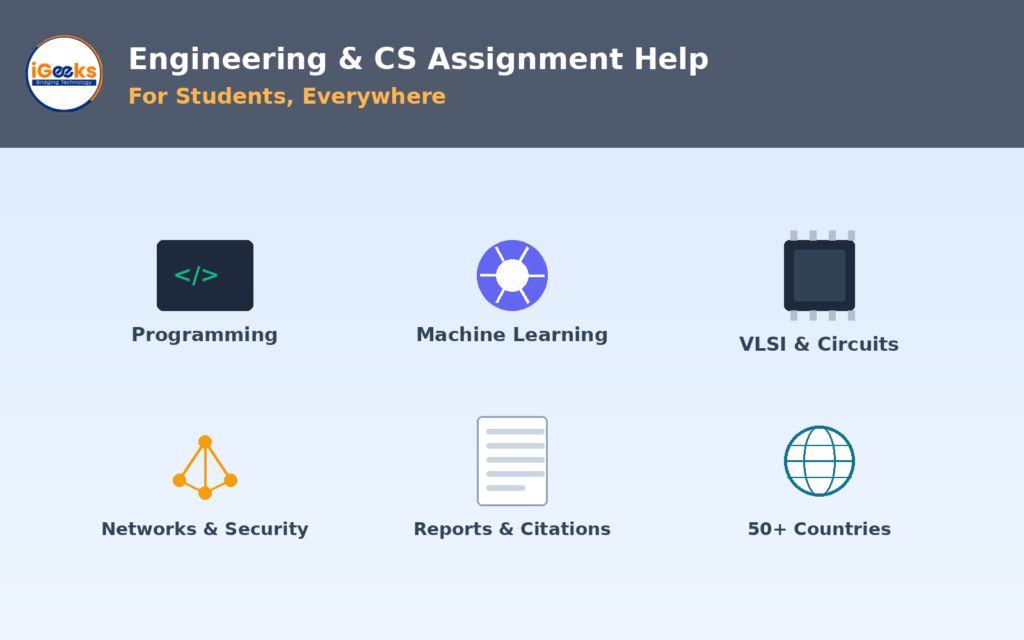
- Machine Learning & Deep Learning — regression, classification, CNNs, RNNs, model evaluation
- IoT & Embedded Systems — sensor integration, microcontroller programming, edge computing
- Cybersecurity & Networks — cryptography, intrusion detection, protocol simulation
- Cloud Computing — IaaS/PaaS/SaaS architectures, containerization, cloud migration
- VLSI & Digital Design — RTL design, FPGA implementation, timing analysis
- Data Structures & Algorithms — complexity analysis, algorithm design, optimization
- Signal Processing — filter design, Fourier analysis, biomedical signal work
- Databases — relational design, SQL, NoSQL systems, transaction management
Very few students find every single one of these areas equally comfortable — and that unevenness is completely normal, not a sign of falling behind.
What Genuinely Useful Assignment Support Should Include
1. Understanding the Actual Requirement First
Before any code is written or content drafted, a clear understanding of the assignment brief, marking rubric, and specific requirements matters enormously. Assignments are frequently marked down not because the work is technically wrong, but because it doesn’t fully address what was actually asked.
2. Working Code, Properly Documented
For technical assignments, the deliverable should be functioning, well-commented code — accompanied by output screenshots, test cases, and a clear explanation of the approach, not just a working script with no context.
3. Academically Structured Reports
Where a written report is required, it should follow proper academic structure — introduction, methodology, results, discussion — with accurate citations in whichever referencing style your program requires (IEEE, APA, Harvard, etc.).
4. Data Analysis Done Correctly
For assignments involving statistical testing or data visualization, results need to be both technically correct and clearly interpreted — a chart or test result on its own isn’t useful without explanation of what it actually shows.
5. Genuine Originality
Every assignment should be developed from scratch, reflecting real engagement with the specific problem — not adapted from a template or reused across multiple students, and checked for originality before delivery.
Common Mistakes Students Make With Technical Assignments
- Starting to code before fully understanding the requirement — leading to technically functional but off-target solutions
- Treating documentation as an afterthought — a working program without clear explanation often loses significant marks
- Using unfamiliar tools without validating results — especially in ML or data analysis assignments, where incorrect parameter choices can silently produce misleading output
- Leaving citation and referencing until the end — increasing the risk of inconsistent or incomplete citations under time pressure
Choosing the Right Support
If you’re considering assignment help, look for support that can genuinely match your specific subject area — a machine learning assignment and a VLSI assignment require completely different expertise, and generic “we do all engineering” claims are worth verifying with specific questions about the actual tools and methods involved in your assignment.
Assignment Help in Bangalore
Whether you’re working through a machine learning model, a VLSI design assignment, a networking simulation, or a data analysis project, having access to genuine domain expertise — not just general writing help — makes a real difference to both your understanding and your results.
Explore our academic support services in Bangalore: 👉 www.makefinalyearproject.com/overseas-assignment-help-india.aspx
Have a specific assignment you need help with? Reach out directly on WhatsApp: 📲 +91 7019280372
The right support helps you understand the work, not just complete it — that’s the difference worth looking for.