
Research projects, dissertations, and thesis work often require students to analyze data and draw meaningful conclusions. One of the most widely used statistical software packages for academic research is SPSS (Statistical Package for the Social Sciences). Whether you are an MBA student, Engineering student, Nursing researcher, Medical professional, or PhD scholar, understanding key SPSS statistical tests is essential for successful research.
Choosing the correct statistical test is one of the most important steps in data analysis. Applying the wrong test can lead to inaccurate results and invalid conclusions.
Why Statistical Testing Matters
Statistical tests help researchers:
- Validate research hypotheses
- Measure relationships between variables
- Compare groups and datasets
- Identify significant patterns
- Support data-driven conclusions
Proper statistical analysis strengthens the credibility and reliability of research findings.
1. Descriptive Statistics
Descriptive statistics provide a summary of collected data.
Common measures include:
- Mean
- Median
- Mode
- Standard Deviation
- Frequency Distribution
These statistics help researchers understand the basic characteristics of a dataset before conducting advanced analysis.
2. Reliability Analysis (Cronbach’s Alpha)
Reliability analysis measures the consistency of questionnaire responses.
It is commonly used for:
- Customer Satisfaction Surveys
- Employee Feedback Studies
- Marketing Research
- Academic Research Questionnaires
A Cronbach’s Alpha value above 0.70 is generally considered acceptable.
3. Correlation Analysis
Correlation analysis examines the relationship between two variables.
Popular correlation methods include:
- Pearson Correlation
- Spearman Correlation
Examples:
- Relationship between training and employee performance
- Relationship between customer satisfaction and loyalty
4. Independent Sample t-Test
The Independent Sample t-Test compares the means of two different groups.
Applications include:
- Comparing male and female responses
- Comparing customer groups
- Comparing employee categories
This test helps determine whether significant differences exist between two independent groups.
5. Paired Sample t-Test
This test compares measurements taken from the same group at two different points in time.
Examples:
- Before and after training programs
- Pre-test and post-test evaluations
It is commonly used in educational and healthcare research.
6. ANOVA (Analysis of Variance)
ANOVA is used when comparing three or more groups.
Examples include:
- Comparing employee satisfaction across departments
- Comparing customer perceptions across age groups
ANOVA helps researchers identify statistically significant differences among multiple categories.
7. Chi-Square Test
The Chi-Square test analyzes relationships between categorical variables.
Applications include:
- Gender and Product Preference
- Education Level and Employment Status
- Age Group and Buying Behavior
This is one of the most frequently used tests in survey-based research.
8. Regression Analysis
Regression analysis helps predict outcomes and understand variable relationships.
Common uses include:
- Sales Forecasting
- Consumer Behavior Analysis
- Financial Research
- Business Performance Studies
Regression models are widely used in MBA projects and market research studies.
9. Factor Analysis
Factor Analysis helps reduce large datasets into meaningful factors or dimensions.
Applications include:
- Consumer Behavior Research
- Brand Perception Studies
- Employee Satisfaction Analysis
This technique is often used when working with questionnaires containing multiple variables.
10. One-Sample Test
One-Sample Tests compare a sample mean against a known value or benchmark.
Researchers use this test to determine whether collected data differs significantly from expected values.
Choosing the Right Statistical Test
The selection of a statistical test depends on:
- Research Objectives
- Type of Data
- Number of Variables
- Research Design
- Sample Size
Choosing the appropriate test is critical for obtaining valid and meaningful research results.
Common Mistakes Students Make During SPSS Analysis
Many students face difficulties such as:
- Selecting incorrect statistical tests
- Improper data coding
- Misinterpreting SPSS outputs
- Ignoring reliability testing
- Drawing unsupported conclusions
These errors can affect the quality and credibility of research findings.
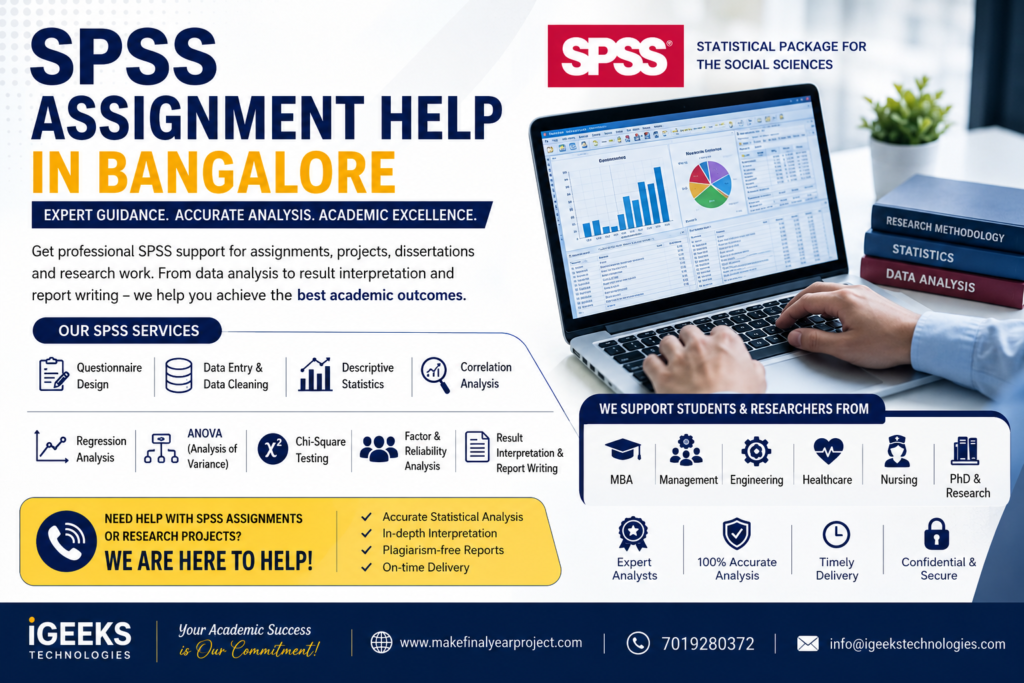
SPSS Support for Academic Projects
Students often require assistance with:
- Questionnaire Design
- Data Entry and Coding
- Statistical Test Selection
- Data Analysis
- Interpretation of Results
- Report Writing
- Dissertation and Thesis Support
Professional guidance can help students understand statistical concepts and complete projects successfully.
Academic Areas Using SPSS
SPSS is widely used in:
- MBA Projects
- BBA Research
- Nursing Studies
- Medical Research
- Engineering Projects
- Social Science Research
- PhD Thesis Work
- Dissertation Studies
Why Learn SPSS?
SPSS skills provide students with:
- Strong Research Capabilities
- Better Academic Performance
- Enhanced Analytical Skills
- Improved Career Opportunities
- Data-Driven Decision-Making Abilities
As organizations increasingly rely on data analytics, statistical knowledge has become a valuable professional skill.
Conclusion
Understanding statistical tests is essential for producing quality academic research. Descriptive Statistics, Correlation Analysis, Regression Analysis, ANOVA, Chi-Square Testing, and Factor Analysis are among the most important techniques used in SPSS. Students who learn these methods can conduct accurate data analysis and develop stronger research projects.
For SPSS Assignment Help, MBA Project Data Analysis, Dissertation Support, and Research Guidance, visit:
https://www.makefinalyearproject.com/spss-assignment-help-bangalore.html
📞 Call / WhatsApp: 7019280372
Keywords: SPSS Statistical Tests, SPSS Assignment Help Bangalore, Regression Analysis SPSS, ANOVA Assignment Help, Chi-Square Analysis, MBA Project Data Analysis, Dissertation Statistics, Research Methodology Support, SPSS Training, Statistical Data Analysis Services.