
Essential Tips for Crafting a Medical Thesis That Gains Acceptance
Writing a medical thesis is one of the most important milestones in the academic journey of an MD, MS, DNB, MDS, or DM student. A well-structured thesis not only fulfills university requirements but also demonstrates your research capabilities, critical thinking, and commitment to evidence-based medicine.
Unfortunately, many postgraduate students struggle with topic selection, research methodology, statistical analysis, referencing, and scientific writing. These challenges often lead to delays, multiple revisions, or even rejection.
In this blog, we share the essential tips that can significantly improve your chances of getting your medical thesis accepted.
1. Choose a Research Topic That Matters
Your research topic should be:
- Clinically relevant
- Original and feasible
- Interesting to your department
- Supported by adequate literature
- Practical within your available time
Avoid selecting topics that are either too broad or too narrow. Discuss multiple ideas with your guide before finalizing the subject.
2. Perform an Extensive Literature Review
Before beginning your study:
- Search recent journal articles.
- Identify research gaps.
- Understand previous methodologies.
- Note limitations in earlier studies.
A strong literature review helps justify your research question and strengthens your thesis proposal. Comprehensive background research also helps avoid duplication of existing work.
3. Develop a Strong Research Protocol
A quality protocol should include:
- Background
- Aim and objectives
- Research hypothesis
- Study design
- Sample size calculation
- Inclusion & exclusion criteria
- Methodology
- Statistical analysis plan
- Ethical considerations
A well-prepared protocol prevents major revisions later.
4. Obtain Ethics Committee Approval
Never begin data collection before obtaining Institutional Ethics Committee (IEC) approval.
Ensure that:
- Patient confidentiality is maintained.
- Informed consent is obtained.
- Ethical guidelines are strictly followed.
Ethical compliance is a mandatory component of postgraduate medical research.
5. Maintain High-Quality Data Collection
Many theses fail because of poor-quality data.
Always:
- Use standardized data collection forms.
- Verify patient information.
- Record observations immediately.
- Avoid missing values.
- Maintain secure backups.
Clean, accurate data improves the credibility of your research.
6. Use Appropriate Statistical Analysis
Incorrect statistics can weaken an otherwise excellent study.
Consult a statistician before data analysis to determine:
- Appropriate statistical tests
- Sample size adequacy
- Confidence intervals
- P-values
- Interpretation of results
Proper statistical planning should begin before the study, not after data collection.
7. Write Every Chapter Systematically
A standard medical thesis generally includes:
- Title Page
- Certificate
- Acknowledgement
- Abstract
- Introduction
- Review of Literature
- Aim & Objectives
- Materials and Methods
- Results
- Discussion
- Conclusion
- References
- Annexures
Each chapter should flow logically and avoid unnecessary repetition.
8. Follow University Formatting Guidelines
Every university has its own formatting requirements.
Check:
- Font style
- Font size
- Margin settings
- Page numbering
- Heading styles
- Citation format
- Reference style
Ignoring formatting guidelines often results in unnecessary corrections.
9. Avoid Plagiarism
Originality is one of the most important evaluation criteria.
Before submission:
- Run plagiarism checks.
- Rewrite copied content.
- Cite every source correctly.
- Use reference management software.
A plagiarism-free thesis reflects academic integrity and improves acceptance chances.
10. Use Standard Referencing
Popular reference styles include:
- Vancouver Style
- APA Style
- MLA Style
Most medical universities prefer Vancouver referencing.
Incorrect citations can reduce the overall quality of your thesis.
11. Create Clear Tables, Charts, and Figures
Visual presentation helps readers understand your findings quickly.
Ensure:
- Proper labeling
- Sequential numbering
- High-quality images
- Consistent formatting
- Accurate legends
Well-designed tables improve readability and make your research more convincing.
12. Write a Strong Discussion
Your discussion should:
- Compare findings with previous studies.
- Explain similarities and differences.
- Highlight clinical significance.
- Mention study limitations.
- Suggest future research directions.
Avoid simply repeating your results.
13. Prepare an Effective Abstract
The abstract is the most-read section of your thesis.
Include:
- Background
- Objectives
- Methods
- Results
- Conclusion
Keep it concise while accurately representing the entire study.
14. Revise Multiple Times
Rarely is a thesis accepted in its first submitted form.
Review your work for:
- Grammar
- Scientific language
- Consistency
- References
- Formatting
- Statistical accuracy
Careful revision and responding thoroughly to feedback substantially improve acceptance rates.
15. Seek Expert Guidance
Working with experienced research mentors can save valuable time and help you avoid common mistakes in protocol development, data analysis, scientific writing, referencing, and final submission.
Professional guidance is particularly beneficial when managing tight postgraduate schedules alongside clinical duties.
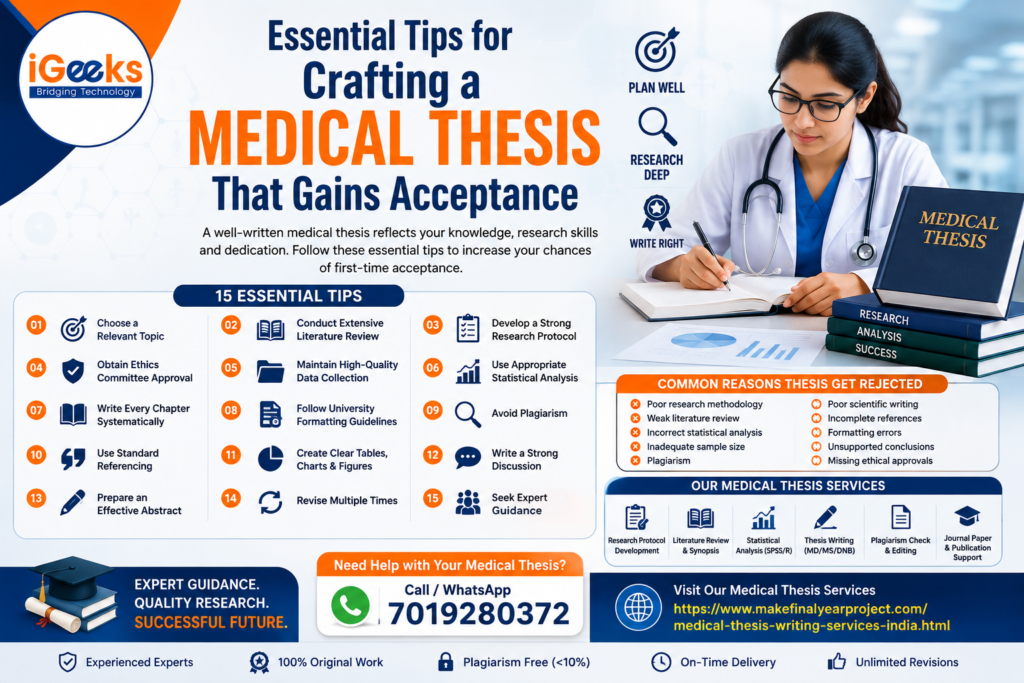
Common Reasons Medical Theses Get Rejected
- Poor research methodology
- Weak literature review
- Incorrect statistical analysis
- Inadequate sample size
- Plagiarism
- Poor scientific writing
- Incomplete references
- Formatting errors
- Unsupported conclusions
- Missing ethical approvals
Most of these issues can be prevented with early planning and systematic execution.
Final Thoughts
A successful medical thesis is built on careful planning, ethical research practices, robust methodology, accurate statistical analysis, and clear scientific writing. Starting early, following institutional guidelines, and seeking timely guidance can significantly improve your chances of first-time acceptance.
If you’re pursuing an MD, MS, DNB, MDS, DM, or other postgraduate medical program, investing time in a well-structured thesis will not only help you complete your degree but also strengthen your academic and professional profile.
Need Professional Medical Thesis Writing Support?
We provide end-to-end assistance for:
- Research Protocol Development
- Synopsis Writing
- Literature Review
- Statistical Analysis (SPSS/R)
- Medical Thesis Writing
- Reference Management
- Plagiarism Reduction
- Journal Paper Preparation
- Publication Support
📞 Call / WhatsApp: 7019280372
🌐 Medical Thesis Services: https://www.makefinalyearproject.com/medical-thesis-writing-services-india.html
Start your medical thesis with confidence and maximize your chances of first-time acceptance.