
For postgraduate medical students in India, completing a thesis is a major academic requirement. Whether you are pursuing MD, MS, DNB, or MCh, a well-planned research project requires much more than writing a final document. It involves selecting an appropriate topic, developing a research protocol, conducting a literature review, collecting and analyzing data, interpreting results, and preparing the thesis according to institutional requirements.
Many postgraduate students also have demanding clinical schedules, making it challenging to manage every stage of research independently. This is where structured medical thesis support services can help students organize and execute their academic research more effectively.
What Is a Medical Thesis?
A medical thesis is a structured research project conducted by a postgraduate medical student under the guidance of an academic supervisor.
Depending on the program and institution, the research may involve:
- Clinical studies
- Observational studies
- Prospective or retrospective studies
- Comparative studies
- Diagnostic studies
- Epidemiological research
- Laboratory-based research
- Surgical outcome studies
- Questionnaire-based research
The objective is to answer a clearly defined research question using an appropriate scientific methodology.
Who May Need Medical Thesis Support?
Medical thesis support can be relevant to postgraduate students pursuing:
MD Thesis
MD students commonly undertake research in specialties such as:
- General Medicine
- Pediatrics
- Dermatology
- Psychiatry
- Radiodiagnosis
- Anesthesiology
- Pathology
- Pharmacology
- Microbiology
- Community Medicine
- Respiratory Medicine
- Emergency Medicine
MS Thesis
MS students may conduct research related to:
- General Surgery
- Orthopedics
- Obstetrics & Gynecology
- Ophthalmology
- ENT
DNB Thesis
DNB trainees may also need structured assistance with research planning, documentation, statistical analysis, thesis preparation, and publication-related activities.
MCh Research
MCh programs involve advanced super-specialty research. Topics may involve complex clinical or surgical questions requiring careful study design, data interpretation, and scientific documentation.
1. Start With the Research Question
One of the most important steps is identifying a focused research question.
A good research question should be:
- Clinically relevant
- Specific
- Researchable
- Feasible within the available period
- Supported by sufficient literature
- Appropriate for the available patient population and resources
Avoid selecting a topic simply because it sounds interesting. Consider whether you can realistically obtain the required sample size, data, investigations, and follow-up.
2. Choose Your Thesis Topic Carefully
A suitable thesis topic should balance originality, feasibility, clinical relevance, and available resources.
Before finalizing the topic, discuss it with your guide and department.
Consider:
- Availability of study participants
- Duration of the study
- Laboratory or diagnostic facilities
- Expected sample size
- Budget
- Ethical considerations
- Availability of previous research
A practical topic that can be completed properly is generally preferable to an overly ambitious project.
3. Conduct a Comprehensive Literature Review
A literature review establishes the scientific background of your research.
Search reliable academic databases and journals to understand:
- What is already known?
- What are the gaps in existing research?
- What methodologies have previous researchers used?
- What limitations have been reported?
- How does your proposed research add value?
Organize relevant references systematically from the beginning rather than trying to collect them immediately before thesis submission.
4. Develop a Strong Research Protocol
The research protocol is the foundation of your thesis.
It commonly includes:
- Title
- Background
- Rationale
- Research question
- Aim
- Objectives
- Hypothesis, where applicable
- Study design
- Study setting
- Study population
- Sample size
- Inclusion criteria
- Exclusion criteria
- Study methodology
- Data collection procedure
- Statistical analysis plan
- Ethical considerations
- References
A well-developed protocol can reduce methodological problems later.
5. Understand Ethics Committee Requirements
Medical research involving human participants requires appropriate ethical oversight.
Before starting data collection, students should understand the requirements of their Institutional Ethics Committee (IEC) and their university/institution.
Important considerations include:
- Informed consent
- Patient confidentiality
- Data protection
- Risk-benefit assessment
- Vulnerable populations
- Appropriate documentation
Students should follow their institution’s current ethical and regulatory requirements rather than relying on templates from unrelated studies.
6. Plan Your Sample Size Properly
Sample size is an important component of research methodology.
An inadequate sample may produce inconclusive findings, while an unnecessarily large sample can consume additional time and resources.
Sample size calculations may depend on factors such as:
- Study design
- Expected effect size
- Prevalence
- Statistical power
- Significance level
- Confidence level
- Expected dropout rate
A qualified statistician or research methodology expert can help determine the appropriate approach for your specific study design.
7. Collect Data Systematically
Once the protocol and required approvals are in place, data collection should follow the predefined methodology.
Maintain:
- Standardized data collection forms
- Consistent measurements
- Accurate patient records
- Proper coding
- Secure data storage
- Regular data verification
Avoid changing the methodology midway through the study without discussing the implications with your guide and following the appropriate institutional process.
8. Use Appropriate Statistical Analysis
Statistical analysis should be planned according to the research question and study design.
Depending on the study, analysis may involve:
- Descriptive statistics
- Tests of association
- Comparative tests
- Correlation
- Regression
- Diagnostic accuracy analysis
- Survival analysis
Software such as SPSS, R, or other statistical platforms may be used depending on the requirements.
Importantly, statistical software does not automatically make an analysis scientifically appropriate. The selected test and interpretation must match the study design and type of data.
9. Write the Thesis Chapter by Chapter
A medical thesis commonly contains sections such as:
- Introduction
- Review of Literature
- Aim and Objectives
- Materials and Methods
- Results
- Discussion
- Conclusion
- References
- Annexures
Additional preliminary sections may include the certificate, declaration, acknowledgement, abstract, tables, figures, and abbreviations according to institutional requirements.
Writing chapter by chapter makes the process more manageable.
10. Present Results Clearly
Your results should answer your research objectives without unnecessary interpretation.
Use:
- Tables
- Graphs
- Charts
- Figures
- Appropriate statistical measures
Every table and figure should have a clear title, numbering, and explanation where necessary.
Avoid presenting the same information repeatedly in multiple formats.
11. Develop a Strong Discussion
The discussion is where you interpret your findings.
Compare your results with relevant previous studies and explain:
- Similarities
- Differences
- Possible reasons for differences
- Clinical relevance
- Strengths
- Limitations
- Implications for future research
A strong discussion demonstrates that you understand the significance of your findings rather than simply reporting numbers.
12. Maintain Academic Integrity
Academic integrity is essential throughout the research process.
Avoid:
- Plagiarism
- Fabrication of data
- Falsification of results
- Unverified references
- Misrepresentation of statistical findings
- Unethical use of published material
Use appropriate citation practices and verify references before submission.
13. Follow University and Institutional Guidelines
Thesis requirements can vary between universities and institutions.
Before final submission, verify:
- Page format
- Font requirements
- Chapter structure
- Referencing style
- Declaration and certificate formats
- Table and figure formatting
- Submission procedures
- Plagiarism requirements
Always follow the latest official guidelines applicable to your program.
14. Consider Publication After Thesis Completion
A well-designed postgraduate thesis may provide a foundation for a research paper.
Publication preparation may involve:
- Selecting an appropriate journal
- Converting the thesis into a manuscript
- Preparing tables and figures
- Formatting references
- Writing an abstract
- Responding to reviewer comments
However, publication should never involve submitting the same manuscript simultaneously to multiple journals or using questionable journals merely for rapid publication.
What Should You Look for in a Medical Thesis Service?
If you decide to obtain professional academic support, evaluate the service carefully.
Look for:
Research Methodology Support
Does the service understand study design, objectives, sampling, and methodology?
Statistical Expertise
Can they provide appropriate statistical guidance rather than simply generating tables?
Scientific Writing
Does the team understand medical terminology and academic writing?
Referencing
Are references accurate, relevant, and properly formatted?
Originality
Does the service emphasize original writing and responsible use of sources?
Confidentiality
Are student research materials and data handled securely?
Revision Support
Is there a clear process for incorporating legitimate feedback from the student and guide?
Common Mistakes to Avoid
Medical postgraduate students should avoid:
❌ Selecting a topic without checking feasibility
❌ Starting data collection before required approvals
❌ Ignoring sample-size considerations
❌ Collecting incomplete data
❌ Choosing statistical tests after seeing the results
❌ Copying material from existing theses
❌ Using unreliable references
❌ Waiting until the final month to begin writing
❌ Ignoring university formatting requirements
❌ Making conclusions that are not supported by the data
How to Make Your Thesis Journey Easier
A practical approach is to divide your thesis into stages:
Stage 1: Topic selection
↓
Stage 2: Literature review
↓
Stage 3: Protocol development
↓
Stage 4: Ethics approval
↓
Stage 5: Data collection
↓
Stage 6: Statistical analysis
↓
Stage 7: Thesis writing
↓
Stage 8: Review and corrections
↓
Stage 9: Final submission
↓
Stage 10: Manuscript/publication preparation
Starting each stage early can reduce last-minute pressure.
Medical Thesis Support Services in India
At Igeeks Technologies, we provide structured academic and research support for postgraduate medical students.
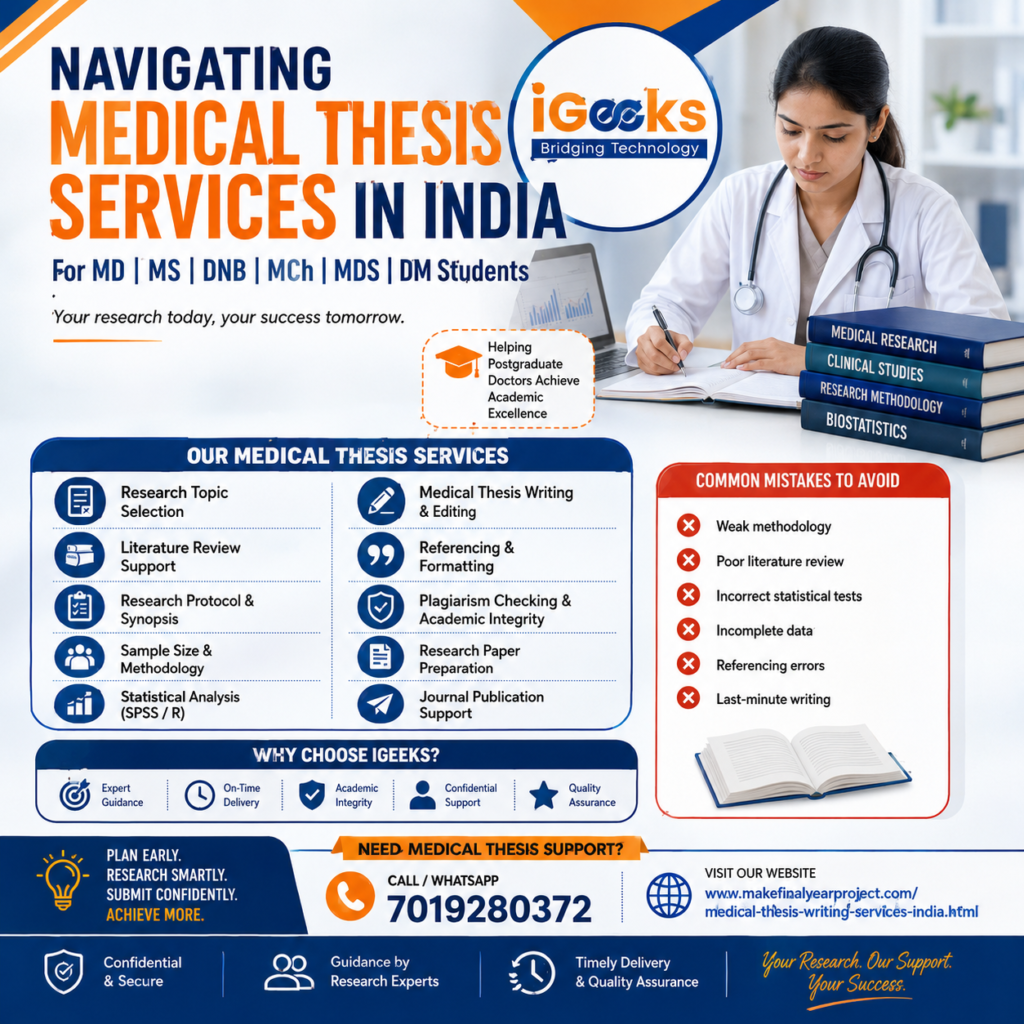
Our services include:
- Medical Research Protocol Development
- Synopsis Preparation
- Literature Review Support
- Thesis Writing Assistance
- Statistical Analysis Support
- SPSS/R Analysis
- Medical Thesis Editing
- Reference Management
- Plagiarism Checking & Academic Integrity Support
- Research Paper Preparation
- Journal Publication Support
Our services are designed to support students throughout their research journey while encouraging students to work with their guide, institution, and ethics committee at every required stage.
Conclusion
Completing an MD, MS, DNB, or MCh thesis is a demanding but valuable academic experience. The key to a successful thesis is not simply producing a lengthy document—it is developing a well-designed research question, scientifically sound methodology, accurate data analysis, ethical research practices, and clear academic writing.
Whether you are at the topic-selection stage or preparing your final submission, structured research support can help you identify methodological problems early and organize your work more effectively.
Need Medical Thesis & Research Support?
📞 Call / WhatsApp: 7019280372
https://www.makefinalyearproject.com/medical-thesis-writing-services-india.html
🌐 Medical Thesis Writing Services:
For MD | MS | DNB | MCh | MDS | DM students
Start your research journey with a clear plan, strong methodology, and academically responsible support.