

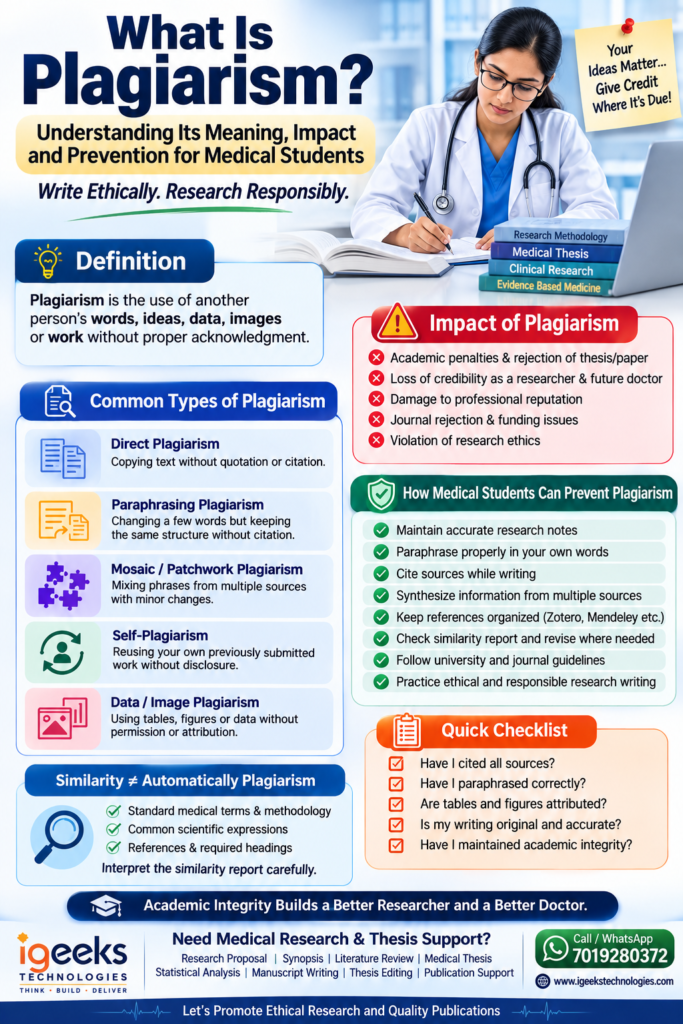
Plagiarism is one of the most important academic integrity issues that medical students and researchers need to understand. Whether preparing a thesis, assignment, research paper, case report, review article or presentation, using another person’s ideas, words, data or work without appropriate acknowledgment can constitute plagiarism.
For medical students, understanding plagiarism is particularly important because academic writing is closely connected to research ethics, scientific integrity and responsible communication of evidence.
What Is Plagiarism?
Plagiarism is the use of another person’s words, ideas, data, images, results or intellectual work without appropriate acknowledgment or attribution.
It can occur intentionally or unintentionally.
For example, copying a paragraph from a research paper and presenting it as your own work without citation is plagiarism. However, plagiarism can also occur when a student paraphrases a source too closely without properly acknowledging the original work.
Therefore, medical students should learn not only how to cite sources, but also how to read, understand, synthesize and communicate scientific information in their own academic writing.
Why Is Plagiarism Important in Medical Research?
Medical education depends heavily on evidence-based knowledge. Students regularly use information from:
- PubMed-indexed research papers
- Medical textbooks
- Review articles
- Clinical guidelines
- Research databases
- Academic websites
- Theses and dissertations
- Conference publications
When using these sources, proper attribution is essential.
Plagiarism can undermine the credibility of academic work and may also raise concerns about research integrity and publication ethics.
Common Types of Plagiarism
1. Direct Plagiarism
This occurs when someone copies another author’s words or sentences without quotation or appropriate attribution.
Example:
Copying several sentences from a published article into a thesis without citing the source.
How to prevent it
Use quotation marks where direct quotation is academically appropriate and provide the required citation. In most scientific writing, however, researchers generally rely more on proper paraphrasing and synthesis than extensive direct quotations.
2. Paraphrasing Plagiarism
Paraphrasing does not simply mean changing a few words.
If the original sentence structure and wording remain substantially similar while the source is not appropriately acknowledged, the writing may still constitute plagiarism.
Better approach
- Read the original source carefully.
- Understand the scientific meaning.
- Put the source aside.
- Write the concept in your own academic language.
- Compare your version with the original.
- Add the appropriate citation.
3. Mosaic or Patchwork Plagiarism
This happens when phrases or sentences from several sources are combined with minor changes and presented as original writing.
It can occur frequently during literature-review preparation.
Prevention
Instead of assembling sentences from different papers, synthesize the findings.
For example:
Several recent studies have investigated the relationship between X and Y, with findings differing according to patient population, study design and clinical setting.
Then cite the relevant studies supporting the statement.
4. Self-Plagiarism
Self-plagiarism refers to reusing one’s own previously submitted or published material without appropriate disclosure or permission when disclosure is required.
Medical researchers may encounter this when preparing:
- Multiple manuscripts from related research
- Conference abstracts
- Thesis-derived publications
- Previously published sections
Previous work should be handled according to the requirements of the university, journal or publisher.
5. Data and Image Plagiarism
Plagiarism is not limited to written text.
Using another researcher’s:
- Tables
- Figures
- Images
- Graphs
- Data
- Diagrams
without appropriate permission, attribution or citation can also create academic and publication-ethics problems.
Plagiarism vs. Proper Citation
A citation tells the reader where information came from.
For example, when discussing findings from a previous study, the source should be appropriately cited according to the required referencing style.
Common referencing systems used in medical and scientific writing include:
- Vancouver
- AMA
- APA
- Harvard
The required style depends on the university, department or target journal.
Why Can Plagiarism Happen Accidentally?
Not every plagiarism problem is intentional.
Medical students may accidentally create plagiarism because of:
Poor note-taking
Copying sentences directly into research notes and later forgetting that they came from another source.
Inadequate citation
Using information from a paper but forgetting to add its reference.
Incorrect paraphrasing
Changing only a few words while retaining the original sentence structure.
Reference-management problems
Losing track of which source supports a particular statement.
Time pressure
Writing a thesis or assignment close to the submission deadline.
Developing good research-writing habits can significantly reduce these problems.
How Can Medical Students Prevent Plagiarism?
1. Maintain Accurate Research Notes
When reading an article, clearly distinguish between:
Direct quotation → Your own interpretation → Source information
Do not mix copied text with your own notes.
2. Cite Sources While Writing
Do not wait until the entire thesis is finished before adding references.
Add citations during the writing process.
This makes it easier to track the evidence supporting each statement.
3. Paraphrase Properly
Good paraphrasing means expressing the meaning of the original source in your own language and structure while still acknowledging the source.
The objective is not simply to replace words with synonyms.
4. Synthesize Multiple Sources
A strong literature review should not read like a collection of summaries.
Instead of:
Study A says X. Study B says Y. Study C says Z.
Try to identify:
- Areas of agreement
- Contradictory findings
- Methodological differences
- Research gaps
- Clinical implications
This produces a more scholarly literature review.
5. Keep References Organized
Reference-management software can help researchers organize citations and bibliographies.
Common tools include:
- Zotero
- Mendeley
- EndNote
However, researchers should still verify references manually before final submission.
What Is a Plagiarism Check?
Plagiarism-detection software compares submitted text with content available in databases and online sources and identifies textual similarity.
A similarity report may show matching or similar passages.
However, an important distinction is:
Similarity ≠ Automatically Plagiarism
A similarity score is not by itself a definitive determination of plagiarism.
Some legitimate similarities may occur because of:
- Standard medical terminology
- Methodological phrases
- Names of diseases
- Statistical terminology
- References
- Common academic expressions
- Required headings
Therefore, the report needs to be interpreted carefully.
How Should Medical Students Handle a Similarity Report?
If a similarity report identifies substantial matching text:
Step 1
Identify the highlighted section.
Step 2
Determine whether the similarity is legitimate or problematic.
Step 3
Check whether the original source has been properly cited.
Step 4
Rewrite unnecessarily similar passages using genuine paraphrasing.
Step 5
Add or correct citations where necessary.
Step 6
Run another review before submission.
The goal should be original academic expression with proper attribution, rather than simply trying to achieve the lowest possible percentage.
Plagiarism in Medical Thesis Writing
Medical theses often contain substantial amounts of previously published scientific information, particularly in the Introduction and Review of Literature.
This makes careful citation particularly important.
A well-prepared thesis should maintain consistency between:
Research Question → Literature Review → Objectives → Methodology → Results → Discussion → Conclusion
The discussion should interpret the student’s own findings while appropriately comparing them with previous research.
Plagiarism and Research Ethics
Academic integrity extends beyond avoiding copied text.
Medical researchers should also maintain integrity in:
- Data collection
- Data analysis
- Patient confidentiality
- Authorship
- Citations
- Reporting of results
- Image handling
- Publication practices
Researchers should never fabricate or manipulate data simply to produce a desired result.
A Simple Plagiarism-Prevention Checklist
Before submitting your medical thesis or research paper, ask:
☑ Have I cited information obtained from other sources?
☑ Have I properly paraphrased published material?
☑ Have I avoided copying sentence structures too closely?
☑ Are tables and figures appropriately attributed?
☑ Have I maintained accurate references?
☑ Have I checked for accidental duplication?
☑ Have I reviewed the similarity report carefully?
☑ Does my writing clearly distinguish my findings from previous research?
☑ Have I followed my university’s academic-integrity requirements?
☑ Have I followed the target journal’s publication-ethics requirements?
Final Thoughts
Plagiarism prevention is not simply about reducing a similarity percentage. It is about developing responsible academic writing practices.
For medical students, the best approach is to:
Read → Understand → Synthesize → Write → Cite → Review
Proper citation, genuine paraphrasing, accurate referencing and responsible research practices help ensure that your thesis, dissertation or research paper reflects academic integrity and scientific credibility.
Need Medical Research & Thesis Support?
iGeeks Technologies, Bengaluru provides academic support for:
Research Proposal | Synopsis | Literature Review | Medical Thesis | Statistical Analysis | Manuscript Writing | Thesis Editing | Publication Support
📲 WhatsApp: 7019280372
🌐 www.makefinalyearproject.com
Academic support should assist researchers in presenting their own research accurately and ethically; it should not involve fabrication, falsification or misrepresentation of research.