

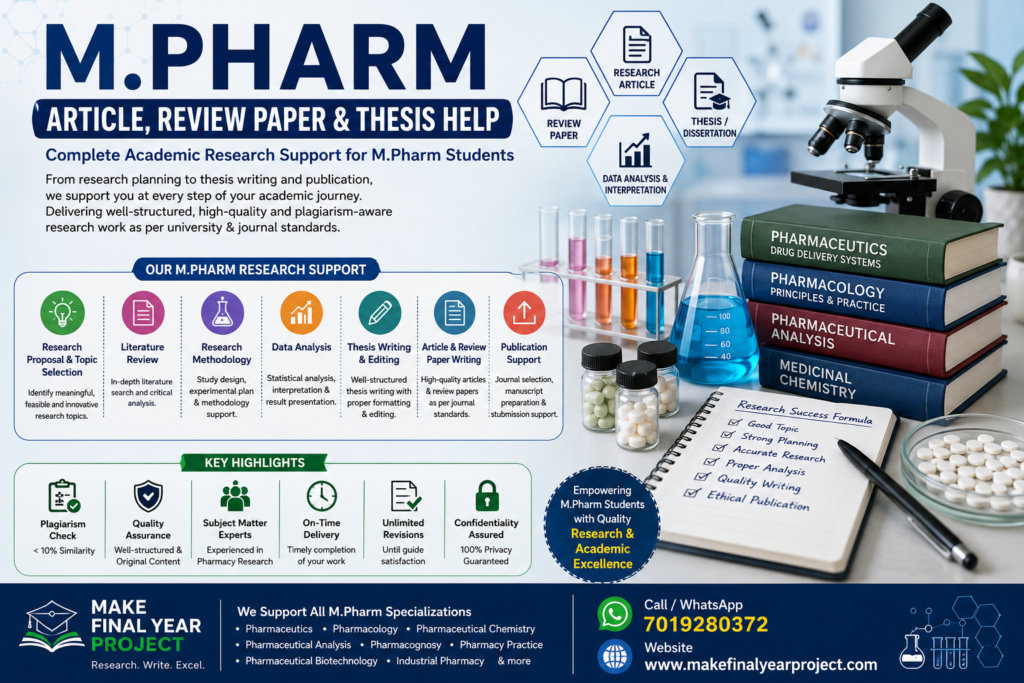
Pursuing an M.Pharm degree involves much more than completing coursework. Students are often expected to undertake research, prepare a dissertation or thesis, write research articles, develop review papers, analyze experimental data and present their findings according to academic and publication standards.
For M.Pharm students, getting the research structure right from the beginning can make the entire process more manageable.
This guide explains the major areas where academic research support can be useful—from selecting a research topic to preparing a thesis and converting research findings into a journal manuscript.
What Kind of Research Work Does an M.Pharm Student Need?
Depending on the specialization and university requirements, an M.Pharm student may work on:
- Research project or dissertation
- Research article
- Review paper
- Literature review
- Research proposal
- Experimental study
- Formulation and development studies
- Analytical method development and validation
- Pharmacological studies
- Pharmacokinetic studies
- Drug-delivery research
- Clinical or observational research
- Thesis writing and editing
- Journal manuscript preparation
The exact requirements vary according to the specialization, institution, university and research methodology.
M.Pharm Research Article Writing Support
A research article communicates the findings of an original research study to the scientific community.
A typical pharmaceutical research article may contain:
1. Title
The title should clearly communicate the subject of the research without unnecessary wording.
2. Abstract
A concise summary generally covering:
- Background
- Objective
- Methods
- Results
- Conclusion
3. Introduction
Explains the research problem, existing knowledge, research gap and rationale for conducting the study.
4. Materials and Methods
This section should clearly describe the research methodology so that the study can be understood and, where appropriate, reproduced.
Depending on the project, it may include:
- Materials
- Chemicals and reagents
- Instruments
- Experimental design
- Sample preparation
- Formulation procedure
- Analytical methods
- Statistical methods
5. Results
Research findings can be presented using:
- Tables
- Figures
- Graphs
- Statistical results
- Experimental observations
6. Discussion
The results are interpreted and compared with relevant previous research.
7. Conclusion
Summarizes the principal findings and their significance.
8. References
Relevant sources are cited according to the requirements of the target journal.
Review Paper Writing for M.Pharm Students
A review paper is different from an original research article.
Instead of presenting primarily new experimental findings, a review paper examines and synthesizes existing research on a focused pharmaceutical topic.
A strong review paper should answer questions such as:
What is already known?
What are the major developments?
Where do studies agree or disagree?
What gaps remain?
What future research is needed?
Common Sections
A review article may include:
- Title
- Abstract
- Keywords
- Introduction
- Search strategy or literature-selection approach, where appropriate
- Main thematic sections
- Current developments
- Research gaps
- Future perspectives
- Conclusion
- References
M.Pharm Thesis & Dissertation Support
The M.Pharm thesis represents the student’s research work and generally requires a systematic presentation of the entire project.
A thesis may include:
Chapter 1 – Introduction
Research background, rationale, problem statement and objectives.
Chapter 2 – Review of Literature
Critical discussion of previous research relevant to the topic.
Chapter 3 – Research Methodology
Detailed explanation of the materials, study design, procedures and analytical methods.
Chapter 4 – Results
Presentation of experimental or research findings.
Chapter 5 – Discussion
Interpretation of findings and comparison with previous literature.
Chapter 6 – Conclusion
Key findings and appropriate conclusions.
References & Appendices
Supporting literature, questionnaires, raw-data-related documentation and other relevant material.
The exact chapter structure should always follow the student’s university and department guidelines.
M.Pharm Research Proposal & Topic Selection
Choosing a suitable research topic is one of the most important early steps.
A good M.Pharm research topic should be:
- Scientifically relevant
- Clearly defined
- Feasible within the available time
- Appropriate for the available laboratory or research facilities
- Supported by sufficient literature
- Ethically appropriate
- Capable of generating meaningful findings
A research proposal can then establish the:
Research Problem → Research Gap → Aim → Objectives → Methodology → Expected Outcomes
Statistical Analysis for M.Pharm Research
Pharmaceutical research often generates substantial experimental data.
Depending on the research design, statistical analysis may involve:
- Descriptive statistics
- t-tests
- ANOVA
- Regression analysis
- Correlation
- Non-parametric tests
- Experimental-design analysis
- Stability-data analysis
- Other study-appropriate statistical methods
The statistical method should be selected based on the research question, experimental design, variables and assumptions of the statistical test.
Results should then be presented clearly in tables, figures and appropriate scientific language.
Literature Review for Pharmaceutical Research
A strong literature review is not simply a collection of copied abstracts.
M.Pharm students should organize literature around important themes such as:
- Existing approaches
- Drug or formulation characteristics
- Previous experimental findings
- Analytical methods
- Advantages and limitations
- Contradictory evidence
- Research gaps
- Opportunities for further investigation
The objective is to demonstrate why the proposed research is necessary.
Journal Manuscript Preparation
After completing an M.Pharm research project, students may wish to prepare a manuscript for journal submission.
Journal preparation may involve:
- Selecting an appropriate target journal
- Restructuring the thesis into an article
- Preparing the abstract
- Formatting tables and figures
- Formatting references
- Checking author guidelines
- Preparing a cover letter
- Responding to reviewer comments
- Revising the manuscript
A thesis and a journal article are not the same document. A thesis may contain extensive background and methodology, while a journal article generally requires a much more concise presentation.
Plagiarism and Academic Integrity
M.Pharm students should pay close attention to academic integrity when preparing their research work.
Good practices include:
✅ Cite sources accurately
✅ Paraphrase rather than copy
✅ Maintain proper research notes
✅ Keep references organized
✅ Attribute tables, figures and images appropriately
✅ Avoid fabrication or falsification of data
✅ Follow university and journal requirements
✅ Review similarity reports carefully
A similarity percentage alone does not automatically establish plagiarism. Legitimate similarities can occur because of scientific terminology, standard methodology and references. The highlighted content should be reviewed in context.
Who Can Benefit From M.Pharm Research Support?
Academic research guidance may be useful for students specializing in areas such as:
Pharmaceutics | Pharmacology | Pharmaceutical Chemistry | Pharmacognosy | Pharmaceutical Analysis | Pharmacy Practice | Industrial Pharmacy | Pharmaceutical Biotechnology
Support can be tailored to the student’s research stage and university requirements.
Complete M.Pharm Academic Research Support
Students may require assistance at different stages:
📚 Research Planning
Topic selection, research objectives, proposal and literature review.
🧪 Research & Data Support
Research methodology, experimental planning and appropriate statistical analysis.
📝 Thesis Support
Chapter structuring, academic writing, editing, formatting and corrections.
📄 Research Article
Manuscript preparation, formatting and journal-specific requirements.
📖 Review Paper
Literature identification, organization, synthesis and academic presentation.
📤 Publication Support
Journal selection, manuscript preparation and revision support.
Why Start Early?
Many M.Pharm students postpone their research writing until the final stage of the project.
This can create unnecessary pressure.
A better approach is:
Select Topic → Develop Proposal → Review Literature → Conduct Research → Analyze Data → Prepare Thesis → Develop Manuscript → Submit
Maintaining documentation throughout the research process also makes the final thesis and manuscript much easier to prepare.
Final Takeaway
An M.Pharm research project is an opportunity to demonstrate scientific thinking, pharmaceutical knowledge and research skills.
Whether you are working on an original research article, review paper, dissertation or thesis, a structured approach can help you present your work more clearly and professionally.
Need M.Pharm Research Support?
iGeeks Technologies provides academic support for:
M.Pharm Thesis | Research Articles | Review Papers | Research Proposals | Literature Reviews | Statistical Analysis | Thesis Editing | Manuscript Preparation | Publication Support
📲 Call / WhatsApp: 7019280372
🌐 Website: www.makefinalyearproject.com
M.Pharm Research Support – From Research Planning to Thesis & Manuscript Preparation.
Academic support should help students develop and present their own research responsibly. Research data, results and findings should always remain authentic and verifiable.