

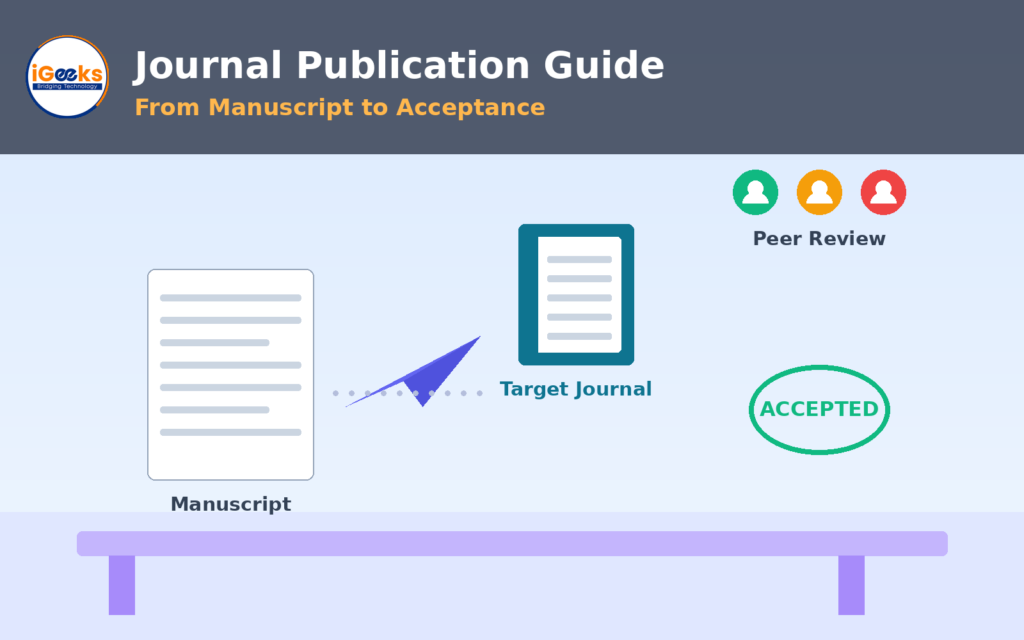
Publishing in a peer-reviewed journal is one of the most important — and most misunderstood — milestones of a PhD. Most universities now require at least one or two publications before submission, yet very few scholars receive formal training in how academic publishing actually works. Understanding the process end-to-end can save you months of avoidable delays and rejected submissions.
Here’s a practical, step-by-step guide to getting your research published.
1. Start With the Right Journal, Not the Right Manuscript
One of the most common mistakes scholars make is writing the paper first and searching for a journal afterward. Instead, identify potential target journals early — before you finalize the manuscript’s structure and tone.
What to check when shortlisting a journal:
- Scope alignment — does the journal regularly publish work in your specific sub-field?
- Impact factor and indexing — is it indexed in Scopus, Web of Science, or UGC-CARE (important for many Indian universities)?
- Peer review turnaround time — some journals take 2-3 months, others take over a year
- Open access vs. subscription — open access often means faster visibility but may involve publication fees
- Legitimacy — cross-check the journal against your university’s approved list and watch for predatory journal warning signs (unusually fast acceptance, aggressive email solicitations, unclear peer review process)
2. Structure Your Manuscript the Way Journals Expect
Most journals follow a standard structure, but small formatting expectations vary. A strong manuscript typically includes:
- Title — specific and searchable, not vague or overly broad
- Abstract — a concise summary (usually 150–250 words) covering purpose, method, key findings, and implications
- Keywords — terms that help your paper get discovered in databases
- Introduction — the research problem and its significance
- Literature Review — brief, focused on directly relevant prior work (not a repeat of your full thesis literature review)
- Methodology — clear enough for replication
- Results — presented objectively, often with tables/figures
- Discussion — interpretation, implications, and comparison with existing research
- Conclusion — key contributions and limitations
- References — formatted exactly per the journal’s citation style
Always download and follow the specific journal’s “Author Guidelines” document — generic formatting is one of the most common reasons for desk rejection.
3. Avoid the Most Common Reasons for Rejection
Editors reject papers at the initial screening stage for reasons that are often avoidable:
- Manuscript doesn’t match the journal’s scope
- Poor English/academic writing quality
- Insufficient novelty or unclear contribution
- Weak or unclear methodology
- Incorrect formatting or missing required sections
- Excessive similarity with previously published work (including your own)
A careful pre-submission review against these points can prevent a large share of early-stage rejections.
4. Understand the Peer Review Process
Once submitted, most manuscripts go through:
- Editorial screening — a quick check for scope and basic quality (days to a few weeks)
- Peer review — typically 2-3 independent reviewers assess the manuscript (often 1-4 months)
- Decision — usually one of four outcomes:
- Accept — rare on first submission
- Minor revisions — small changes required, resubmission expected
- Major revisions — significant changes needed, may go through another review round
- Reject — either due to fit or unresolved quality concerns
Receiving “major revisions” is common and not a bad outcome — it means reviewers see potential in the work.
5. Respond to Reviewer Comments Strategically
How you handle revisions often matters as much as the original manuscript. Best practices include:
- Address every single comment, even ones you disagree with
- Create a point-by-point response letter, showing exactly what was changed and where
- If you disagree with a reviewer, explain your reasoning respectfully and with evidence, rather than ignoring the comment
- Keep track of exact page/line numbers for each change to make the editor’s review easier
6. Manage Realistic Timelines
Academic publishing takes longer than most scholars expect. From submission to final publication, a realistic timeline often looks like:
- Editorial screening: 1–3 weeks
- Peer review: 1–4 months
- Revisions and re-review: 1–3 months
- Final production and publication: 1–2 months
If your university requires publication before thesis submission, factor this timeline into your overall PhD schedule early — ideally starting the publication process well before your final thesis deadline.
7. Consider Co-Authorship and Supervisor Involvement
Most PhD publications include your supervisor as a co-author, given their guidance throughout the research. Clarify authorship order and contributions early to avoid disputes later, and follow your university’s and journal’s specific authorship criteria (many follow ICMJE guidelines).
A Quick Pre-Submission Checklist
Before hitting submit, confirm:
- The manuscript matches the journal’s scope and word limit
- All formatting follows the journal’s author guidelines exactly
- References are complete, accurate, and correctly styled
- The abstract clearly conveys your contribution
- Co-authors have reviewed and approved the final version
- A cover letter is included, briefly explaining the paper’s relevance to the journal
Get Support With Your Publication Journey
Turning a thesis chapter into a publishable paper — and navigating peer review — is a distinct skill from thesis writing itself. If you’d like guidance on manuscript preparation, journal selection, or handling reviewer feedback, we’re here to help.
Explore our PhD Thesis Help services in Bangalore: 👉 www.makefinalyearproject.com/phd-thesis-help-bangalore.aspx
Have a question? Reach out directly on WhatsApp: 📲 +91 70192 80372
Your research deserves to be published well — let’s help you get there.