
How to Avoid Plagiarism in Your PhD Thesis: A Practical Guide for Research Scholars
Plagiarism is one of the most serious concerns in academic research — and one of the most misunderstood. Most PhD scholars aren’t at risk because they intend to copy someone else’s work. They’re at risk because plagiarism can happen accidentally: a paraphrase that stays too close to the original, a missed citation, or reused text from their own earlier papers. Understanding what plagiarism actually covers — and how to avoid it systematically — is essential before you submit.
What Counts as Plagiarism in a Thesis
Plagiarism isn’t limited to copy-pasting someone else’s sentences. Universities typically flag several forms:
- Direct plagiarism — using someone else’s words without quotation marks or citation
- Paraphrasing plagiarism — rewording a source so closely that the structure and ideas remain unchanged, without credit
- Self-plagiarism — reusing your own previously published work (including your own conference papers) without disclosure
- Mosaic plagiarism — blending copied phrases from a source into your own sentences without clear attribution
- Uncited data or ideas — presenting someone else’s findings, theories, or frameworks as your own original contribution
- Incomplete citation — citing a source in-text but leaving it out of the reference list, or vice versa
Many scholars are surprised to learn that self-plagiarism is treated seriously by most universities and journals, especially when thesis chapters overlap with previously published papers.
Why It Happens More Often Than Scholars Expect
Plagiarism issues in a thesis usually come from a few common situations:
- Reading too many sources back-to-back — mixing up phrasing from different papers while writing later
- Note-taking without proper attribution — copying text into notes for “later paraphrasing” and forgetting the original source
- Time pressure near deadlines — leading to rushed paraphrasing that stays too close to the source
- Reusing your own earlier work — assuming that because you wrote it, it doesn’t need citation
- Over-reliance on a single source — restructuring one paper’s argument so closely that the similarity remains high even after rewording
None of these reflect dishonesty — but universities’ plagiarism-detection software (like Turnitin or iThenticate) doesn’t distinguish intent. A high similarity score creates real problems regardless of why it happened.
Practical Ways to Keep Your Thesis Plagiarism-Free
1. Take Notes in Your Own Words From the Start
When reading a source, avoid copying full sentences into your notes. Summarize the idea immediately, in your own phrasing, and record the citation details right away. This prevents the common problem of forgetting which words were yours and which were the author’s.
2. Paraphrase the Idea, Not the Sentence
True paraphrasing means understanding the concept well enough to explain it independently — not swapping a few words in the original sentence. If you find yourself rearranging the same sentence structure with synonyms, stop and rewrite the idea from scratch in your own words.
3. Quote Sparingly and Cite Precisely
Direct quotes should be used only when the original wording is essential — a legal definition, a precise statistic, or a uniquely phrased argument. Keep quotes short, use quotation marks, and cite the exact source and page number.
4. Track Every Source as You Write
Use a reference manager (Zotero, Mendeley, or EndNote) from your very first draft, not just before submission. Attaching citations as you write — rather than trying to reconstruct them later — dramatically reduces the risk of missed or incorrect attribution.
5. Disclose Any Reused Content From Your Own Work
If part of your thesis overlaps with a paper you’ve already published, check your university’s self-plagiarism policy and disclose it appropriately, often through proper citation of your own earlier work.
6. Run a Similarity Check Before Submission
Don’t wait for your university’s official plagiarism check to be your first check. Run your draft through a similarity detection tool earlier in the process so you have time to revise problem sections — not just the final draft.
7. Understand What an Acceptable Similarity Score Looks Like
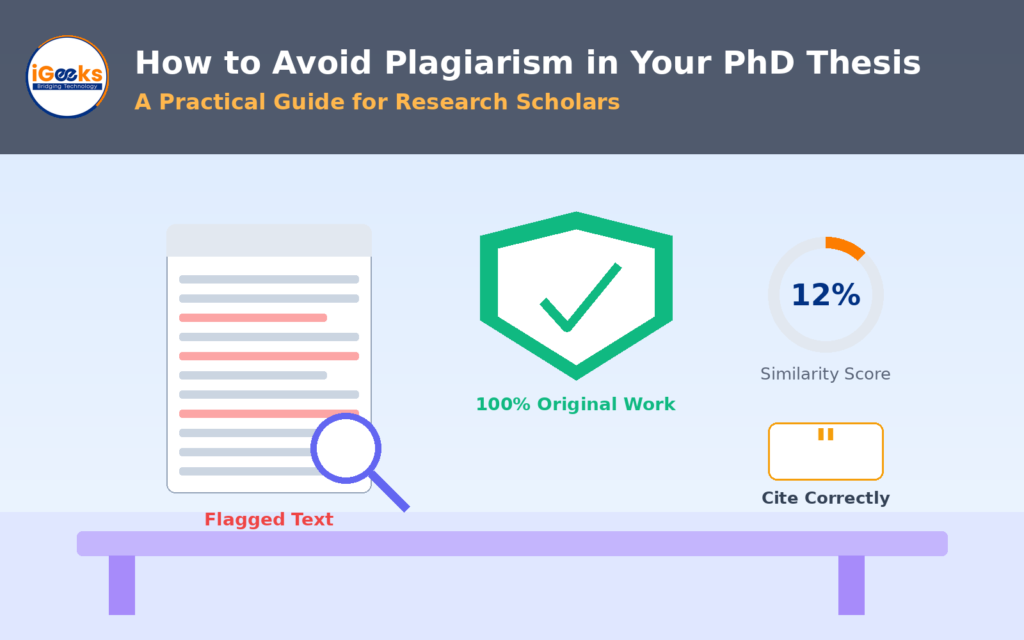
A similarity report isn’t inherently bad — quoted material, references, and common academic phrases will always show some overlap. What matters is whether flagged sections are properly cited and whether the overall pattern reflects original analysis rather than copied structure. Most universities specify an acceptable threshold; check yours directly rather than assuming.
A Quick Self-Check Before You Submit
Before finalizing any chapter, ask yourself:
- Have I cited every idea, data point, or framework that isn’t originally mine?
- Are all direct quotes clearly marked and properly cited?
- Did I paraphrase in my own structure, not just swap words?
- Have I disclosed any overlap with my own previously published work?
- Does my reference list match every in-text citation exactly?
If you can answer yes to all five, you’re in a strong position heading into your university’s plagiarism check.
Get Expert Support for a Clean, Original Thesis
Avoiding plagiarism isn’t just about caution — it’s about having a system in place from your very first draft. If you’d like expert guidance on writing, citation management, and producing a genuinely original, plagiarism-free thesis, we’re here to help.
Explore our PhD Thesis Help services in Bangalore: 👉 www.makefinalyearproject.com/phd-thesis-help-bangalore.aspx
Have a question? Reach out directly on WhatsApp: 📲 +91 70192 80372
Original research deserves original writing — let’s make sure yours reflects both.