

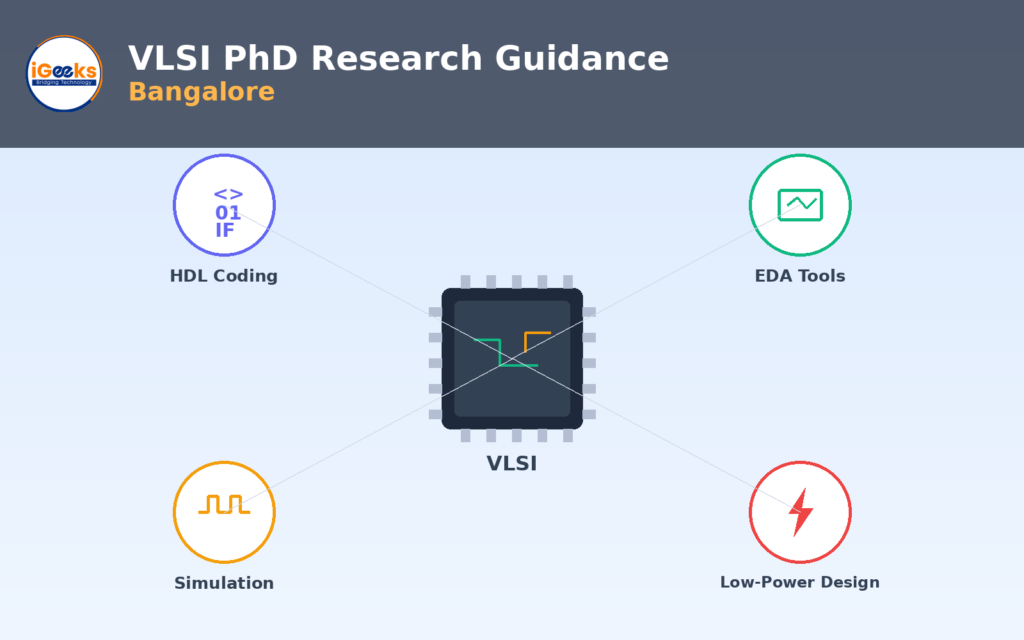
VLSI (Very Large Scale Integration) research sits at a demanding intersection of electronics, computer architecture, and increasingly, machine learning — making it one of the more technically intensive PhD specializations a scholar can pursue. Bangalore, home to a dense concentration of semiconductor and chip design companies, is also home to a large and active community of VLSI research scholars. Yet despite this strong ecosystem, VLSI PhD research comes with its own specific challenges that general research guidance often doesn’t fully address.
Here’s a closer look at what VLSI PhD research actually involves, where scholars commonly get stuck, and what genuinely useful guidance in this field looks like.
Why VLSI Research Is Distinct From Other PhD Disciplines
Unlike many social science or even general engineering research areas, VLSI research typically requires:
- Deep familiarity with hardware description languages (Verilog, VHDL, SystemVerilog)
- Proficiency with specialized EDA (Electronic Design Automation) tools — Cadence, Synopsys, Xilinx Vivado, Mentor Graphics
- Strong grounding in digital and analog circuit design principles
- Simulation, synthesis, and physical design workflows that differ significantly from general-purpose programming or data analysis
- Often, a combination of hardware implementation and algorithmic or architectural innovation
This combination of specialized tooling and deep domain knowledge means VLSI scholars frequently need guidance that’s specific to their field, rather than general academic writing or statistics support.
Common VLSI Research Areas
VLSI PhD research in Bangalore and beyond typically spans several active sub-fields:
- Low-power VLSI design — techniques for reducing power consumption in digital circuits, critical for mobile and IoT applications
- VLSI for AI/ML hardware acceleration — designing specialized chips (ASICs, accelerators) optimized for machine learning workloads
- Analog and mixed-signal design — circuits that bridge analog real-world signals with digital processing
- FPGA-based system design — reconfigurable hardware implementations for prototyping and deployment
- Testing and verification (DFT) — ensuring chip designs function correctly before costly fabrication
- VLSI physical design and floorplanning — layout, placement, and routing optimization for chip fabrication
- Emerging device technologies — research into next-generation transistor architectures and materials
Each of these areas comes with distinct tools, simulation approaches, and evaluation metrics — meaning generic research guidance rarely translates well without domain-specific understanding.
Where VLSI Scholars Commonly Get Stuck
1. Choosing a Topic With Genuine Novelty and Feasibility
VLSI is a fast-moving field, with industry research often outpacing academic publication. Identifying a topic that’s both genuinely novel and realistically achievable with available lab resources and fabrication access is a common early challenge.
2. Tool-Specific Technical Hurdles
EDA tools like Cadence and Synopsys have steep learning curves, and scholars often lose significant time troubleshooting tool-specific issues — license configurations, simulation errors, or synthesis constraints — that have little to do with their actual research question.
3. Simulation and Verification Bottlenecks
Ensuring a circuit design behaves correctly across all conditions requires extensive simulation and verification work, which is often more time-consuming than scholars initially estimate, especially for complex mixed-signal or large-scale digital designs.
4. Bridging Circuit-Level Work With Publishable Research Contribution
A working circuit or design isn’t automatically a strong research contribution — scholars often need guidance translating technical implementation into a clearly articulated, publishable research narrative that satisfies both technical and academic rigor.
5. Access to Fabrication and Testing Resources
Unlike purely simulation-based research, some VLSI work requires actual chip fabrication or specialized testing equipment, which can create resource and timeline constraints that need to be factored into research planning early.
What Effective VLSI PhD Guidance Looks Like
Genuinely useful support for VLSI scholars typically includes:
- Topic refinement grounded in current industry and academic trends specific to VLSI sub-fields
- Tool-specific technical support for Cadence, Synopsys, MATLAB, Xilinx, and other relevant platforms
- Simulation and verification guidance to ensure designs are properly validated before results are finalized
- Data analysis and result interpretation for performance metrics like power, area, timing, and throughput
- Academic writing support that accurately translates technical implementation into a clear, examiner-ready research narrative
- Journal and conference guidance specific to VLSI and electronics publication venues (IEEE Transactions, VLSI Design conferences, etc.)
Why Bangalore Is a Strong Base for VLSI Research
Bangalore’s dense semiconductor industry presence — including major chip design centers for global companies — creates a research environment with certain practical advantages:
- Easier access to industry-relevant research trends and problem areas
- Local networking opportunities with practicing VLSI engineers and researchers
- Familiarity among regional guidance providers with the specific requirements of VTU and other Bangalore-based university VLSI programs
- A broader ecosystem of technical expertise to draw on for specialized troubleshooting
Support Tailored to Your VLSI Research
VLSI PhD research demands both deep technical expertise and strong academic research skills — a combination that’s genuinely difficult to navigate alone. Whether you’re refining your research topic, troubleshooting a specific EDA tool issue, working through simulation results, or structuring your thesis chapters, having guidance that understands the specific demands of VLSI research makes a meaningful difference.
Explore our PhD Thesis Help services in Bangalore, including VLSI-specific research guidance: 👉 www.makefinalyearproject.com/phd-thesis-help-bangalore.aspx
Have a question about your specific VLSI research challenge? Reach out directly on WhatsApp: 📲 +91 70192 80372
From circuit design to your final thesis chapter, let’s help you build VLSI research you can defend with confidence.