

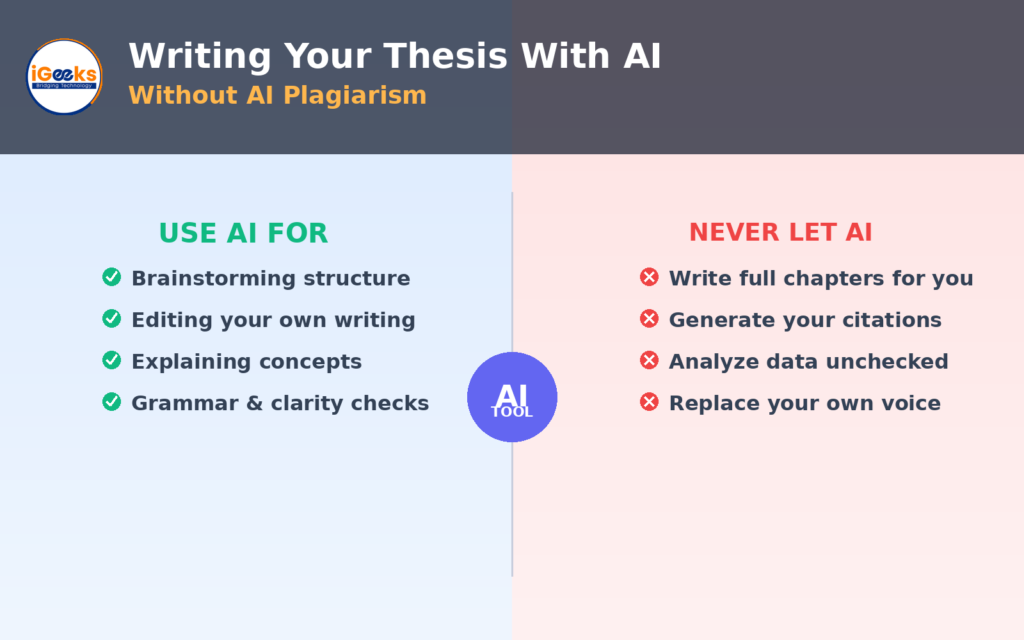
AI writing tools have become part of how many scholars approach research and writing — used well, they can genuinely accelerate parts of the PhD process. Used carelessly, they can create serious problems: AI-generated text flagged by originality checkers, factually incorrect “hallucinated” citations, or writing that doesn’t actually reflect your own understanding of your research. The scholars who benefit most from AI tools are the ones who understand exactly where the line is — using AI to support their thinking, not replace it.
Here’s a practical guide to using tools like ChatGPT responsibly throughout your thesis, without creating AI plagiarism risks.
Understanding What Counts as AI Plagiarism
AI plagiarism isn’t just about copying text directly from a chatbot into your thesis. Universities and journals are increasingly concerned with several related issues:
- Directly submitting AI-generated text as your own original academic writing
- Fabricated or “hallucinated” citations — AI tools can generate plausible-sounding references that don’t actually exist
- Undisclosed AI use where your university’s policy requires disclosure of any AI assistance
- Losing your authentic academic voice — even original-sounding AI text may not reflect genuine engagement with your research
Most universities are now developing explicit AI-use policies for theses — checking yours before you begin is essential, since acceptable use varies significantly between institutions.
Where AI Tools Can Genuinely Help
Used as a support tool rather than a replacement, AI can meaningfully speed up several stages of thesis work:
1. Brainstorming and Structuring
AI tools are useful for generating initial structural ideas — a rough chapter outline, possible angles on a research question, or ways to organize a complex argument. You’re using it to think faster, not to think for you.
2. Clarifying Your Own Writing
Pasting your own already-written paragraph and asking for feedback on clarity, flow, or conciseness is a legitimate editing aid — similar to asking a colleague to review your writing, provided your university’s policy permits this kind of use.
3. Explaining Unfamiliar Concepts
If you’re learning a new statistical method, theoretical framework, or technical concept, AI tools can offer accessible initial explanations — though these should always be verified against authoritative academic sources before being relied upon.
4. Improving Grammar and Sentence-Level Clarity
Using AI as a more sophisticated grammar and style checker — similar to tools like Grammarly — is generally lower-risk than using it to generate substantive content, provided the underlying ideas and structure remain entirely your own.
5. Summarizing Long Documents for Your Own Understanding
AI can help you quickly grasp the gist of a lengthy paper before deciding whether it’s worth reading in full — but any content that ends up in your literature review should come from your own reading and analysis of the original source, not from an AI-generated summary.
Where AI Use Becomes Genuinely Risky
Generating Substantial Original Content
Asking an AI tool to “write my literature review” or “write my discussion chapter” and submitting that text with minimal changes is where most serious problems arise — both from an academic integrity standpoint and because the writing won’t reflect genuine engagement with your specific research.
Trusting AI-Generated Citations Without Verification
AI tools can generate citations that look completely legitimate — correct formatting, plausible author names, believable titles — but don’t actually exist, or misrepresent what a real source actually says. Every single citation must be independently verified against the actual source before it appears in your thesis.
Using AI for Data Analysis Without Understanding the Output
Asking an AI tool to “analyze this data and tell me what it means” without understanding the statistical reasoning yourself is risky — you need to be able to defend every result and interpretation during your viva, which isn’t possible if you don’t genuinely understand how you arrived at it.
Skipping Disclosure Where It’s Required
If your university requires disclosure of AI tool use, failing to disclose it — even for legitimate editing assistance — can itself constitute an academic integrity violation, regardless of how the AI was actually used.
A Practical Framework for Responsible AI Use
Before using an AI tool for any specific task, ask yourself:
- Does my university’s policy explicitly allow this type of use? Check first, don’t assume.
- Am I using this to support my own thinking, or to replace it? Brainstorming and clarifying are different from generating substantive content.
- Could I explain and defend this content in my viva without relying on the AI tool? If not, it shouldn’t be in your thesis as-is.
- Have I independently verified every fact, citation, and claim? AI-generated information should never be trusted without verification.
- Do I need to disclose this use according to my institution’s policy? When in doubt, disclose.
Protecting Yourself From AI-Related Plagiarism Issues
- Run your thesis through your university’s approved similarity and AI-detection tools before submission, not just as a final check
- Keep records of your own research notes, drafts, and data — genuine evidence of your own process is your best protection if AI-related questions arise
- When in doubt about whether a specific use is acceptable, ask your supervisor directly rather than assuming
- Treat any AI output as a first draft or a starting point requiring substantial independent verification and rewriting — never as a finished product
AI as a Tool, Not a Shortcut
Used thoughtfully, AI tools can genuinely support a PhD scholar’s efficiency — helping you think through structure, catch unclear writing, or grasp unfamiliar concepts faster. Used as a shortcut to avoid the actual intellectual work of research and writing, they create real risks to both your academic integrity and your ability to defend your own thesis.
Get Expert, Human Support for Your Thesis
If you’d like guidance on structuring your thesis, strengthening your writing, or navigating your university’s specific policies around AI use, working with experienced academic professionals ensures your thesis reflects genuine, defensible scholarship.
Explore our PhD Thesis Help services in Bangalore: 👉 www.makefinalyearproject.com/phd-thesis-help-bangalore.aspx
Have a question about using AI responsibly in your thesis? Reach out directly on WhatsApp: 📲 +91 70192 80372
AI can support your thinking — but your thesis should always be genuinely, defensibly yours.