

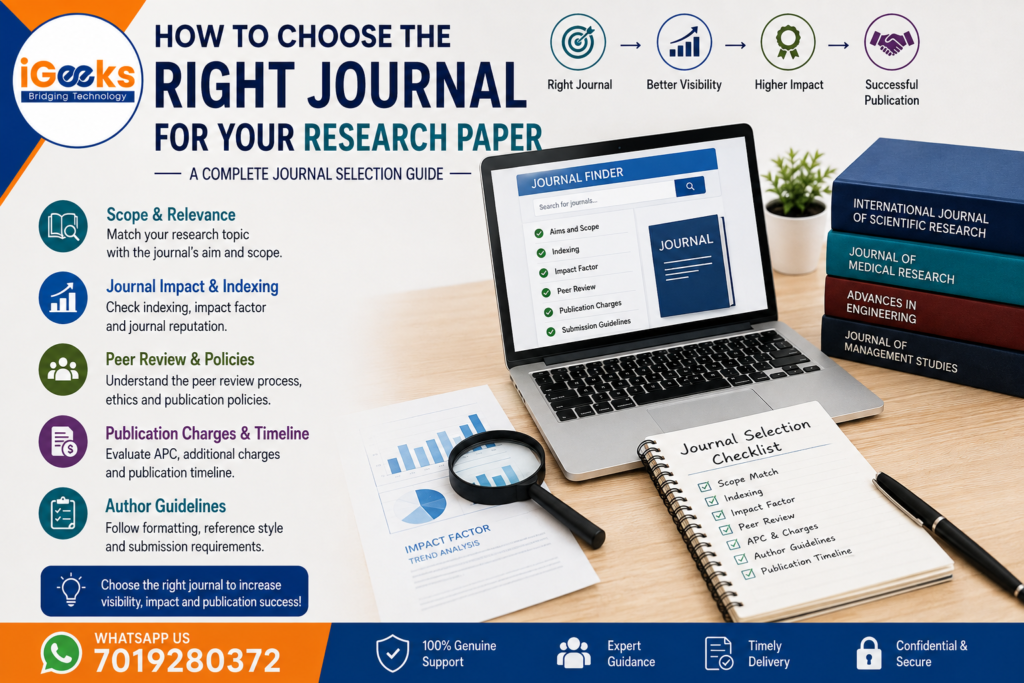
Publishing a research paper is an important milestone for researchers, PhD scholars, medical professionals, postgraduate students, and academic institutions. However, completing a manuscript is only one part of the publication process. Choosing the right journal is equally important.
Submitting a manuscript to an unsuitable journal can result in rejection, unnecessary delays, or wasted submission opportunities. A well-planned journal selection process helps researchers identify publications that match their research scope, audience, methodology, and academic objectives.
This guide explains the key factors researchers should consider when selecting a journal for their research paper.
What Is Journal Selection?
Journal selection is the process of identifying and evaluating suitable academic journals for submitting a research manuscript.
A good journal should ideally match:
- The subject area of your research
- The scope of your manuscript
- The intended academic audience
- Your publication requirements
- The journal’s indexing and reputation
- Article type and formatting requirements
- Publication policies and timelines
The goal is not simply to find a journal that accepts papers. The objective is to find a legitimate and suitable journal where your research has a reasonable opportunity of being evaluated appropriately.
1. Understand Your Research Paper Before Selecting a Journal
Start by clearly identifying your manuscript.
Ask yourself:
- What is the main research topic?
- What is the research methodology?
- Is it an original research article or review article?
- Which discipline does it belong to?
- Who is the intended audience?
- What is the major contribution of the research?
For example, a manuscript involving artificial intelligence in medical diagnosis may potentially fit journals covering artificial intelligence, medical informatics, healthcare technology, or clinical research.
Understanding the manuscript helps narrow down suitable journals.
2. Check the Journal’s Scope
One of the most important steps in journal selection is reviewing the journal’s Aims and Scope.
A journal may publish papers within a broad discipline but still exclude specific topics or methodologies.
Before submitting, check:
- Subject areas covered
- Types of manuscripts accepted
- Research methodologies accepted
- Target readership
- Recent publications
- Special issues
- Article categories
Simple rule:
Your research topic should clearly fit the journal’s scope.
If your manuscript is outside the journal’s scope, it may be rejected before detailed peer review.
3. Examine Recently Published Articles
Don’t select a journal based only on its name.
Read several recently published papers from the journal.
Look for:
- Similar research topics
- Similar methodologies
- Similar study populations
- Similar statistical methods
- Similar article types
If you find multiple recently published articles closely related to your research, that is a positive indication of scope alignment.
4. Check Journal Indexing
Indexing can be an important consideration when your university, institution, supervisor, or research objective requires publication in a particular database.
Depending on your discipline, researchers may evaluate databases such as:
- PubMed/MEDLINE
- Scopus
- Web of Science
- DOAJ
- IEEE Xplore
- Other recognized subject-specific databases
However, do not rely solely on a journal’s claim that it is indexed.
Always verify the journal directly through the relevant database or indexing organization’s official source.
5. Evaluate the Journal’s Reputation
Consider the journal’s overall academic standing.
Review:
- Publisher
- Editorial board
- Peer-review process
- Publication history
- Article quality
- Transparency of policies
- Retraction/correction policies
- Ethics policies
A reputable journal should provide clear information about its editorial and peer-review procedures.
6. Check the Journal’s Peer-Review Process
Peer review is a central component of scholarly publishing.
Before submission, understand whether the journal uses:
- Single-blind review
- Double-blind review
- Open peer review
- Editorial review followed by peer review
Also check whether the journal clearly explains its review process.
Be cautious about journals promising guaranteed acceptance or unrealistically fast peer review.
7. Check Article Processing Charges
Some journals operate under subscription models, while others charge an Article Processing Charge (APC) for accepted articles.
Before submission, check:
- APC amount
- When payment is required
- Whether there are submission fees
- Waiver policies
- Taxes or additional charges
- Colour/figure charges, if applicable
Never choose a journal solely because it has a low publication fee.
The journal’s legitimacy, relevance, editorial standards, and indexing are more important.
8. Check the Journal’s Publication Timeline
If publication timing matters for your academic requirement, examine:
- Submission-to-first-decision time
- Peer-review timeline
- Acceptance-to-publication time
- Publication frequency
However, be careful with journals advertising guaranteed publication within a few days.
Quality peer review takes time, and publication schedules vary.
9. Verify the Journal’s Editorial Board
A legitimate academic journal should provide information about its editorial team.
Check:
- Editor-in-Chief
- Associate editors
- Editorial board members
- Institutional affiliations
- Research expertise
Where possible, verify that listed researchers are genuinely associated with the journal.
10. Check Author Guidelines
Before submission, read the journal’s Instructions for Authors.
Important requirements may include:
- Manuscript structure
- Word count
- Abstract format
- Keywords
- Reference style
- Figures and tables
- Supplementary material
- Ethical declarations
- Conflict-of-interest statements
- Data availability
- Author contribution statements
Following these instructions can prevent avoidable technical rejection.
11. Examine the Journal’s Reference Style
Different journals use different citation systems.
Common styles include:
- Vancouver
- APA
- Harvard
- IEEE
- AMA
Medical journals frequently use numbered citation systems such as Vancouver.
Make sure your manuscript can be adapted to the journal’s required reference format.
12. Be Careful About Predatory Journals
One of the most important parts of journal selection is identifying potentially predatory or deceptive journals.
Warning signs may include:
- Guaranteed publication
- Guaranteed acceptance
- Extremely short peer-review periods
- Aggressive email invitations
- False or unverifiable indexing claims
- Unclear editorial board
- Hidden publication charges
- Poor-quality published articles
- Misleading journal metrics
Researchers should independently verify the journal’s claims before submitting.
13. Don’t Depend Only on Journal Metrics
Researchers often look at:
- Impact Factor
- CiteScore
- SJR
- SNIP
- h-index
- Other journal-level metrics
These can provide useful information, but metrics should not be the only criterion.
A high-metric journal that does not fit your research scope may be a worse choice than a reputable journal that is closely aligned with your topic.
14. Prepare a Journal Shortlist
Instead of selecting one journal immediately, create a shortlist of approximately 3–5 potential journals.
For each journal, compare:
| Criteria | Journal 1 | Journal 2 | Journal 3 |
|---|---|---|---|
| Scope match | ✓ | ✓ | ✓ |
| Relevant recent papers | ✓ | ✓ | — |
| Indexing | ✓ | ✓ | ✓ |
| Peer review | ✓ | ✓ | ✓ |
| APC | ₹ | ₹₹ | ₹₹₹ |
| Publication timeline | Moderate | Fast | Moderate |
| Article type accepted | ✓ | ✓ | ✓ |
| Overall suitability | High | Medium | High |
This makes the decision more systematic.
15. Consider Your Publication Objective
The “best” journal depends on your objective.
For example:
PhD Scholar
You may prioritize:
- University requirements
- Recognized indexing
- Subject relevance
- Publication credibility
Medical Researcher
You may prioritize:
- Medical database indexing
- Clinical scope
- Peer-review quality
- Research audience
Engineering Researcher
You may prioritize:
- Scopus/Web of Science coverage
- Engineering subject relevance
- Conference/journal ecosystem
- Technical readership
Therefore, journal selection should be research-goal driven.
16. Journal Selection for Review Articles
Review articles require additional consideration.
Check whether the journal publishes:
- Narrative reviews
- Systematic reviews
- Scoping reviews
- Meta-analyses
Some journals may have specific requirements for systematic reviews, including reporting guidelines and registration information where applicable.
Always check the current author instructions.
17. Journal Selection for Medical Research
Medical researchers should pay particular attention to:
- PubMed/MEDLINE status where relevant
- Clinical specialty
- Ethical requirements
- Patient consent requirements
- Trial registration requirements where applicable
- Reporting guidelines
- Conflict-of-interest declarations
- Data and ethics policies
For example, a radiology manuscript should generally be targeted toward journals whose scope includes radiology, diagnostic imaging, medical imaging, or a closely related field.
18. Why Manuscripts Get Rejected Because of Journal Selection
A technically strong paper can still face rejection if:
- The topic doesn’t fit the journal
- The article type isn’t accepted
- The manuscript doesn’t match the readership
- The methodology is outside the journal’s scope
- The paper doesn’t follow author guidelines
- The journal’s priorities have changed
- The manuscript doesn’t meet the journal’s novelty expectations
Therefore:
Good research + wrong journal = unnecessary rejection risk.
19. A Simple Journal Selection Workflow
You can follow this process:
Research Paper Completed
↓
Identify Subject & Article Type
↓
Search Relevant Journals
↓
Check Aims & Scope
↓
Review Recent Publications
↓
Verify Indexing
↓
Check Peer Review & Editorial Policies
↓
Compare APC & Timeline
↓
Check Author Guidelines
↓
Shortlist 3–5 Journals
↓
Select the Most Suitable Journal
↓
Format Manuscript
↓
Submit
20. Professional Journal Selection Support
Selecting a journal can be challenging when researchers have multiple publication requirements.
Professional journal selection support can help researchers evaluate:
- Journal scope
- Article type
- Indexing requirements
- Publication policies
- Manuscript suitability
- Formatting requirements
- Reference style
- Publication charges
- Submission requirements
The final journal decision should always be made by the researcher/authors after independently verifying the journal’s current status and requirements.
Final Thoughts
Journal selection is a strategic part of academic publishing.
Rather than submitting your manuscript to the first journal you find, evaluate its scope, recent publications, indexing, peer-review process, editorial policies, publication charges, author guidelines, and overall suitability.
A systematic journal-selection process can help you avoid unsuitable submissions and improve the efficiency of your publication journey.
Need Help Selecting a Journal for Your Research Paper?
We provide journal selection and manuscript preparation support for:
- PhD Scholars
- Research Scholars
- MD/MS/DNB Students
- Medical Researchers
- MDS/DM/MCh Researchers
- Engineering Researchers
- Management Researchers
- Postgraduate Students
Services include:
✓ Journal Shortlisting
✓ Scope & Topic Matching
✓ Indexing Verification
✓ Journal Comparison
✓ Manuscript Formatting
✓ Reference Formatting
✓ Submission Preparation
✓ Revision Support
📞 Call / WhatsApp: 7019280372
🌐 Medical Thesis & Research Support:
Medical Thesis Writing Services