
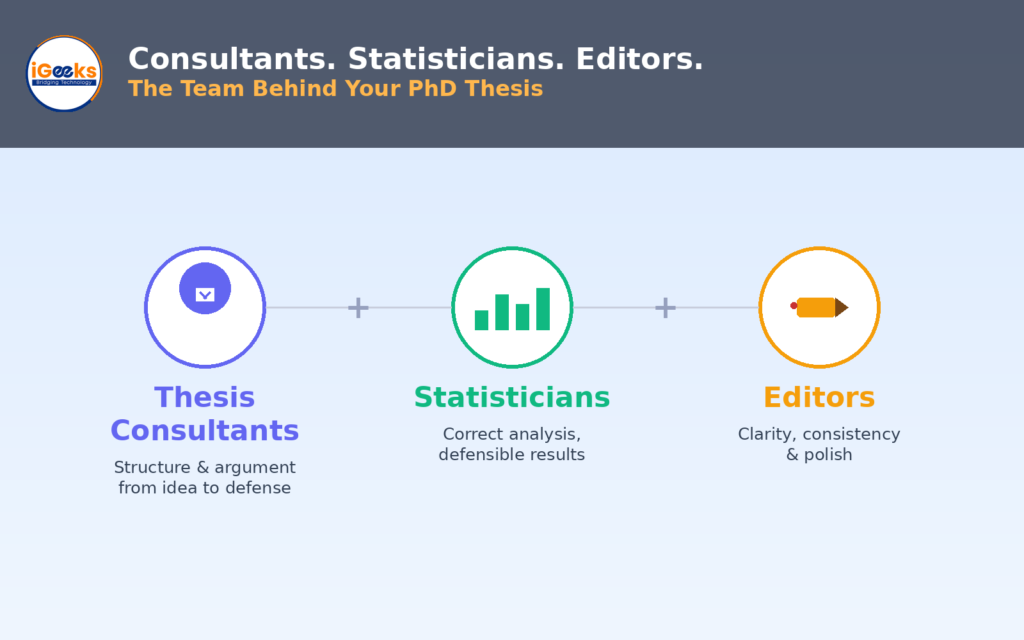
A PhD thesis rarely comes together through one skill alone. It takes a research consultant who understands academic structure, a statistician who can make sense of your data, and an editor who can turn a technically sound draft into a polished, examiner-ready document. At iGeeks Bangalore, we bring exactly this combination together — a dedicated team built around the different stages of doctoral research, rather than a single generalist trying to do it all.
Here’s a closer look at the roles that make up genuine, complete PhD thesis support — and why each one matters.
Why “One-Size-Fits-All” Support Falls Short
Many scholars first look for help at the point they’re personally stuck — usually writing or analysis — and assume that’s the extent of support they’ll need. In practice, a thesis draws on several distinct skill sets:
- Structuring an argument across multiple chapters
- Running and interpreting statistical or qualitative analysis correctly
- Writing in a clear, formal academic register
- Editing for consistency, flow, and precision
- Formatting and referencing to exact university and journal standards
Very few individuals are genuinely strong across all of these simultaneously — which is exactly why specialized roles, working together, produce stronger results than one person attempting everything.
Thesis Writing Consultants: Structuring the Research Journey
A thesis writing consultant’s role goes beyond just writing — it starts with the shape of the research itself. This includes:
- Helping refine a research problem into a focused, researchable question
- Structuring a logical, examiner-ready chapter flow — introduction, literature review, methodology, results, discussion, conclusion
- Ensuring each chapter builds toward a clear, defensible contribution
- Advising on how findings should be framed and discussed in relation to existing literature
A strong consultant essentially acts as a second, experienced pair of eyes on your research design and argument — someone who has seen many theses come together and can spot structural issues early, before they become bigger problems close to submission.
Statisticians: Making Your Data Defensible
Data analysis is one of the most common places PhD scholars seek expert support — not because they lack effort, but because statistical and analytical software require a distinct skill set. A dedicated statistician’s role includes:
- Selecting the appropriate statistical tests or models for your specific research questions
- Running analysis correctly using tools such as SPSS, R, Python, AMOS, SmartPLS, or NVivo, depending on your research design
- Checking that assumptions behind chosen tests (sample size, normality, independence, etc.) are actually met
- Interpreting output clearly, so results are both accurate and understandable to a non-specialist reader
- Helping you anticipate and prepare for likely questions about your methodology during the viva
A statistician’s involvement isn’t just about running numbers — it’s about ensuring your results can withstand close scrutiny from your examination committee.
Editors: Polishing the Final Voice of Your Thesis
Even technically strong research can be undermined by inconsistent language, unclear sentences, or formatting errors. An academic editor’s role focuses on:
- Refining clarity, tone, and academic register throughout the thesis
- Ensuring consistency in terminology, tense, and structure across chapters
- Checking citation and reference formatting against specific university or journal guidelines
- Catching grammatical, structural, or logical inconsistencies a writer often misses in their own work after months of close involvement
A good editor doesn’t change your voice or your findings — they make sure your strongest ideas are expressed as clearly as possible.
How These Roles Work Together
In practice, these roles aren’t sequential silos — they overlap and inform each other throughout a thesis:
- A consultant’s structural guidance shapes what data needs to be collected and analyzed
- A statistician’s findings often reshape how a chapter’s argument should be framed
- An editor’s review frequently surfaces structural or clarity issues that get looped back to the consultant
This kind of integrated support — rather than disconnected, one-off help — is what allows a thesis to come together as a single, coherent piece of work, rather than a patchwork of separately produced sections.
What This Means for You as a Scholar
Working with a coordinated team doesn’t mean stepping back from your own research — quite the opposite. It means:
- You spend more of your own time on thinking, interpreting, and owning your research
- Technical execution — analysis, formatting, polishing — is handled by people specifically skilled in those areas
- You get a second, expert perspective at multiple stages, rather than only when something has already gone wrong
The research remains yours. The support exists to help you execute and present it at its strongest.
Work With a Complete Research Support Team
Whether you need structural guidance on your thesis, expert statistical analysis, or professional editing before submission, having the right specialist at the right stage makes a meaningful difference to both your results and your experience getting there.
Explore our PhD Thesis Help services in Bangalore: 👉 www.makefinalyearproject.com/phd-thesis-help-bangalore.aspx
Have a question about which kind of support fits your current stage? Reach out directly on WhatsApp: 📲 +91 70192 80372
A strong thesis is built by the right expertise at the right stage — let iGeeks Bangalore be that team for you.