

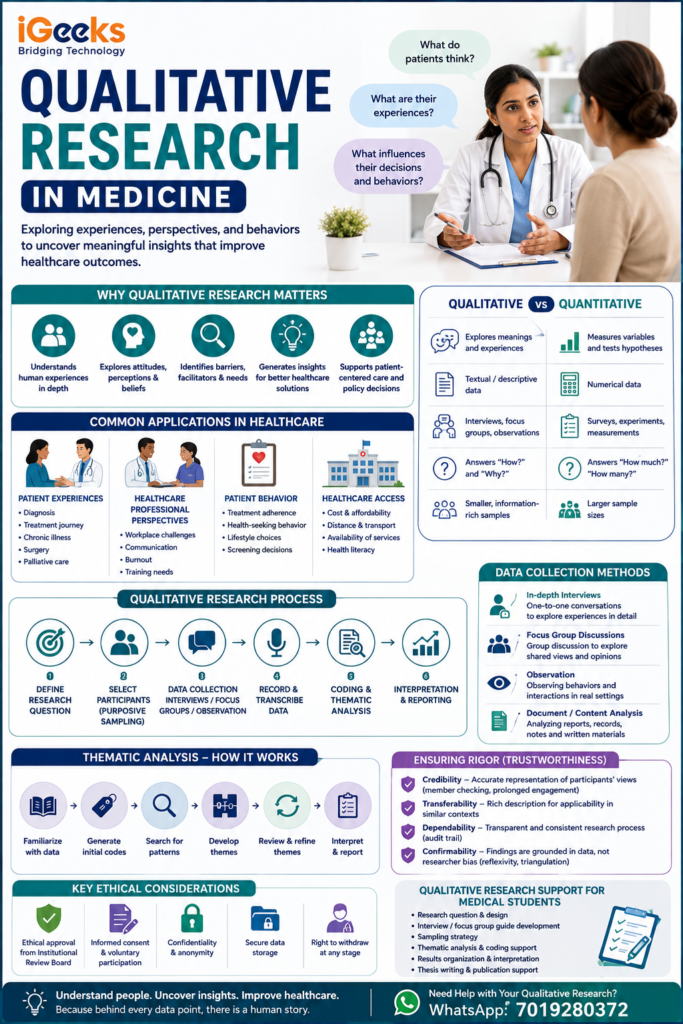
Healthcare is not only about numbers. It is also about understanding what patients, caregivers and healthcare professionals experience, think and feel.
Qualitative research provides a structured approach to exploring these experiences and can help medical researchers understand why people behave in particular ways, how they experience healthcare services, and what influences their decisions.
For MD, MS, DNB, MDS, DM, MCh and other medical students, qualitative methods can be particularly valuable when the research question involves experiences, perceptions, attitudes, barriers, expectations or behaviours that cannot be adequately captured through quantitative measurements alone.
What Is Qualitative Research?
Qualitative research is an approach used to explore and understand experiences, perceptions, meanings, attitudes and behaviours in depth.
Instead of primarily asking:
“How many patients experienced this?”
qualitative research may ask:
“How did patients experience this, and why?”
Researchers commonly collect detailed information through:
- In-depth interviews
- Focus group discussions
- Observations
- Open-ended questionnaires
- Patient narratives
- Document or content analysis
The collected information is then systematically analyzed to identify recurring concepts, patterns and themes.
Why Is Qualitative Research Important in Medicine?
Clinical research frequently involves complex human experiences.
For example, a quantitative study might demonstrate that a proportion of patients do not adhere to treatment. Qualitative research can explore why they do not adhere.
Possible reasons could include:
- Fear of adverse effects
- Financial difficulties
- Lack of understanding
- Cultural beliefs
- Difficulty accessing healthcare
- Previous negative healthcare experiences
- Family or social influences
Understanding these factors can help researchers and healthcare teams develop interventions that are more responsive to patients’ needs.
Common Applications of Qualitative Research in Healthcare
Qualitative methods can be used across many medical disciplines.
1. Patient Experiences
Researchers can explore how patients experience:
- Diagnosis
- Hospitalization
- Surgery
- Chronic disease
- Cancer treatment
- Rehabilitation
- Palliative care
2. Healthcare Professional Perspectives
Interviews with doctors, nurses and other healthcare professionals can help identify:
- Workplace challenges
- Communication barriers
- Burnout-related experiences
- Clinical decision-making processes
- Training needs
- Interprofessional collaboration
3. Patient Behaviour
Qualitative research can investigate:
- Treatment adherence
- Health-seeking behaviour
- Screening decisions
- Lifestyle choices
- Medication use
- Follow-up behaviour
4. Healthcare Access
Researchers can investigate barriers related to:
- Cost
- Distance
- Availability of services
- Waiting times
- Health literacy
- Social factors
Qualitative vs Quantitative Research
Understanding the difference between these two approaches is important when developing a medical research protocol.
| Qualitative Research | Quantitative Research |
|---|---|
| Explores experiences and meanings | Measures variables |
| Primarily uses textual or observational data | Primarily uses numerical data |
| Interviews and focus groups are common | Surveys, measurements and experiments are common |
| Identifies themes and patterns | Tests hypotheses and estimates effects |
| Answers questions such as “How?” and “Why?” | Often answers “How much?”, “How many?” or “What is the association?” |
| Usually involves smaller, information-rich samples | Often involves larger samples |
These approaches are not necessarily competing methods. In some research questions, they can be combined through mixed-methods research.
Designing a Qualitative Medical Study
A strong qualitative study begins with a clearly defined research question.
For example:
Weak question:
“Are patients satisfied with telemedicine?”
More suitable qualitative question:
“How do patients experience and perceive telemedicine consultations for chronic disease management?”
The second question allows researchers to explore experiences, expectations, concerns and perceived barriers in greater depth.
Choosing Participants
Qualitative studies generally aim to recruit participants who can provide relevant and information-rich perspectives.
Depending on the research question, participants might include:
- Patients
- Caregivers
- Doctors
- Nurses
- Allied healthcare professionals
- Medical students
- Community health workers
Purposive Sampling
Purposive sampling is commonly used to intentionally recruit participants who meet predefined characteristics relevant to the research question.
For example, a study examining experiences of diabetes management might recruit adults with established diabetes who have different treatment experiences.
Other approaches may include:
- Convenience sampling
- Snowball sampling
- Maximum variation sampling
- Criterion sampling
The sampling strategy should be justified according to the research objectives.
Data Collection Methods
1. In-Depth Interviews
Individual interviews allow researchers to explore participants’ experiences in detail.
A semi-structured interview may contain predefined questions while allowing the interviewer to ask follow-up questions when new issues emerge.
For example:
Primary question:
“Can you describe your experience after receiving the diagnosis?”
Possible follow-up questions:
- “What was the most difficult part?”
- “How did your family respond?”
- “What information did you receive?”
- “What support would have helped you?”
2. Focus Group Discussions
Focus groups involve guided discussions among a small group of participants.
They can be useful for exploring:
- Shared experiences
- Different opinions
- Social perceptions
- Attitudes toward healthcare services
- Community perspectives
The interaction between participants can generate insights that may not emerge during individual interviews.
3. Observation
Researchers may observe behaviours, interactions or processes in appropriate clinical or community settings.
For example, observation might be used to understand:
- Patient–doctor communication
- Workflow in healthcare settings
- Patient navigation
- Interprofessional interactions
Ethical approval and participant privacy must be carefully considered.
Developing an Interview Guide
A qualitative interview guide should contain open-ended questions that encourage participants to describe their experiences.
Instead of:
“Did you have difficulty accessing the hospital?”
consider:
“Can you tell me about your experience accessing healthcare services?”
Open-ended questions generally provide greater opportunity for participants to introduce issues that researchers may not have anticipated.
Recording and Transcribing Data
With appropriate consent, interviews or focus groups may be audio-recorded.
The recordings can then be transcribed for systematic analysis.
Researchers should maintain:
- Participant confidentiality
- Secure data storage
- Appropriate anonymization
- Accurate transcription
Any identifying information should be handled according to the approved study protocol and applicable institutional requirements.
What Is Thematic Analysis?
Thematic analysis is a commonly used method for identifying and organizing patterns or themes within qualitative data.
A simplified workflow is:
Data Collection
↓
Transcription
↓
Familiarization with Data
↓
Initial Coding
↓
Searching for Patterns
↓
Developing Themes
↓
Reviewing & Refining Themes
↓
Interpretation & Reporting
Example
Suppose researchers interview patients about barriers to cancer screening.
Participants may repeatedly discuss:
- Lack of awareness
- Fear of diagnosis
- Financial concerns
- Transportation difficulties
- Family responsibilities
These codes could contribute to broader themes such as:
Theme 1: Knowledge and Awareness
Theme 2: Emotional Barriers
Theme 3: Practical and Financial Barriers
The researcher then interprets how these themes relate to the research question.
Coding in Qualitative Research
Coding involves assigning meaningful labels to relevant portions of the data.
For example:
Participant statement:
“I knew the test was important, but I couldn’t take another day off work.”
Possible code:
Work-related barrier
Another participant might say:
“The hospital is very far from my village.”
Possible code:
Geographical access barrier
Several related codes may eventually contribute to a broader theme such as:
Healthcare Accessibility Challenges
Coding should be systematic and connected to the study objectives rather than simply collecting interesting quotations.
Ensuring Rigour in Qualitative Research
Qualitative research requires methodological rigour.
Researchers may consider concepts such as:
Credibility
Does the interpretation accurately represent participants’ experiences?
Transferability
Is there sufficient contextual information for readers to assess whether findings may apply elsewhere?
Dependability
Is the research process sufficiently transparent and consistent?
Confirmability
Are findings grounded in the data rather than solely reflecting researcher assumptions?
Depending on the study, researchers may use strategies such as:
- Reflexivity
- Member checking
- Triangulation
- Peer debriefing
- Audit trails
- Multiple researchers during coding
The appropriate strategies should be selected and clearly described.
Researcher Reflexivity
The researcher is an important part of qualitative research.
Their background, assumptions, professional position and relationship with participants can potentially influence data collection and interpretation.
Reflexivity involves critically considering these influences throughout the research process.
For medical researchers, this can be particularly relevant when interviewing patients about sensitive clinical experiences.
Ethical Considerations
Qualitative research involving patients or healthcare professionals requires careful attention to ethics.
Important considerations include:
- Institutional ethical approval
- Informed consent
- Voluntary participation
- Confidentiality
- Secure data storage
- Protection of participant identity
- Appropriate handling of sensitive information
- The right to withdraw where applicable
Participants should understand how their information will be collected, used and reported.
Reporting Qualitative Research
A qualitative research paper should clearly explain:
Introduction
- Background
- Research problem
- Research gap
- Research question/objectives
Methods
- Study design
- Study setting
- Participants
- Sampling strategy
- Data collection
- Interview/focus group process
- Data analysis
- Reflexivity
- Ethical approval
Results
- Themes
- Subthemes
- Supporting participant quotations where appropriate
Discussion
- Interpretation of findings
- Comparison with existing literature
- Clinical or healthcare implications
- Strengths and limitations
Conclusion
- Main findings
- Implications
- Potential areas for future research
Common Mistakes in Qualitative Medical Research
Researchers should avoid:
❌ Using qualitative methods without a clear research question
❌ Asking only closed-ended interview questions
❌ Selecting participants without a clear sampling rationale
❌ Treating interviews like simple surveys
❌ Reporting quotations without analytical interpretation
❌ Confusing codes with themes
❌ Ignoring researcher reflexivity
❌ Providing insufficient methodological detail
❌ Making conclusions that are not supported by the data
Good qualitative research requires systematic methodology, transparent analysis and careful interpretation.
Can Qualitative and Quantitative Research Be Combined?
Yes. Mixed-methods research combines qualitative and quantitative approaches when this provides a better answer to the research question.
For example:
Quantitative phase:
Measure the prevalence of medication non-adherence.
Qualitative phase:
Interview selected patients to understand the reasons behind non-adherence.
Together, these approaches may provide both the scale of a problem and a deeper understanding of why it occurs.
Qualitative Research Support for Medical Students
Qualitative research can be challenging, particularly when developing the research question, interview guide, sampling strategy and analytical framework.
Academic research support may include:
✅ Research question development
✅ Qualitative study design
✅ Interview/focus-group guide development
✅ Sampling strategy guidance
✅ Thematic analysis support
✅ Coding framework development
✅ Results organization
✅ Tables and thematic presentation
✅ Literature review support
✅ Thesis methodology and results structuring
✅ Manuscript preparation and journal-specific formatting
For MD, MS, DNB, MDS, DM, MCh and medical/allied health research.
📲 WhatsApp: 7019280372
Final Takeaway
Qualitative research allows medical researchers to move beyond numbers and understand the experiences, perspectives, motivations and behaviours that influence healthcare.
When properly designed and rigorously analyzed, interviews, focus groups and thematic analysis can generate valuable insights for clinical practice, medical education, healthcare policy and patient-centred care.
Good medical research asks not only “What is happening?” but also “Why is it happening, how is it experienced, and what can we learn from it?”