
A Complete Guide for MD, MS, MDS, Nursing, Pharm D & Allied Health Science Students
For postgraduate students under Rajiv Gandhi University of Health Sciences (RGUHS), completing a dissertation is a mandatory academic milestone. Whether you are pursuing MD, MS, MDS, MSc Nursing, Pharm D, Physiotherapy, or Allied Health Sciences, your dissertation demonstrates your ability to conduct scientific research, analyze data, and present findings in a structured academic format.
Unfortunately, many students underestimate the time required for topic selection, ethics approval, data collection, statistical analysis, and final dissertation submission. Proper planning can help avoid last-minute stress and ensure timely completion. Research guidance sources consistently emphasize starting early, maintaining a realistic timeline, and aligning objectives, methods, and results throughout the dissertation process.
For professional dissertation guidance and thesis support, visit:
https://www.makefinalyearproject.com/medical-thesis-writing-services-india.html
Why Is the RGUHS Dissertation Important?
The dissertation is more than a university requirement. It helps students:
- Develop research skills
- Understand scientific methodology
- Learn evidence-based medical practice
- Improve academic writing skills
- Prepare research papers for publication
- Build a strong academic profile
A well-executed dissertation can often serve as the foundation for future journal publications and academic presentations.
Step 1: Plan Your Dissertation Early
One of the biggest reasons students miss deadlines is delayed planning.
Suggested Timeline
Month 1–2
- Topic Selection
- Guide Consultation
- Literature Review
Month 3–4
- Synopsis Preparation
- Ethical Committee Submission
Month 5–8
- Data Collection
Month 9–10
- Statistical Analysis
Month 11–12
- Dissertation Writing
- Formatting
- Submission Preparation
Students who follow a structured timeline generally experience fewer delays during dissertation submission.
Step 2: Select a Feasible Research Topic
Choosing the right topic is the most critical step.
Characteristics of a Good Dissertation Topic
- Relevant to your specialty
- Clinically meaningful
- Researchable within available time
- Adequate patient/sample availability
- Ethical feasibility
- Availability of resources
Avoid Topics That Are
- Too broad
- Expensive to execute
- Difficult to collect data for
- Dependent on multiple departments
- Already extensively researched
A practical and achievable topic often produces better results than an overly ambitious one.
Step 3: Prepare a Strong Synopsis
The synopsis serves as the blueprint of your research.
Components of a Synopsis
Title
Clear and focused research title.
Introduction
Background information and significance of the study.
Review of Literature
Summary of existing research.
Aim and Objectives
Specific and measurable objectives.
Methodology
- Study design
- Sample size
- Inclusion criteria
- Exclusion criteria
- Data collection methods
Statistical Analysis Plan
Appropriate analytical methods.
References
Recent and relevant literature citations.
A well-prepared synopsis simplifies later stages of dissertation writing.
Step 4: Obtain Ethical Committee Approval
Most clinical studies require approval from the Institutional Ethics Committee (IEC).
Students should prepare:
- Research Protocol
- Patient Information Sheet
- Consent Forms
- Data Collection Forms
Ethics approval should be obtained before initiating patient recruitment and data collection. Delays in ethical clearance are among the most common causes of dissertation timeline disruptions.
Step 5: Organize Data Collection Properly
Data collection is often the longest phase of the dissertation.
Best Practices
- Use standardized forms
- Maintain patient confidentiality
- Record data accurately
- Backup records regularly
- Verify entries periodically
Proper documentation helps reduce errors during statistical analysis and manuscript preparation.
Step 6: Perform Statistical Analysis
Many postgraduate students struggle with statistics.
Commonly used methods include:
- Chi-Square Test
- T-Test
- ANOVA
- Correlation Analysis
- Regression Analysis
- Survival Analysis
Accurate statistical interpretation strengthens the scientific validity of the dissertation and improves publication potential.
Step 7: Write the Dissertation Efficiently
Instead of writing from the beginning, experienced researchers recommend writing in the following sequence:
Recommended Writing Order
- Materials and Methods
- Results
- Discussion
- Introduction
- Abstract
This approach makes writing easier because the research findings are already available.
Standard RGUHS Dissertation Structure
Preliminary Pages
- Title Page
- Certificate
- Declaration
- Acknowledgement
- Abstract
Main Chapters
Chapter 1: Introduction
Research background and rationale.
Chapter 2: Review of Literature
Summary of previous studies.
Chapter 3: Materials and Methods
Study design and methodology.
Chapter 4: Results
Tables, graphs, and statistical findings.
Chapter 5: Discussion
Interpretation and comparison with existing studies.
Chapter 6: Conclusion
Key findings and recommendations.
References
Usually prepared in Vancouver style.
Annexures
- Ethical Approval Certificate
- Consent Forms
- Questionnaires
- Data Collection Proforma
Proper formatting significantly improves the professional appearance of the dissertation.
Common Mistakes That Delay Submission
Many dissertations are delayed because of avoidable errors.
Common Problems
- Delayed ethics approval
- Poorly defined objectives
- Incomplete data collection
- Incorrect statistical methods
- Missing references
- Formatting inconsistencies
- Missing annexures
- Inadequate plagiarism checking
Avoiding these issues can significantly improve submission readiness.
Final Dissertation Submission Checklist
Before submission, verify:
✓ Guide and Co-Guide Signatures
✓ Ethics Approval Attached
✓ Abstract Finalized
✓ References Verified
✓ Tables and Figures Numbered
✓ Plagiarism Check Completed
✓ Annexures Included
✓ Formatting Reviewed
✓ Soft Copy Prepared
✓ Final Proofreading Completed
A detailed checklist helps minimize last-minute corrections and submission delays.
Viva Preparation Tips
After submission, students must prepare for dissertation viva voce.
Common Questions
- Why did you select this topic?
- What are your objectives?
- What methodology was used?
- Why was the sample size selected?
- What statistical tests were applied?
- What are your major findings?
- What are the limitations of your study?
Tips for Success
- Understand your methodology thoroughly.
- Know your results and tables.
- Review recent literature.
- Practice concise answers.
- Be confident and professional.
A strong understanding of your own research is the best preparation for viva examinations.
How Igeeks Helps RGUHS Students
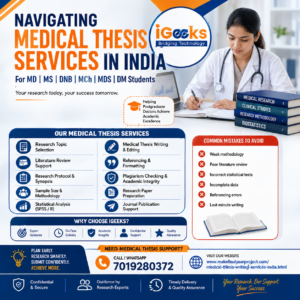
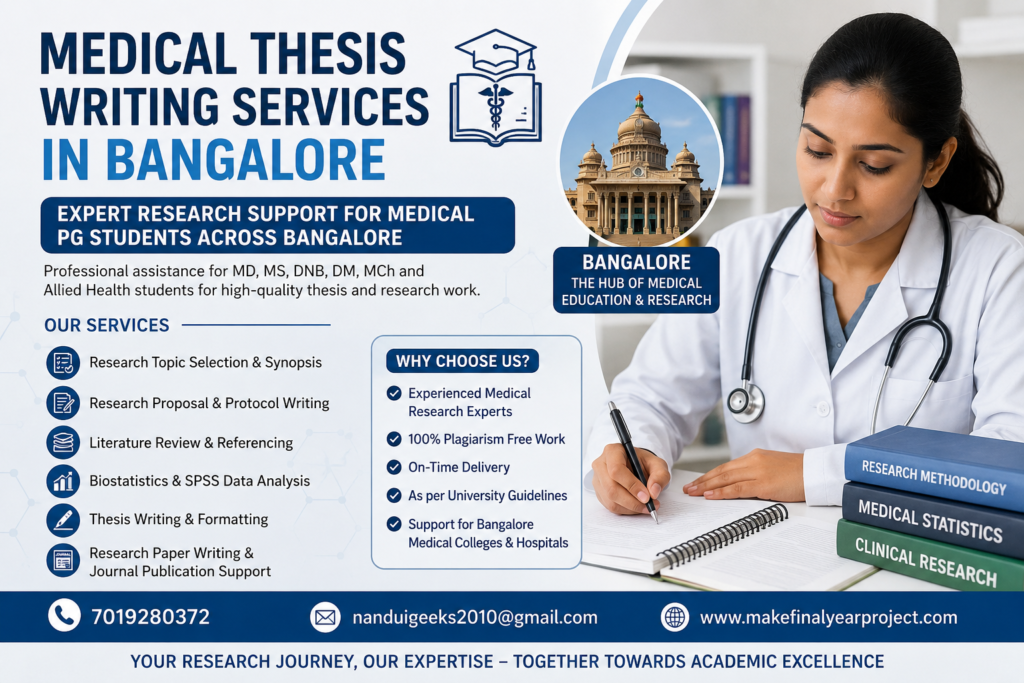
At Igeeks Technologies, we provide comprehensive academic support for postgraduate medical students across India.
Our Services Include
- Dissertation Topic Selection
- Synopsis Writing Support
- Literature Review Assistance
- SPSS Statistical Analysis
- Data Interpretation
- Dissertation Formatting
- Plagiarism Reduction Support
- Journal Paper Writing
- Publication Guidance
- Viva Preparation
We support students from:
- MD
- MS
- MDS
- Nursing
- Pharm D
- Physiotherapy
- Allied Health Sciences
Contact Igeeks Medical Thesis Help
Need support with your RGUHS dissertation?
Visit:
https://www.makefinalyearproject.com/medical-thesis-writing-services-india.html
Call / WhatsApp
7019280372
Website
Conclusion
Completing an RGUHS dissertation on time requires proper planning, disciplined execution, accurate data analysis, and professional documentation. Students who start early, follow a structured timeline, and seek expert guidance when required can successfully complete their dissertation with confidence.
Igeeks Medical Thesis Help provides end-to-end academic support to help postgraduate healthcare students complete their research projects efficiently and achieve academic excellence.