

Introduction
Publishing research papers in reputed journals has become an essential requirement for PhD scholars, faculty members, researchers, and postgraduate students. High-quality journal publications not only enhance academic credentials but also contribute to career advancement, research visibility, funding opportunities, and successful thesis completion.
However, writing a journal paper that meets the standards of Scopus, Web of Science, SCI, SCIE, ESCI, PubMed, or UGC CARE journals requires strong research methodology, scientific writing skills, data analysis, and adherence to journal guidelines.
This guide explains the complete journal paper writing process, publication strategies, and common challenges faced by researchers in 2026.
What is a Journal Paper?
A journal paper is a scholarly article that presents original research findings, experimental results, theoretical developments, systematic reviews, or case studies. Before publication, the manuscript undergoes a peer-review process to ensure its quality, originality, and scientific contribution.
Journal papers are commonly published in:
- Scopus Indexed Journals
- Web of Science Indexed Journals
- SCI & SCIE Journals
- ESCI Journals
- PubMed Indexed Journals
- UGC CARE Journals
- IEEE, Springer, Elsevier, Taylor & Francis, and Wiley journals
Why Journal Publications Are Important
Publishing in reputed journals offers several benefits:
- Enhances your academic profile
- Improves research credibility
- Supports PhD thesis submission requirements
- Increases citation potential
- Strengthens faculty promotion and API scores
- Opens opportunities for research funding and collaboration
Many universities now encourage or require journal publications before awarding a PhD degree.
Types of Journal Papers
Original Research Article
Reports new research findings supported by data, analysis, and conclusions.
Suitable for:
- Engineering
- Medical Sciences
- Management
- Computer Science
- Pharmacy
- Nursing
- Social Sciences
Review Paper
Summarizes and critically evaluates existing literature on a research topic.
Suitable for identifying research gaps and future directions.
Systematic Review
Uses a structured methodology to identify, evaluate, and synthesize existing studies.
Common in healthcare and medical research.
Case Study
Analyzes a specific organization, patient, technology, or real-world problem.
Widely used in business, medicine, and education.
Survey Paper
Provides a comprehensive overview of developments in a particular research domain.
Standard Structure of a Journal Paper
A well-written manuscript generally includes:
- Title
- Abstract
- Keywords
- Introduction
- Literature Review
- Research Methodology
- Results
- Discussion
- Conclusion
- References
Most journals also provide author guidelines that specify formatting, citation style, and submission requirements.
How to Write a High-Quality Journal Paper
Step 1: Select a Strong Research Topic
Choose a topic that is:
- Original
- Relevant
- Research-oriented
- Supported by sufficient literature
- Aligned with current trends
Step 2: Conduct a Literature Review
Search trusted databases such as:
- Google Scholar
- Scopus
- Web of Science
- IEEE Xplore
- PubMed
- SpringerLink
A strong literature review helps identify research gaps and justify your study.
Step 3: Define Research Objectives
Clear objectives guide the research and improve manuscript quality.
Example:
- Analyze customer satisfaction
- Evaluate machine learning performance
- Assess treatment effectiveness
Step 4: Develop the Research Methodology
The methodology should clearly describe:
- Research design
- Sampling method
- Data collection
- Variables
- Statistical analysis
- Software used (SPSS, R, Python, MATLAB, etc.)
Step 5: Analyze the Data
Use appropriate analytical techniques such as:
- Descriptive Statistics
- Regression Analysis
- ANOVA
- Correlation Analysis
- Machine Learning Models
- Qualitative Coding
Step 6: Discuss the Findings
Compare your results with previous studies and explain their significance.
Highlight practical implications, limitations, and recommendations for future research.
Choosing the Right Journal
Before submission, verify:
- Scope of the journal
- Indexing status
- Peer-review process
- Publication ethics
- Acceptance rate
- Publication timeline
Always confirm the journal’s indexing status using official sources rather than relying solely on promotional claims.
Common Reasons for Journal Rejection
Many manuscripts are rejected because of:
- Weak research methodology
- Poor English language
- Inadequate literature review
- Lack of originality
- Improper statistical analysis
- Formatting errors
- Plagiarism
- Mismatch with the journal’s scope
Addressing these issues before submission significantly improves the chances of acceptance.
Tips to Improve Acceptance Chances
- Select the right journal.
- Follow the journal’s author guidelines carefully.
- Ensure originality and proper citations.
- Present clear research objectives and methodology.
- Include high-quality tables and figures.
- Proofread the manuscript thoroughly.
- Respond professionally to reviewer comments.
Journal Publication Ethics
Researchers should always:
- Report original work
- Cite all sources appropriately
- Avoid plagiarism
- Disclose conflicts of interest
- Avoid duplicate submissions
- Follow ethical guidelines for human or animal research where applicable
Maintaining publication ethics is essential for long-term academic credibility.
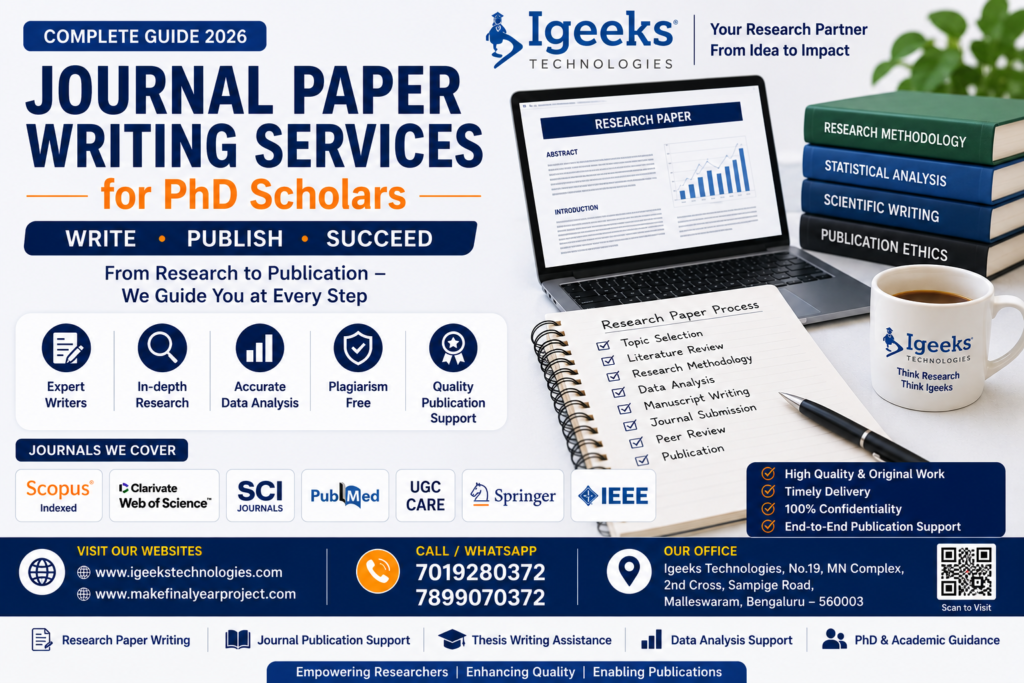
Professional Journal Paper Writing Support
Researchers often seek expert guidance for:
- Topic Selection
- Literature Review
- Research Methodology
- Statistical Analysis
- Manuscript Writing
- Editing and Proofreading
- Plagiarism Reduction
- Reviewer Comment Responses
- Journal Selection
- Publication Support
Professional mentoring can help researchers prepare manuscripts that align with international journal standards.
Why Choose Igeeks for Journal Paper Writing Support?
At Igeeks Technologies, we provide end-to-end research assistance for:
- PhD Scholars
- MD/MS/DNB Researchers
- M.Tech & MBA Students
- Faculty Members
- International Researchers
Our services include:
- Research Paper Writing
- Scopus Journal Publication Guidance
- Web of Science Publication Support
- Literature Review Development
- SPSS and Statistical Analysis
- Research Methodology Assistance
- Thesis Writing Support
- Reviewer Comment Revision
- Formatting as per Journal Guidelines
For more information, visit:
https://www.makefinalyearproject.com/phd-thesis-help-bangalore.aspx
Frequently Asked Questions (FAQs)
1. What is a journal paper?
A journal paper is a peer-reviewed research article that presents original findings, reviews, or case studies for publication in an academic journal.
2. How long should a journal paper be?
The length depends on the journal, but many research articles range from 4,000 to 8,000 words.
3. What is the difference between a conference paper and a journal paper?
Journal papers usually undergo a more rigorous peer-review process and often provide greater detail than conference papers.
4. How can I select the right journal?
Choose a journal based on its scope, indexing, audience, publication ethics, and relevance to your research topic.
5. How long does journal publication take?
The review and publication process can take several weeks to several months, depending on the journal.
6. Can I publish my thesis as a journal paper?
Yes. Many researchers publish parts of their thesis as journal articles after adapting them to the journal’s format and scope.
7. How important is plagiarism checking?
Very important. Journals expect original work with proper citations and generally require a low similarity score.
8. What should I do if reviewers request revisions?
Address each comment carefully, revise the manuscript accordingly, and provide a clear response explaining the changes made.
9. Can I publish in Scopus or Web of Science journals?
Yes, provided your research meets the journal’s quality standards and fits its scope.
10. Does Igeeks provide journal publication guidance?
Yes. Igeeks offers mentoring for research paper writing, manuscript improvement, journal selection, statistical analysis, and publication support.
Conclusion
Writing and publishing a journal paper requires careful planning, sound research methodology, ethical practices, and effective scientific communication. By selecting an appropriate journal, following author guidelines, and presenting high-quality research, scholars can improve their chances of successful publication. Whether you are a PhD scholar, faculty member, medical researcher, or postgraduate student, professional guidance can streamline the publication process and help you achieve your academic goals.