

Introduction
Publishing a research paper is an important achievement for PhD scholars, medical professionals, university faculty members, and academic researchers. However, publication is only one step in the research journey. Making published work discoverable to the right academic audience is equally important.
Many researchers have valuable findings but struggle to improve the visibility of their journal articles, maintain accurate academic profiles, or understand their citation records. This is where research paper visibility services can provide practical assistance.
At Igeeks Technologies, we support researchers in reviewing publication information, improving scholarly discoverability, monitoring citation records, and identifying ethical strategies to communicate their research to relevant academic audiences.
What Are Research Paper Visibility Services?
Research paper visibility services help authors assess how easily their published work can be found, accessed, and correctly identified across academic search platforms, scholarly databases, institutional repositories, and research profiles.
These services focus on improving the presentation and discoverability of existing research rather than artificially increasing citation counts.
Research visibility support may include:
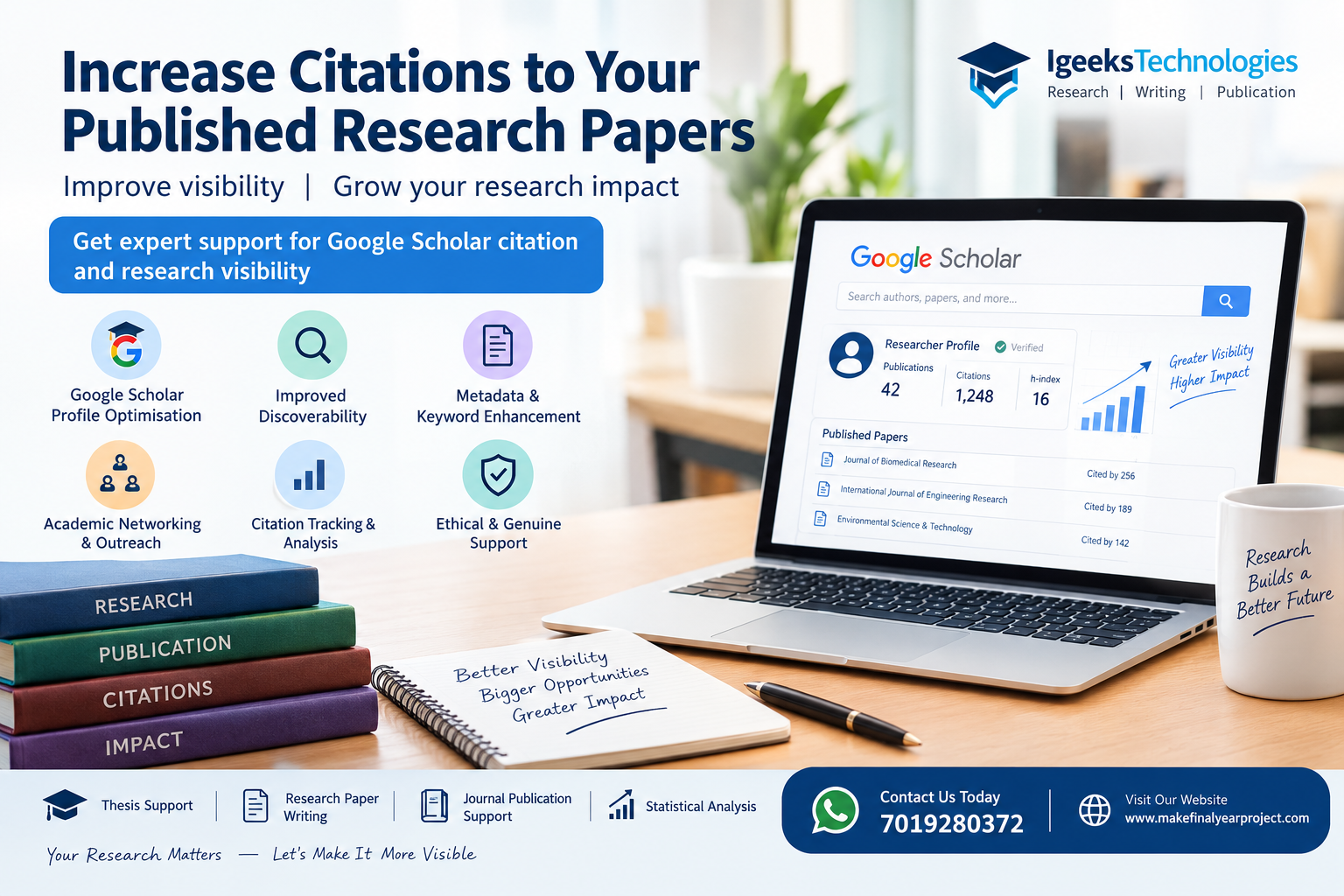
Google Scholar profile and publication-record review.
Research paper metadata and DOI verification.
Academic author profile optimisation.
Publication discoverability assessment.
Citation tracking and bibliometric analysis.
Guidance on sharing research through permitted academic channels.
Recommendations for improving research communication and outreach.
The appropriate approach depends on the research discipline, publication history, journal policies, and the author’s objectives.
Why Is Research Paper Visibility Important?
1. Helps Relevant Researchers Discover Your Work
Researchers frequently search academic databases for specific problems, methods, technologies, and findings. Clear publication information and accurate metadata help readers identify papers relevant to their work.
2. Supports Academic Profile Development
An accurate academic profile allows researchers to present their publications consistently. This can be useful when documenting research experience, preparing academic portfolios, or reviewing scholarly output.
3. Helps Researchers Monitor Citation Activity
Citation tracking enables authors to understand how their published work is referenced in subsequent scholarly publications. Different databases may report different counts because their coverage and indexing methods vary.
4. Improves Access to Research Findings
Where publisher policies permit, sharing an accepted manuscript or depositing a paper in an institutional repository can help make research accessible to a wider audience.
5. Supports Long-Term Research Impact
Research impact involves more than citation numbers. It can include the use of findings in later studies, research collaboration, methodological development, and contributions to professional practice.
Common Reasons Research Papers Have Low Visibility
Incomplete Publication Metadata
Missing DOI information, inconsistent author names, incorrect publication years, or incomplete journal details can make it harder to identify a paper across scholarly platforms.
Poorly Aligned Keywords
If a title, abstract, or keyword list does not clearly communicate the study’s topic, researchers searching for related work may find it harder to identify the publication.
Inaccurate Academic Profiles
Duplicate entries, missing papers, and incorrectly merged publications can affect the presentation of an author’s research output.
Limited Research Promotion
Researchers may publish their findings without sharing them through appropriate institutional repositories, academic profiles, conferences, or relevant research communities.
Restricted Full-Text Access
Some journal articles are subscription-based. Authors should review publisher policies to determine whether an accepted manuscript or another permitted version can be shared publicly.
How to Improve Research Paper Visibility
1. Review Your Google Scholar Profile
Check that your profile includes the correct publications and that author details are accurate. Review duplicate entries, missing papers, and incorrectly attributed publications.
If a citation or publication record is incorrect, use the platform’s available correction process rather than attempting to manipulate citation counts.
2. Verify DOI and Publication Details
Confirm the accuracy of your paper title, author names, journal name, publication year, volume, issue, page range, and DOI.
Consistent bibliographic information helps academic systems identify publications correctly.
3. Improve Research Titles, Abstracts, and Keywords
For future submissions, use a clear title and an informative abstract that communicates the research question, methods, key findings, and contribution.
Choose keywords that accurately reflect the paper’s subject, methods, and application. Do not add unrelated or misleading keywords simply to attract more searches.
For already-published papers, changes to official article information should be handled through the journal’s correction procedures.
4. Share Publications Through Appropriate Academic Channels
Depending on publisher permissions, researchers may share their work through:
University or institutional repositories.
Author profiles and academic networking platforms.
Personal or institutional research webpages.
Conference presentations and research seminars.
Relevant professional associations and scholarly communities.
Whenever possible, link to the official publisher page or an authorised full-text version.
5. Connect With Relevant Research Communities
Academic visibility improves when research reaches people who work on related problems. Researchers can participate in conferences, seminars, collaborative projects, and subject-specific discussions.
Share findings because they are relevant to the audience, not to solicit reciprocal citations.
6. Monitor Citations and Research Metrics
Review publication and citation records periodically using Google Scholar, Scopus, Web of Science, and other appropriate resources.
Keep in mind that citation counts may differ between platforms. Evaluate the underlying records and trends rather than relying on a single metric to measure research quality.
7. Communicate Your Research Clearly
A short, accurate summary of a paper can help readers understand its contribution. Where appropriate, explain the research problem, the method used, the main findings, and why the work may be useful to other researchers.
All summaries and promotional materials should represent the original findings accurately.
Research Paper Visibility Services for PhD Scholars and Medical Researchers
PhD scholars and medical professionals often manage multiple research papers, thesis requirements, publication records, and academic profiles. A structured review can help identify problems with publication metadata and opportunities to improve discoverability.
Igeeks Technologies provides research-related support for authors across several disciplines.
Our Research Visibility Support May Include
Google Scholar profile review: checking publication listings and author details.
Publication-record verification: reviewing DOI information and bibliographic accuracy.
Research discoverability assessment: identifying potential issues with metadata and publication presentation.
Citation tracking: reviewing available citation records and explaining differences between platforms.
Academic research support: assistance with research paper writing, thesis preparation, formatting, and statistical analysis.
Publication guidance: helping authors understand manuscript preparation and relevant journal requirements.
The final scope of service depends on the author’s requirements and the information available for review.
Can Research Visibility Services Increase Citations?
Improving discoverability can create more opportunities for relevant researchers to find and read a paper. However, visibility and citation growth are not the same.
A citation occurs when another author refers to your work in a scholarly publication. Whether this happens depends on the relevance, quality, accessibility, and use of your findings by independent researchers.
No legitimate service can guarantee a fixed number of new citations. Purchased citations, artificial citation exchanges, or irrelevant references can undermine research integrity and may violate platform or publisher policies.
The goal should be to make genuine research easier to discover and use.
Who Can Benefit From Research Visibility Support?
Our services may be relevant to:
PhD scholars and doctoral researchers.
Medical professionals and clinical researchers.
MTech, MSc, and engineering researchers.
University faculty and research supervisors.
Authors with publications indexed in Google Scholar, Scopus, or Web of Science.
Researchers seeking to review citation records or improve publication discoverability.
Why Choose Igeeks Technologies?
Igeeks Technologies supports researchers with academic and publication-related requirements across multiple subject areas.
We help researchers review publication records, understand citation data, improve research presentation, and identify practical next steps for academic visibility.
Our approach emphasises accurate publication information, ethical research promotion, and transparent service scope. We do not sell citations or promise specific citation counts, database indexing outcomes, or journal acceptance.
Frequently Asked Questions
What are research paper visibility services?
They help authors review publication records, academic profiles, metadata, citation information, and permitted ways to share research so that relevant readers can discover their work more easily.
How can I improve the visibility of an already-published paper?
Review your academic profiles, verify DOI and publication details, correct errors through official channels, and share permitted versions through relevant academic platforms and communities.
Can research visibility support increase Google Scholar citations?
It may improve the opportunity for relevant researchers to discover your work, but new citations depend on independent scholarly use and cannot be guaranteed.
Why are my Google Scholar and Scopus citation counts different?
The platforms have different indexing coverage and data-processing methods. As a result, their publication records and citation counts may not match.
What information is required for a research visibility review?
Share your paper title, DOI or publisher link, research area, Google Scholar profile link if available, and the particular publication-record or visibility issue you want to address.
Contact Igeeks Technologies for Research Visibility Support
Your published work represents your research effort and contribution to your field. Making it easier to discover can help the right academic audience find and evaluate your findings.
If you need assistance with publication records, research visibility, citation tracking, thesis support, statistical analysis, or research paper writing, contact Igeeks Technologies.
WhatsApp: 7019280372
Website: https://www.makefinalyearproject.com
Share your published paper details to discuss your research visibility requirements.