
A Master’s thesis or dissertation is one of the most important academic requirements of a postgraduate degree. It demonstrates a student’s ability to identify a research problem, review existing evidence, select an appropriate methodology, analyze information, and communicate findings in a structured academic format.
Many Master’s students struggle with topic selection, literature review, research methodology, data analysis, referencing, plagiarism, formatting, and submission deadlines. Understanding the complete thesis process before starting can make the research journey much more manageable.
This guide explains the Master’s thesis and dissertation format, step-by-step writing process, research methodology, statistical analysis, academic integrity, and the role of professional research support.
What Is a Master’s Thesis or Dissertation?
The terms thesis and dissertation are sometimes used interchangeably, and their meaning varies between universities and countries.
At Master’s level, either may involve an extended research project designed to demonstrate:
- Research skills
- Critical thinking
- Subject knowledge
- Academic writing ability
- Data analysis
- Problem-solving
- Independent research capability
The exact requirements, length, format, and assessment criteria depend on your university, course, department, and country.
Master’s Thesis vs Dissertation
Although terminology varies, a simplified comparison is:
| Master’s Thesis | Master’s Dissertation |
|---|---|
| Often research-focused | May be research or application-focused |
| Develops a research question | May address a practical problem |
| Usually involves systematic research | May involve applied/project-based research |
| Emphasizes analysis and academic contribution | May emphasize practical outcomes |
| Format depends on university | Format depends on university |
The most important point is to follow your institution’s official guidelines, rather than relying on a generic thesis format.
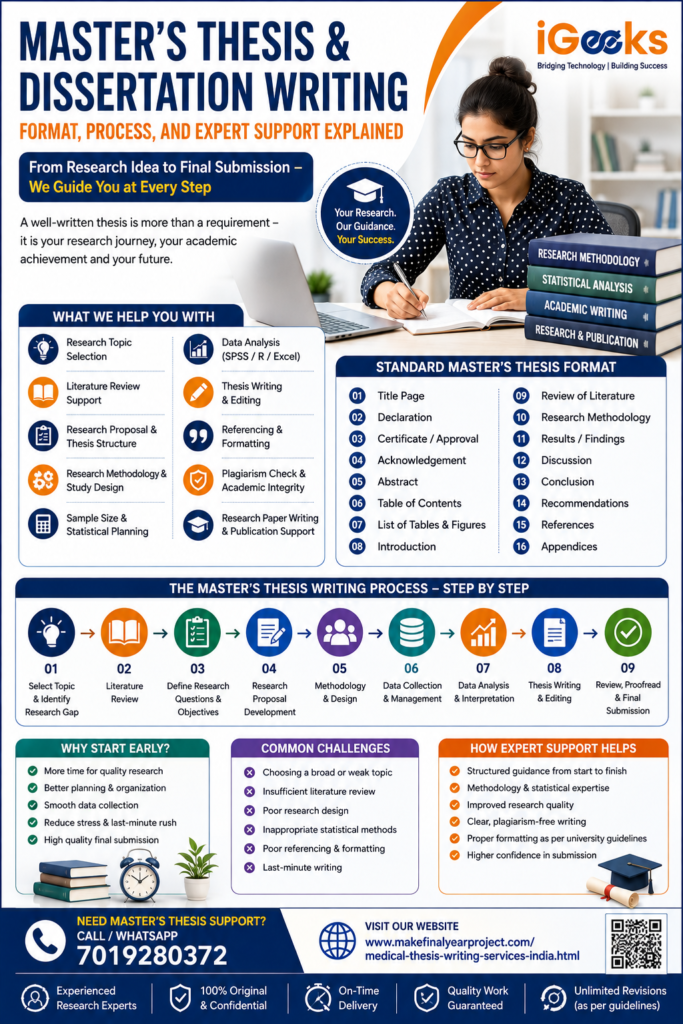
Standard Master’s Thesis Format
A typical Master’s thesis or dissertation may contain the following sections.
1. Title Page
The title page generally includes:
- Thesis/dissertation title
- Student name
- University
- Department
- Degree/program
- Supervisor or guide
- Year of submission
Your title should clearly communicate the subject and scope of the research.
2. Declaration
Some universities require a declaration confirming that the submitted work complies with their academic-integrity requirements.
Always use the wording prescribed by your institution.
3. Certificate or Approval Page
Where applicable, this section may contain approval or certification from the supervisor, department, or university.
4. Acknowledgement
The acknowledgement section allows the researcher to recognize legitimate academic, institutional, or personal support received during the research process.
5. Abstract
The abstract provides a concise overview of the entire research project.
It generally covers:
- Background
- Research problem
- Objectives
- Methodology
- Key findings
- Conclusion
A good abstract should give the reader a clear understanding of the research without requiring them to read the entire thesis.
6. Introduction
The introduction establishes the foundation of your research.
It may include:
- Background of the study
- Research problem
- Research gap
- Research question
- Aim
- Objectives
- Significance of the study
- Scope of the research
The introduction should answer a fundamental question:
Why is this research necessary?
7. Review of Literature
The literature review examines existing research related to your topic.
A strong literature review should do more than summarize individual papers.
It should:
- Identify major themes
- Compare previous findings
- Evaluate existing methodologies
- Identify limitations
- Highlight disagreements
- Identify research gaps
- Establish the rationale for your study
Use reliable academic sources and maintain accurate citations throughout the writing process.
8. Research Methodology
The methodology explains how your research was conducted or will be conducted.
Depending on your discipline, this section may include:
Research Design
Examples include:
- Experimental
- Descriptive
- Exploratory
- Case study
- Cross-sectional
- Longitudinal
- Comparative
- Mixed-methods
Study Population and Sample
Explain:
- Target population
- Sample size
- Sampling method
- Selection criteria
Data Collection
Describe whether the data was obtained through:
- Surveys
- Interviews
- Experiments
- Observations
- Databases
- Documents
- Secondary datasets
Research Instruments
Explain the questionnaires, interview guides, software, tools, equipment, or other instruments used.
9. Data Analysis and Results
The results section presents the findings of your research.
Depending on your study, this could involve:
- Tables
- Graphs
- Charts
- Statistical outputs
- Descriptive statistics
- Inferential statistics
- Qualitative themes
- Experimental observations
Results should be presented objectively and clearly.
Avoid making conclusions that are not supported by the collected evidence.
10. Discussion
The discussion explains the meaning and importance of your findings.
You can:
- Compare your findings with previous studies
- Explain similarities and differences
- Discuss unexpected findings
- Explain theoretical implications
- Explain practical implications
- Discuss strengths and limitations
The discussion should connect your findings back to your research questions and objectives.
11. Conclusion
The conclusion summarizes the key findings of the study.
A strong conclusion should:
- Address the research objectives
- Summarize the major findings
- Explain the contribution of the study
- Avoid introducing completely new evidence
12. Recommendations
Depending on your research, you may provide recommendations for:
- Industry
- Organizations
- Policymakers
- Healthcare
- Education
- Technology
- Business
- Future researchers
Recommendations should be based on your findings.
13. References
All sources used in your research should be appropriately cited.
Common referencing styles include:
- APA
- Harvard
- MLA
- Vancouver
- IEEE
- Chicago
Your university or department should determine the required referencing style.
14. Appendices
Supporting materials may be placed in the appendices.
Examples include:
- Questionnaires
- Interview schedules
- Consent forms
- Additional tables
- Technical documentation
- Research instruments
- Supplementary calculations
Step-by-Step Master’s Thesis Writing Process
Step 1: Select Your Research Topic
Choose a topic that is:
- Relevant
- Specific
- Researchable
- Feasible
- Supported by sufficient literature
- Appropriate for your degree
Discuss the proposed topic with your supervisor before proceeding.
Step 2: Identify the Research Problem
A strong research problem explains what needs to be investigated.
Ask:
What is the problem?
Why does it matter?
What is already known?
What remains unknown?
How can this study contribute?
Step 3: Develop Research Questions
Research questions should be specific and answerable.
For example:
How does the adoption of artificial intelligence affect productivity among small businesses?
The research question should guide the methodology, data collection, analysis, and conclusion.
Step 4: Define Research Objectives
Objectives describe what your research intends to accomplish.
They should be:
- Specific
- Measurable
- Relevant
- Achievable
- Directly connected to the research question
Step 5: Conduct a Comprehensive Literature Review
Search relevant academic databases, journals, books, conference proceedings, and credible institutional publications.
While reviewing literature, identify:
- Existing theories
- Previous findings
- Research methodologies
- Limitations
- Contradictory findings
- Research gaps
Organize your references from the beginning rather than waiting until the final stage.
Step 6: Prepare the Research Proposal
Depending on your university, you may need to submit a research proposal before beginning the main study.
A proposal can include:
- Title
- Background
- Problem statement
- Literature review
- Research gap
- Research questions
- Objectives
- Methodology
- Expected outcomes
- Timeline
- References
Step 7: Obtain Necessary Approvals
Some research requires formal approvals before data collection.
Depending on the project, this may include:
- University approval
- Ethics approval
- Institutional permission
- Organizational permission
- Participant consent
- Data-access authorization
Follow your institution’s procedures before collecting research data.
Step 8: Collect and Manage Data
Maintain an organized research workflow.
Keep:
- Original data
- Research instruments
- Coding information
- Documentation
- Analysis files
- Secure backups
Good data management helps reduce errors during analysis.
Step 9: Perform Statistical or Qualitative Analysis
The analysis method depends on your research design and data.
Quantitative Analysis
Possible methods include:
- Descriptive statistics
- Correlation
- Regression
- t-tests
- ANOVA
- Chi-square
- Factor analysis
Qualitative Analysis
Possible approaches include:
- Thematic analysis
- Content analysis
- Narrative analysis
- Case analysis
Tools such as SPSS, R, Excel, or other specialized software may be appropriate depending on the project.
The software itself does not determine the correct method—the analysis must be appropriate for the research question and data.
Step 10: Write the Thesis Chapter by Chapter
Instead of attempting to write everything at once, divide the project into manageable sections.
A common sequence is:
Introduction → Literature Review → Methodology → Results → Discussion → Conclusion
Then conduct a complete review for consistency.
Step 11: Edit and Proofread
Before submission, carefully check:
- Grammar
- Academic language
- Logical flow
- Chapter consistency
- Tables
- Figures
- Citations
- References
- Formatting
- Page numbering
- Headings
- Statistical reporting
Supervisor feedback should be addressed systematically.
Step 12: Check Academic Integrity
Academic integrity is essential.
Avoid:
❌ Plagiarism
❌ Fabrication of data
❌ Falsification of results
❌ Fake references
❌ Misrepresentation of findings
❌ Unauthorized copying
Use proper citations whenever you rely on another researcher’s ideas, words, data, or findings.
Statistical Analysis: Why It Matters
Many Master’s students find data analysis challenging.
Depending on your study, statistical support may involve:
- Data cleaning
- Variable coding
- Descriptive analysis
- Selection of appropriate statistical tests
- Confidence intervals
- P-values
- Effect sizes
- Tables and graphs
- Interpretation of statistical outputs
The objective should not simply be to produce statistical tables.
The analysis should help answer your research questions and objectives.
Common Master’s Thesis Problems
Students often face:
1. Poor Topic Selection
An overly broad or impractical topic can create problems later.
2. Weak Literature Review
Simply listing previous studies does not demonstrate critical analysis.
3. Unclear Methodology
A poorly defined methodology makes the research difficult to reproduce or evaluate.
4. Inappropriate Statistics
Selecting statistical tests without considering the research design or data type can weaken the study.
5. Poor Referencing
Incomplete or inconsistent citations reduce academic quality.
6. Last-Minute Writing
Waiting until the deadline can result in unnecessary stress and rushed work.
7. Ignoring University Guidelines
Formatting and submission requirements vary considerably between institutions.
How Professional Thesis Support Can Help
Students may seek professional academic guidance when they need assistance understanding or organizing specific research tasks.
Support can include:
Research Topic Guidance
Help narrowing a broad research area into a practical research question.
Proposal Development
Assistance with organizing:
- Background
- Research problem
- Objectives
- Research methodology
- Timeline
Literature Review Support
Help organizing relevant literature and identifying research themes and gaps.
Statistical Support
Guidance on appropriate analytical methods and interpretation of statistical outputs.
Academic Editing
Improving:
- Grammar
- Clarity
- Structure
- Academic language
- Consistency
Formatting and Referencing
Assistance with university-specific formatting and reference styles.
Thesis Review
A structured review can identify gaps, inconsistencies, and formatting issues before submission.
What to Look for in a Thesis Support Provider
If you are considering professional support, evaluate the provider carefully.
Look for:
✅ Research methodology expertise
✅ Subject-specific academic knowledge
✅ Transparent scope of work
✅ Clear revision process
✅ Proper citation practices
✅ Confidential handling of research materials
✅ Academic-integrity standards
✅ No fabricated data or results
✅ Support aligned with university requirements
Avoid services that promise guaranteed grades or offer fabricated research results.
Master’s Thesis Submission Checklist
Before submitting your thesis, check:
☐ Topic approved
☐ Research question finalized
☐ Objectives clearly defined
☐ Literature review completed
☐ Research methodology documented
☐ Required approvals obtained
☐ Data analysis completed
☐ Results accurately presented
☐ Discussion addresses objectives
☐ Conclusion supported by findings
☐ References checked
☐ Tables and figures numbered
☐ Formatting follows university guidelines
☐ Academic-integrity requirements addressed
☐ Supervisor feedback incorporated
☐ Final proofreading completed
Final Thoughts
A successful Master’s thesis is not simply a long academic document. It is a demonstration of your ability to identify a research problem, investigate it systematically, analyze evidence, and communicate meaningful conclusions.
Starting early is one of the most effective ways to reduce thesis-related stress. Break the project into stages, maintain regular communication with your supervisor, keep your research data organized, and follow your university’s official requirements.
Professional research support can be useful for areas such as research methodology, literature review, statistical analysis, academic editing, referencing, and formatting, provided that the work remains consistent with your institution’s academic-integrity policies.
Need Master’s Thesis & Dissertation Support?
Igeeks Technologies provides structured academic and research support for postgraduate students.
Our Support Areas
✔ Research Topic & Proposal Development
✔ Literature Review Support
✔ Research Methodology
✔ Data Analysis
✔ SPSS / R Statistical Support
✔ Thesis Editing & Proofreading
✔ Academic Formatting
✔ Reference Management
✔ Research Paper Preparation
✔ Publication Support
📞 Call / WhatsApp: 7019280372
🌐 Medical Thesis & Research Support:
Medical Thesis Writing Services India
Plan your research early. Follow your university guidelines. Build your thesis on sound research and academic integrity.