

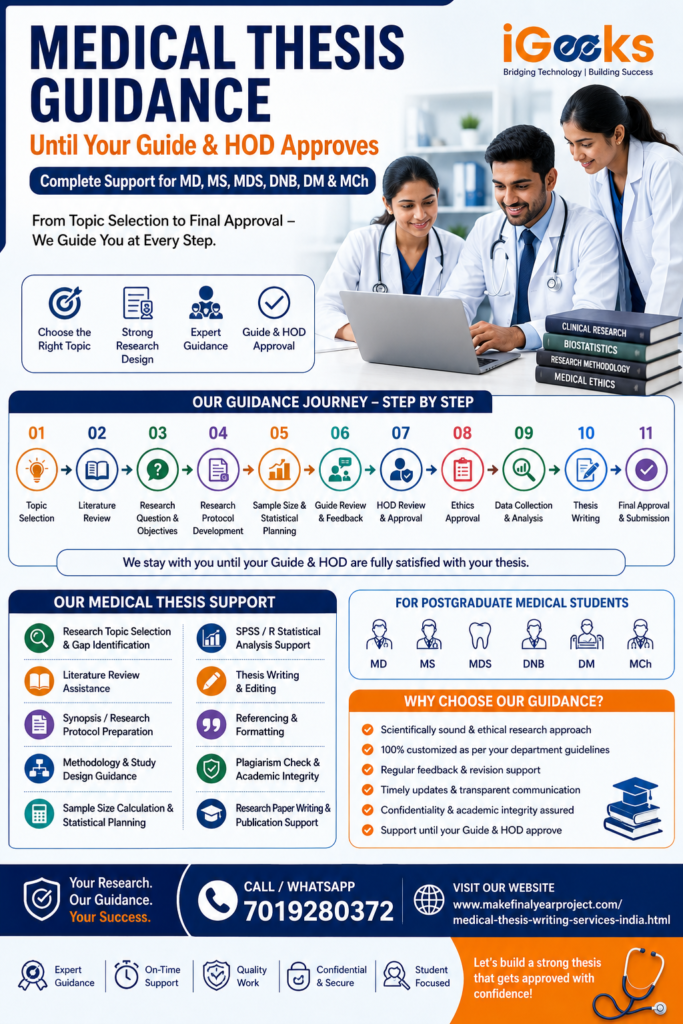
Completing a postgraduate medical thesis is a major academic responsibility. For students pursuing MD, MS, MDS, DNB, DM, or MCh, the process often begins with an idea and develops through several stages of discussion, modification, protocol preparation, and academic review.
One of the most important stages is obtaining approval from your thesis guide and Head of Department (HOD) before moving forward with the research.
A good thesis topic is not simply one that sounds interesting. It should be clinically or academically relevant, feasible, methodologically sound, ethically appropriate, and acceptable to your department and institution.
This blog explains how structured medical thesis guidance can support postgraduate students from the initial research idea through guide and HOD approval and subsequent stages of the research process.
Why Guide & HOD Approval Matters
Your thesis guide and HOD play an important role in ensuring that the proposed research is suitable for the department and institution.
They may evaluate:
- Relevance of the research topic
- Originality and research gap
- Feasibility
- Availability of patients or study participants
- Sample size
- Study duration
- Methodology
- Available resources
- Ethical considerations
- Statistical approach
- Expected academic contribution
A topic may need several modifications before it becomes suitable for formal submission.
The goal of thesis guidance should therefore be to help you develop a scientifically sound proposal—not to bypass your guide or institutional approval process.
Who Can Benefit From Medical Thesis Guidance?
Structured research support can be useful for postgraduate students in:
MD
Students from specialties such as:
- General Medicine
- Pediatrics
- Dermatology
- Psychiatry
- Anesthesiology
- Radiodiagnosis
- Pathology
- Pharmacology
- Microbiology
- Community Medicine
- Respiratory Medicine
- Emergency Medicine
MS
Including:
- General Surgery
- Orthopedics
- Obstetrics & Gynecology
- Ophthalmology
- ENT
MDS
Research may involve:
- Oral Medicine
- Oral Surgery
- Orthodontics
- Periodontology
- Prosthodontics
- Conservative Dentistry
- Pediatric Dentistry
DNB
DNB trainees may require assistance with research planning, protocol development, statistical analysis, thesis documentation, and manuscript preparation.
DM & MCh
Super-specialty research often requires particularly careful attention to:
- Research design
- Patient selection
- Clinical variables
- Outcome measures
- Statistical methodology
- Ethical considerations
- Scientific documentation
Stage 1: Understanding Your Research Interest
The first step is to identify an area that interests you academically and clinically.
Ask yourself:
- What clinical problem interests me?
- What problem do I see regularly in my department?
- Is there an unanswered research question?
- Is sufficient literature available?
- Can I access the required patients or data?
- Can the research realistically be completed within the available time?
A good research idea should be transformed into a specific and researchable question.
Stage 2: Selecting a Suitable Thesis Topic
Topic selection is one of the most important parts of the thesis process.
A good topic should ideally be:
Relevant
It should address a meaningful clinical, scientific, or healthcare issue.
Feasible
You should have access to the required participants, investigations, equipment, and data.
Specific
Avoid topics that are excessively broad.
Researchable
There should be measurable variables and an appropriate method of investigation.
Supported by Literature
Previous research should provide enough background while still leaving room for a meaningful research question.
Stage 3: Identifying the Research Gap
A thesis should not simply repeat what is already well established.
Conduct a literature review to identify:
- What previous studies have found
- Where studies disagree
- What populations have not been adequately studied
- Which methodologies have limitations
- What questions remain unanswered
The research gap provides the rationale for your proposed study.
Stage 4: Developing the Research Question
Once the research area is identified, convert it into a clear research question.
For example:
Does a particular intervention improve a defined clinical outcome among a specified patient population?
A well-defined research question helps determine:
- Study design
- Population
- Variables
- Sample size
- Data collection
- Statistical analysis
Stage 5: Preparing Aim and Objectives
Your aim describes the overall purpose of the study.
Your objectives break the aim into measurable components.
Objectives should generally be:
- Specific
- Measurable
- Relevant
- Achievable
- Clearly connected to the research question
Avoid objectives that cannot realistically be measured using your proposed methodology.
Stage 6: Developing the Synopsis / Research Protocol
A strong protocol forms the foundation of the thesis.
Depending on institutional requirements, it may include:
- Title
- Introduction
- Background
- Rationale
- Research question
- Aim
- Objectives
- Hypothesis, where applicable
- Review of literature
- Study design
- Study setting
- Study population
- Sample size
- Inclusion criteria
- Exclusion criteria
- Methodology
- Data collection procedure
- Outcome measures
- Statistical analysis plan
- Ethical considerations
- References
- Timeline
The exact format should always follow the requirements of your university and institution.
Stage 7: Sample Size and Statistical Planning
Sample size should not be selected simply because a particular number is convenient.
It may depend on:
- Study design
- Primary outcome
- Expected effect size
- Prevalence or variability
- Statistical power
- Significance level
- Expected attrition/dropout
Statistical planning should ideally occur before data collection.
This can help prevent situations where the study reaches completion but the collected data cannot adequately answer the research question.
Stage 8: Preparing for Guide Review
Before approaching your guide, make sure the proposal is logically organized.
Your discussion with the guide may cover:
- Topic relevance
- Research gap
- Objectives
- Methodology
- Sample size
- Study duration
- Feasibility
- Outcome variables
- Statistical analysis
- Ethical considerations
Your guide may ask you to modify the topic or methodology.
This is a normal part of the research-development process.
Stage 9: Incorporating Guide Corrections
One of the most important parts of thesis preparation is responding systematically to feedback.
Common guide corrections may involve:
- Changing the title
- Narrowing the research question
- Revising objectives
- Adding literature
- Changing inclusion criteria
- Revising methodology
- Modifying outcome measures
- Recalculating sample size
- Improving the statistical plan
- Correcting references
Do not treat corrections as a setback.
Each revision can make the protocol more scientifically defensible.
Stage 10: Preparing for HOD Review
Once the guide is satisfied with the proposal, the research may proceed through the department’s required review process.
The HOD may evaluate:
- Departmental relevance
- Feasibility
- Patient availability
- Resources
- Workload implications
- Methodology
- Research objectives
- Academic value
Students should be prepared to explain their research clearly and confidently.
Stage 11: Finalizing the Approved Proposal
After receiving feedback, prepare the revised version according to your institution’s requirements.
Before considering the proposal finalized, verify:
☑ Title
☑ Research question
☑ Aim
☑ Objectives
☑ Study design
☑ Sample size
☑ Inclusion/exclusion criteria
☑ Methodology
☑ Outcome measures
☑ Statistical plan
☑ References
☑ Ethical considerations
Maintain a record of the versions and corrections made during the review process.
Stage 12: Ethics Committee Approval
Guide or HOD approval does not necessarily replace ethics approval.
Where human participants are involved, the appropriate institutional ethics process must be followed before beginning research activities that require approval.
Important areas include:
- Informed consent
- Confidentiality
- Participant safety
- Data protection
- Risk-benefit considerations
- Vulnerable participants
Do not begin data collection simply because a draft proposal has received informal departmental approval. Follow your institution’s formal approval requirements.
Stage 13: Data Collection
Once all required approvals are in place, data collection should follow the approved methodology.
Maintain:
- Accurate records
- Consistent measurements
- Proper documentation
- Secure data storage
- Regular data verification
Avoid altering the research methodology simply to obtain a desired result.
Stage 14: Statistical Analysis
After data collection, appropriate statistical analysis should be performed according to the study design and predefined analysis plan.
Possible methods include:
- Descriptive statistics
- Chi-square tests
- t-tests
- ANOVA
- Correlation
- Regression
- Diagnostic accuracy analysis
- Survival analysis
Software such as SPSS or R may be used where appropriate.
The software is only a tool—the statistical method must be scientifically appropriate for the data and research question.
Stage 15: Thesis Writing
After analysis, the thesis can be developed into a complete academic document.
A typical medical thesis structure includes:
Chapter 1 – Introduction
Background, rationale, research problem, aim, and objectives.
Chapter 2 – Review of Literature
Relevant previous research and identification of the research gap.
Chapter 3 – Materials and Methods
Detailed methodology, participants, sample size, data collection, and statistical plan.
Chapter 4 – Results
Presentation of findings using appropriate tables and figures.
Chapter 5 – Discussion
Interpretation and comparison of findings with previous studies.
Chapter 6 – Conclusion
Concise conclusions based on the research findings.
References and Annexures
Relevant sources and supporting documents.
Common Reasons Medical Thesis Proposals Need Revisions
Students may be asked to revise their proposals because of:
❌ An overly broad topic
❌ Weak research rationale
❌ Unclear objectives
❌ Insufficient literature review
❌ Inappropriate study design
❌ Inadequate sample-size justification
❌ Unclear inclusion/exclusion criteria
❌ Poorly defined outcome measures
❌ Inappropriate statistical methodology
❌ Feasibility concerns
❌ Formatting or referencing problems
These issues can often be identified and addressed before formal submission.
How Professional Medical Thesis Guidance Can Help
Professional research guidance can help students organize their work at different stages.
Research Topic Guidance
Evaluate possible topics based on relevance, feasibility, literature availability, and research potential.
Literature Review Support
Organize existing research and identify important research gaps.
Protocol Development
Help structure:
- Research questions
- Objectives
- Study design
- Methodology
- Sampling
- Outcome measures
- Statistical planning
Statistical Guidance
Assist with selecting appropriate statistical approaches and interpreting statistical outputs.
Academic Writing
Improve the clarity, organization, scientific language, and consistency of the thesis.
Formatting and Referencing
Help ensure the document follows the required institutional format.
Revision Support
Organize and incorporate legitimate corrections provided by the guide, HOD, or institution.
Why Start Thesis Preparation Early?
Postgraduate medical students have demanding clinical responsibilities.
Waiting until the final months can create significant pressure.
Starting early allows time for:
Topic Selection → Literature Review → Protocol → Guide Review → HOD Review → Ethics Approval → Data Collection → Analysis → Thesis Writing → Corrections → Final Submission
Early preparation gives you more time to address unexpected delays.
Important: Your Guide and Institution Remain the Final Authority
Professional thesis guidance should support your academic process, not replace it.
Your:
- Thesis guide
- HOD
- Department
- University
- Institutional Ethics Committee
remain the appropriate authorities for approving your research.
Any changes requested by them should be addressed according to institutional procedures.
Students should also remain responsible for the authenticity of their data, research decisions, interpretation, and final academic submission.
Complete Medical Thesis Guidance for MD, MS, MDS, DNB, DM & MCh
At Igeeks Technologies, structured academic and research support can be provided across different stages of postgraduate medical research.
Our Support Areas
✔ Research Topic Selection
✔ Research Gap Identification
✔ Literature Review Support
✔ Research Protocol Development
✔ Synopsis Preparation
✔ Methodology Guidance
✔ Sample Size & Statistical Planning
✔ SPSS / R Statistical Support
✔ Thesis Writing & Editing
✔ Referencing & Formatting
✔ Plagiarism & Academic Integrity Support
✔ Research Paper Preparation
✔ Publication Support
✔ Revision Support Based on Guide/HOD Feedback
Our Objective
To help postgraduate medical students prepare a structured, scientifically sound thesis proposal and improve it through the required academic review process.
Final Checklist Before Guide & HOD Approval
Before submitting your proposal for review, ask:
Research
☐ Is the research question clear?
☐ Is the topic clinically/academically relevant?
☐ Is there a genuine research gap?
Methodology
☐ Is the study design appropriate?
☐ Is the sample size justified?
☐ Are inclusion/exclusion criteria clear?
☐ Are outcome measures defined?
Statistics
☐ Is the analysis plan appropriate?
☐ Are the statistical tests suitable for the data?
Academic
☐ Is the literature review current and relevant?
☐ Are references accurate?
☐ Does the protocol follow university requirements?
Ethics
☐ Have all required approvals been identified?
☐ Are consent and confidentiality requirements addressed?
Feasibility
☐ Can the study be completed within the available time?
☐ Are patients/data/resources available?
Conclusion
Getting a medical thesis approved is a process of research development, academic discussion, and revision. A strong thesis proposal is built through careful topic selection, literature review, research-gap identification, sound methodology, statistical planning, and repeated feedback from your guide and HOD.
Whether you are pursuing MD, MS, MDS, DNB, DM, or MCh, starting early and working systematically can make the thesis journey significantly more manageable.
If you need structured support with your research protocol, synopsis, literature review, statistical planning, thesis writing, or revisions, professional academic guidance can help you organize the process while keeping your work aligned with your institution’s requirements.
📞 Need Medical Thesis Guidance?
For MD | MS | MDS | DNB | DM | MCh Students
Call / WhatsApp: 7019280372
🌐 Medical Thesis Writing & Research Support:
Medical Thesis Writing Services India
Start early. Prepare scientifically. Take your guide’s feedback seriously. Submit with confidence.