

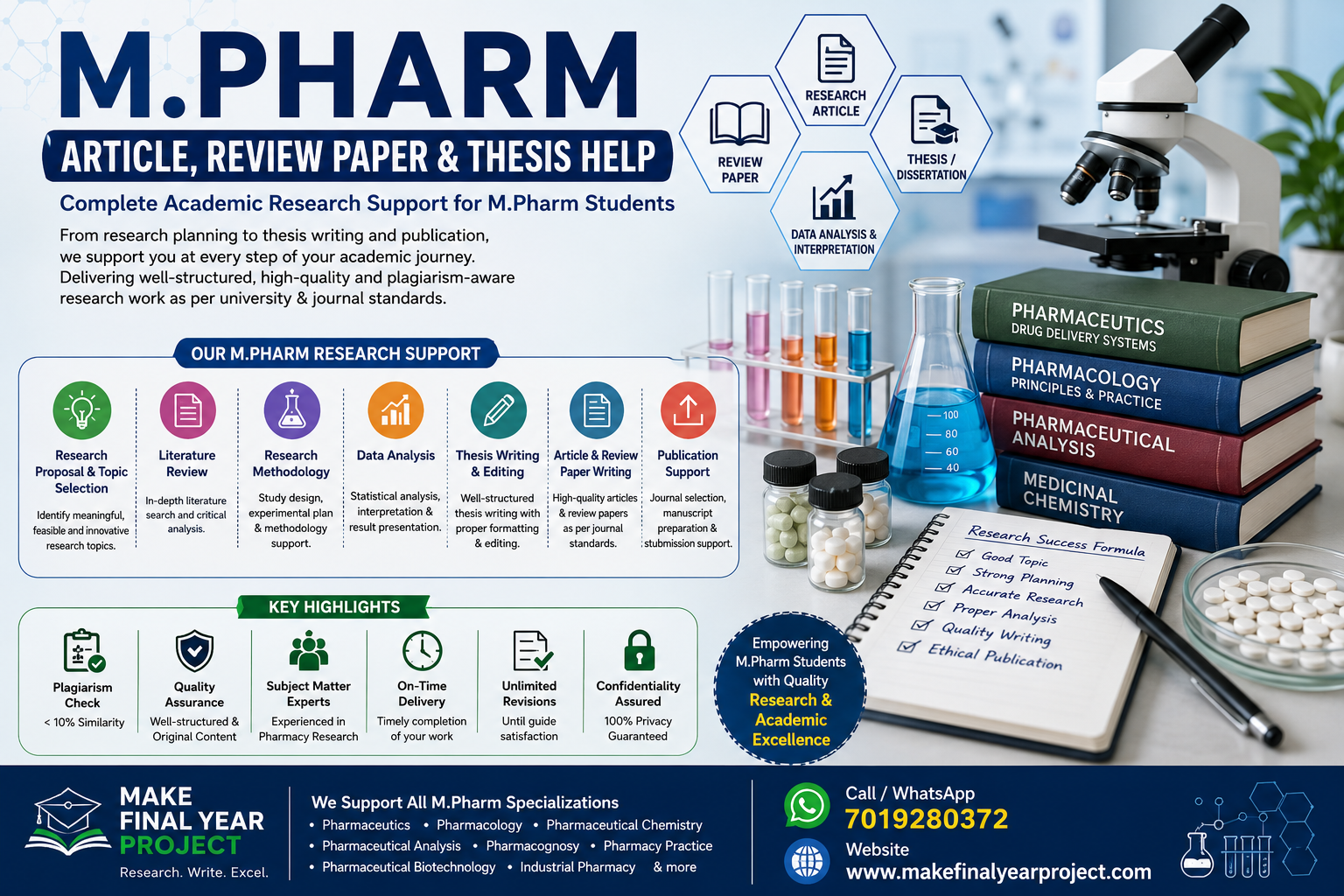
Choosing the right dissertation topic is one of the most important decisions in an M.Pharm (Master of Pharmacy) programme. A well-selected research topic can help students develop scientific knowledge, improve research skills, explore innovative pharmaceutical technologies, and build a strong academic profile.
However, many M.Pharm students find it difficult to identify a suitable research problem, understand research gaps, select an appropriate methodology, and determine whether their proposed topic can be completed within the available time and budget.
This guide explains how to select an M.Pharm dissertation topic, identify research opportunities, and plan a successful pharmaceutical research project.
1. Understand Your M.Pharm Specialization
The first step is to identify your area of specialization. Your dissertation topic should be closely related to your department and research interests.
Some popular M.Pharm specializations and their research areas include:
A. M.Pharm Pharmaceutics
Pharmaceutics focuses on formulation development, drug delivery systems, and pharmaceutical technology.
Potential research areas:
Novel Drug Delivery Systems (NDDS)
Nanoparticle-based drug delivery
Sustained and controlled-release formulations
Transdermal drug delivery systems
Herbal drug formulations
Microspheres and nanoparticles
Gastroretentive drug delivery systems
Liposomal drug delivery
Solubility enhancement techniques
B. M.Pharm Pharmaceutical Analysis
This specialization focuses on analytical techniques, drug quality evaluation, and method development.
Potential research areas:
HPLC method development and validation
Stability-indicating analytical methods
UV-Visible spectrophotometric analysis
RP-HPLC analytical methods
Pharmaceutical impurity profiling
Forced degradation studies
Analytical method validation according to ICH guidelines
Dissolution method development
C. M.Pharm Pharmacology
Pharmacology research focuses on drug action, therapeutic effects, and biological evaluation.
Potential research areas:
In-vitro pharmacological studies
In-vivo evaluation of drug activity
Antioxidant activity of plant extracts
Anti-inflammatory activity
Antidiabetic activity
Neuroprotective activity
Drug toxicity evaluation
Pharmacological evaluation of herbal compounds
D. M.Pharm Pharmacognosy
Pharmacognosy focuses on natural products, medicinal plants, and herbal drug research.
Potential research areas:
Phytochemical screening
Extraction and isolation of bioactive compounds
Standardization of herbal formulations
Antioxidant evaluation of medicinal plants
Herbal formulation development
HPTLC fingerprinting
Evaluation of medicinal plant extracts
E. M.Pharm Pharmacy Practice
This specialization focuses on clinical pharmacy, patient care, and healthcare outcomes.
Potential research areas:
Medication adherence among diabetic patients
Assessment of adverse drug reactions
Drug utilization evaluation
Pharmacovigilance studies
Medication error assessment
Clinical pharmacist interventions
Patient counselling and medication safety
Quality of life assessment among chronic disease patients
2. Identify a Research Gap
A dissertation should address a specific research problem rather than simply repeat an existing study.
A research gap refers to an area where existing studies have limitations, unanswered questions, or opportunities for further investigation.
Follow these steps to identify a research gap:
Search recent research articles related to your specialization.
Review publications from 2020–2026.
Identify limitations mentioned by previous researchers.
Compare the methodologies and results of existing studies.
Identify opportunities to improve formulations, analytical methods, or research outcomes.
Develop a research question based on the identified gap.
For example:
Existing research: Several studies have developed conventional drug formulations for a particular therapeutic application.
Possible research gap: Limited comparative evaluation of different polymer concentrations and their influence on drug release behaviour.
Proposed research direction: Formulation and evaluation of a sustained-release drug delivery system using selected pharmaceutical polymers.
A clearly defined research gap makes your dissertation more meaningful and scientifically relevant.
3. Consider the Availability of Research Facilities
Before finalizing your dissertation topic, evaluate whether your college or research laboratory has the necessary infrastructure.
Consider the following:
Availability of laboratory equipment
Access to HPLC, UV spectrophotometer, FTIR, DSC, and other instruments
Availability of chemicals, reagents, and reference standards
Access to cell culture or animal research facilities, where applicable
Availability of suitable datasets or clinical research participants
Institutional approvals and ethical committee requirements
Availability of research supervisors
Avoid selecting a topic that requires expensive equipment or specialized facilities that are not accessible to you.
4. Evaluate the Research Time and Budget
M.Pharm dissertation projects generally have a limited research period. Therefore, the proposed research should be achievable within the academic schedule.
Evaluate:
Research material and chemical costs
Instrumentation and testing expenses
Sample collection requirements
Laboratory availability
Data analysis requirements
Publication-related expenses, if applicable
Time required for experimentation and documentation
A focused research topic with clearly defined objectives is generally more manageable than an excessively broad research project.
5. Review Recent Research Publications
Literature review is an essential part of selecting a dissertation topic.
Students should explore reliable scientific databases and research platforms.
Recommended resources:
PubMed
Google Scholar
ScienceDirect
SpringerLink
Wiley Online Library
Scopus
Web of Science
Semantic Scholar
Focus on recent research articles, systematic reviews, and relevant experimental studies.
While reviewing research papers, note:
Research objectives
Materials and methods
Experimental design
Analytical techniques
Major findings
Research limitations
Future research recommendations
These observations can help you identify a feasible and relevant dissertation topic.
6. Prepare a Preliminary Research Proposal
Once you identify a suitable topic, prepare a preliminary research proposal.
A well-structured M.Pharm dissertation proposal should include:
Proposed research title
Introduction and background
Research problem
Research gap
Aim of the study
Specific research objectives
Review of literature
Proposed methodology
Materials and instruments required
Expected outcomes
References
Discuss your proposal with your research supervisor before proceeding with the experimental work.
7. Common Mistakes to Avoid When Selecting an M.Pharm Topic
Many students face difficulties because they finalize their research topics without evaluating feasibility.
Avoid these common mistakes:
Selecting a topic only because it sounds innovative.
Copying an existing dissertation title without identifying a research gap.
Choosing a topic without reviewing recent publications.
Ignoring the availability of laboratory facilities.
Selecting a research area beyond the available budget.
Defining too many research objectives.
Underestimating the time required for experimentation.
Ignoring statistical analysis and data interpretation.
Starting experimental work without a clear methodology.
8. How Igeeks Can Support Your M.Pharm Dissertation Journey
Selecting a dissertation topic is only the beginning of your research journey. Students may also need academic and technical guidance at different stages of their dissertation.
Igeeks Technologies – MakeFinalYearProject.com provides customized academic research guidance for M.Pharm students across different pharmaceutical specializations.
Our support areas include:
M.Pharm dissertation topic selection guidance
Research gap identification
Research proposal and synopsis preparation
Literature review guidance
Pharmaceutics formulation research guidance
NDDS research planning
HPLC method development and validation guidance
Pharmaceutical analytical research
SPSS and statistical analysis support
Research data interpretation
Dissertation structuring and documentation
Research paper writing and journal publication support
Our team helps students understand their research requirements and plan their academic work according to their university guidelines.
All research activities, experimental work, data collection, and academic submissions should comply with institutional requirements and research ethics.
9. Frequently Asked Questions (FAQs)
Q1. How do I select the best M.Pharm dissertation topic?
Select a topic based on your specialization, research interests, recent literature, research gap, available laboratory facilities, time, and budget.
Q2. Which specialization has good research opportunities in M.Pharm?
Pharmaceutics, Pharmaceutical Analysis, Pharmacology, Pharmacognosy, and Pharmacy Practice all offer research opportunities. The best choice depends on your interests, facilities, and research objectives.
Q3. Can I select an M.Pharm dissertation topic based on published research papers?
Yes. Published research papers are useful for identifying research gaps and developing new research questions. However, your dissertation should have a clearly defined and independently justified research contribution.
Q4. How many research objectives should an M.Pharm dissertation have?
The number depends on the scope of the study. Typically, three to five focused objectives may be sufficient for a manageable dissertation, subject to your university and supervisor’s requirements.
Q5. Can I publish my M.Pharm dissertation research?
Yes. Research findings may be developed into a research article or review paper, provided the work meets the journal’s scope, originality, methodological, and ethical requirements.
Q6. Can I get help with M.Pharm research topic selection and statistical analysis?
Yes. Academic guidance is available for topic selection, proposal development, methodology planning, SPSS analysis, and research documentation.
Conclusion
Selecting the right M.Pharm dissertation topic requires careful planning, literature review, research gap identification, and feasibility assessment.
Students should focus on selecting a scientifically relevant research problem that matches their specialization, available facilities, academic requirements, and research timeline.
A well-planned dissertation can strengthen your pharmaceutical knowledge, research capabilities, and future academic or professional opportunities.
Need guidance for your M.Pharm dissertation?
Connect with Igeeks Technologies for customized M.Pharm research guidance, dissertation planning, statistical analysis, and research paper support.
Website: https://www.makefinalyearproject.com
Email: nanduigeeks2010@gmail.com
Contact our team with your specialization, research area, and university requirements to discuss your dissertation needs.