
For most of a PhD, the goal feels singular: finish the thesis, pass the viva, get the degree. But what comes after is a question many scholars don’t seriously address until it’s suddenly urgent — often in the final year, when research demands are still high and career decisions feel rushed. The scholars who transition smoothly into their next role are rarely the ones who figure it out at the last minute; they’re the ones who started planning early, alongside their research.
Here’s a practical guide to building a PhD-to-career transition plan well before you need one.
Why This Deserves Planning, Not Just Reaction
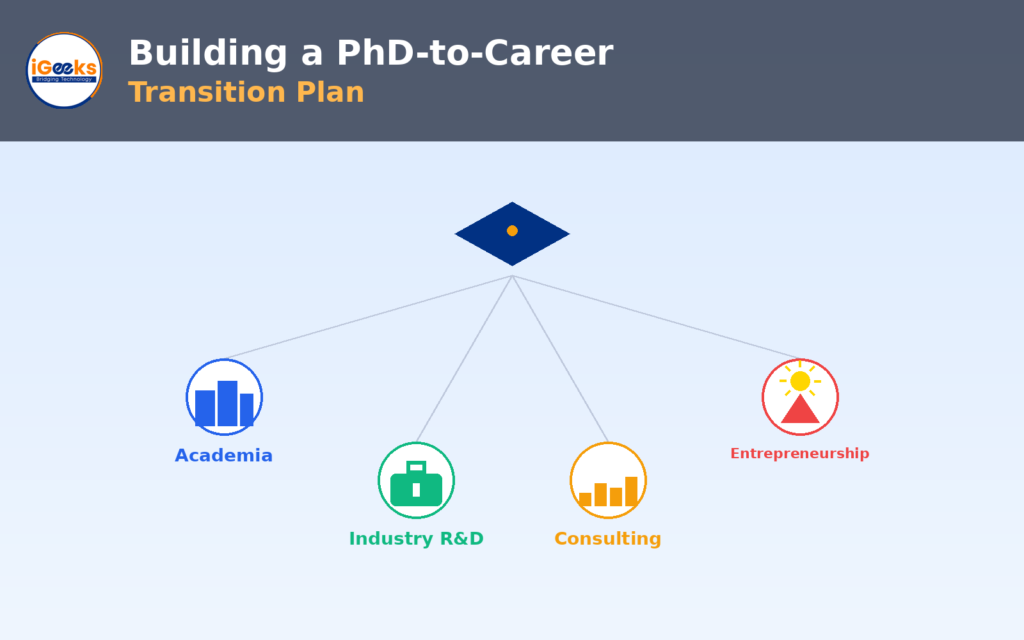
A PhD develops deep expertise, but the career paths available afterward are broader — and less obvious — than many scholars initially assume. Common paths include:
- Academia — postdoctoral research, teaching positions, tenure-track roles
- Industry research and R&D — corporate research labs, product development, innovation teams
- Consulting — leveraging deep analytical and research skills in strategic or specialized consulting roles
- Government and policy — research-informed roles in public sector or policy institutions
- Entrepreneurship — building on research with direct commercial or social application
- Data science and analytics — a increasingly common path for scholars with strong quantitative skills, regardless of original field
Without deliberate planning, many scholars default to academia simply because it’s the most familiar path — not necessarily because it’s the best fit for their actual goals and strengths.
1. Start the Reflection Early — Ideally by Your Second or Third Year
Career clarity doesn’t need to mean a final decision years in advance, but early reflection helps you make more intentional choices along the way. Useful questions to revisit periodically:
- Do I enjoy the process of research itself, or am I more drawn to applying findings to real problems?
- Am I energized by teaching and mentoring, or does it feel like a distraction from research?
- Do I want to stay closely tied to my specific PhD topic, or am I open to applying my skills more broadly?
- What parts of my PhD work (data analysis, writing, project management, stakeholder communication) do I genuinely enjoy?
These reflections often shift over the course of a PhD — which is exactly why starting early, rather than deciding everything upfront, tends to produce better outcomes.
2. Audit Your Transferable Skills Honestly
PhD scholars often undersell how broadly applicable their skills are outside academia. Beyond deep subject expertise, most PhDs develop:
- Advanced data analysis and research methodology skills
- Strong technical and academic writing ability
- Project management across long, complex, multi-year work
- The ability to synthesize large amounts of information quickly
- Resilience and independent problem-solving under uncertainty
- Experience communicating complex ideas to varied audiences (supervisors, committees, students)
Explicitly mapping these skills to the language used in non-academic job descriptions is often the biggest translation challenge scholars face when moving outside academia.
3. Build Your Network Before You Need It
Networking during a PhD often gets deprioritized in favor of research demands, but relationships built early are far more valuable than a rushed outreach effort in your final months. Practical ways to build this over time:
- Attend conferences with an eye toward both academic and industry contacts, where relevant
- Engage with alumni from your program who’ve moved into different sectors
- Join professional associations or online communities relevant to your target industry, not just your academic field
- Consider informational interviews with people in roles you’re curious about — most professionals are open to a short conversation
4. Gain Relevant Experience Alongside Your Research
Where possible, look for opportunities during your PhD that build experience relevant to your target path:
- For academia — teaching experience, conference presentations, journal publications, grant writing exposure
- For industry — internships, industry-sponsored research projects, consulting side projects, collaborations with corporate partners
- For consulting or policy — case competitions, policy briefs, guest analysis work, cross-disciplinary projects
Even limited exposure to your target field can meaningfully strengthen both your applications and your own clarity about fit.
5. Translate Your Thesis Into Career-Ready Materials Early
Waiting until after your viva to think about your CV, LinkedIn profile, or portfolio often creates unnecessary last-minute pressure. Start building these in parallel with your final thesis stages:
- Draft an academic CV and a separate, non-academic resume — the two formats differ significantly in structure and emphasis
- Translate your thesis’s core contribution into a concise, non-technical summary you can use in interviews or informal conversations
- Identify 2-3 specific projects or findings from your PhD that clearly demonstrate skills relevant to your target roles
6. Understand the Different Timelines Involved
Academic and industry hiring cycles often run on very different schedules:
- Academic positions (postdocs, faculty roles) often have long application-to-start timelines, sometimes 6-12 months, tied to specific hiring seasons
- Industry roles can move considerably faster, sometimes within weeks, but may require more targeted, role-specific applications
Understanding these differing timelines helps you plan your final PhD year realistically, rather than assuming all paths move at the same pace.
7. Give Yourself Permission to Change Direction
It’s common for scholars to feel locked into the path they assumed at the start of their PhD, even after years of research reveal a genuine preference for a different direction. A shift toward industry, policy, or an entirely different field isn’t a failure of the PhD — it’s simply a more informed decision made with years of additional self-knowledge.
A Quick Career Planning Self-Check
- Have I reflected specifically on what parts of my PhD work I enjoy most, beyond just my research topic?
- Can I clearly articulate my transferable skills in language relevant to non-academic roles, if needed?
- Am I building relevant network connections before I urgently need them?
- Have I sought out experience — teaching, industry, consulting — aligned with my likely direction?
- Do I have a realistic sense of the application timelines for my target path?
Focus on Finishing Strong — We’ll Help With the Thesis
A clear career plan matters, but so does finishing your PhD with a thesis you’re genuinely proud of. If you’d like support with your writing, data analysis, or thesis structuring so you can dedicate more energy to your career transition, we’re here to help.
Explore our PhD Thesis Help services in Bangalore: 👉 www.makefinalyearproject.com/phd-thesis-help-bangalore.aspx
Have a question? Reach out directly on WhatsApp: 📲 +91 70192 80372
Your PhD is a launchpad, not just an endpoint — let’s help you finish strong and move forward with clarity.