
After years of research, the idea of thesis rejection or major revision is one of the most stressful possibilities a PhD scholar faces. The good news: outright rejections are relatively rare, and most of the reasons theses run into serious trouble are well-known, well-documented, and avoidable with the right preparation. Understanding these common pitfalls early can help you build safeguards into your research and writing process long before submission.
Here’s a practical look at why PhD theses most often get rejected or sent back for major revisions — and how to avoid each one.
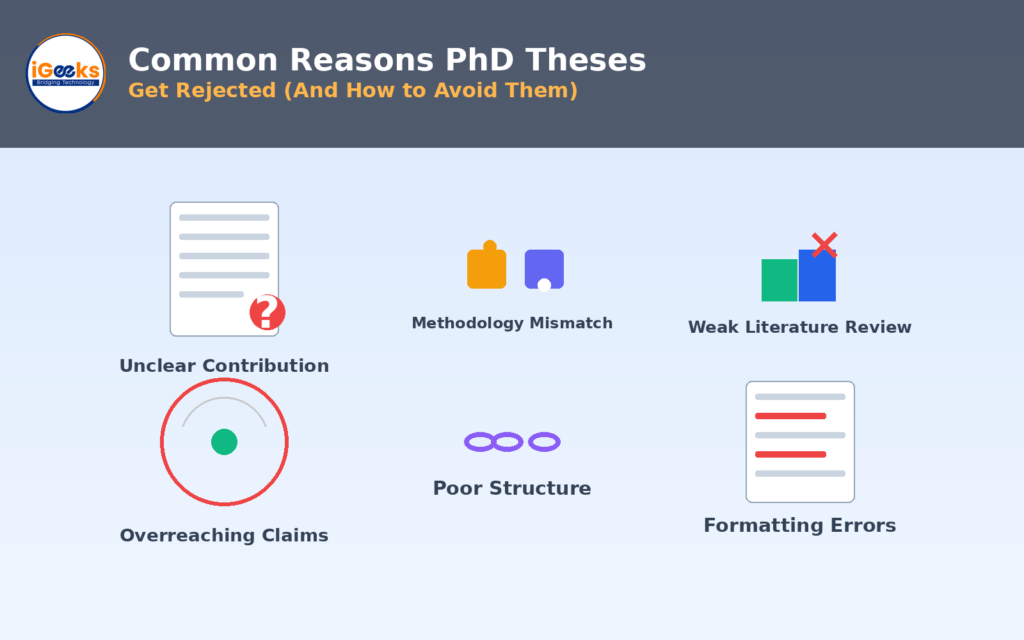
1. Unclear or Weak Research Contribution
The problem: Examiners consistently cite an unclear or insufficiently original contribution as one of the most common reasons for rejection. If a thesis doesn’t clearly articulate what’s new — theoretically, practically, or contextually — examiners are left asking, “So what?”
How to avoid it: Make your contribution explicit, not implied. Your introduction and conclusion should both clearly state what your research adds to existing knowledge, and your literature review should build a clear case for the gap your study fills.
2. Methodology That Doesn’t Match the Research Questions
The problem: A mismatch between what you’re trying to find out and how you’re trying to find it out undermines an examiner’s confidence in your results — even if your writing is otherwise strong.
How to avoid it: Every methodological choice should be explicitly justified in relation to your specific research questions, not simply described. If you’re using a particular method because it’s familiar rather than because it’s the best fit, that’s a sign to revisit your approach before submission.
3. Insufficient Engagement With Existing Literature
The problem: A thesis that either ignores key relevant work or engages with literature only superficially raises doubts about how well the scholar understands their own field.
How to avoid it: Ensure your literature review critically engages with — not just lists — the most relevant and recent work in your area. Examiners often check whether major, well-known studies in the field are meaningfully addressed.
4. Weak or Inconsistent Data Analysis
The problem: Errors in statistical analysis, misapplied tests, or conclusions that aren’t actually supported by the data are among the most common technical issues examiners flag — sometimes serious enough to require a full re-analysis.
How to avoid it: Have your analysis reviewed by someone with strong statistical or methodological expertise before submission, ideally before your data collection is even complete, to confirm your planned tests are appropriate for your research design.
5. Overreaching Conclusions
The problem: Claiming broader significance than the data actually supports — generalizing findings from a small or specific sample to a much wider population, for instance — is a common and avoidable weakness.
How to avoid it: Be precise and honest about the scope of your findings. Clearly state your study’s limitations, and frame conclusions in proportion to what your specific data and methodology can actually support.
6. Poor Structure and Argument Flow
The problem: Even strong research can be undermined by a thesis that reads as disconnected chapters rather than a coherent argument — where the literature review doesn’t clearly justify the research questions, and the discussion doesn’t clearly connect back to the literature.
How to avoid it: Before submission, read your thesis as a single argument, not a set of separate deliverables. Each chapter should visibly build on the last, and your discussion should explicitly return to the gap identified in your literature review.
7. Inadequate Discussion of Limitations
The problem: Some scholars avoid discussing their study’s limitations, worried it will weaken their work. In reality, examiners view an honest, well-reasoned limitations section as a sign of academic maturity — and its absence as a red flag.
How to avoid it: Dedicate proper space to discussing your study’s limitations candidly, along with how they might be addressed in future research. This strengthens, rather than weakens, your thesis’s credibility.
8. Formatting, Referencing, and Presentation Errors
The problem: While rarely a sole cause of rejection, inconsistent formatting, citation errors, or a messy reference list can seriously undermine an examiner’s confidence in the rigor of your work — and in more borderline cases, can tip a decision toward major revisions.
How to avoid it: Treat formatting and referencing as a distinct, dedicated review pass — not something to rush through in the final days before submission.
9. Insufficient Preparation for the Viva
The problem: A well-written thesis can still face serious revision requirements if a scholar struggles to defend their choices, methodology, or findings clearly during the viva voce.
How to avoid it: Prepare specifically for likely questions about your methodology choices, key findings, and limitations — not just a general summary of your thesis. Mock vivas with colleagues or your supervisor are genuinely valuable here.
What to Do If You Receive Major Revisions
Major revisions are common — not a sign of failure. If this happens:
- Read all feedback carefully before reacting, and give yourself time to process it
- Address every point raised, even ones you disagree with, explaining your reasoning where relevant
- Create a clear response document showing exactly what was changed and where
- Ask your supervisor for clarification on any feedback that feels ambiguous
Most scholars who receive major revisions go on to pass — the process exists to strengthen the work, not to end it.
A Pre-Submission Self-Check
Before submitting, ask yourself:
- Is my original contribution stated explicitly, not just implied?
- Does my methodology clearly match my research questions?
- Have I critically engaged with the most relevant literature in my field?
- Has my data analysis been reviewed for accuracy and appropriateness?
- Are my conclusions proportionate to what my data actually supports?
- Does my thesis read as one coherent argument, chapter to chapter?
- Have I honestly and thoroughly discussed my study’s limitations?
- Is my formatting and referencing fully consistent throughout?
- Have I prepared specifically for likely viva questions, not just a general summary?
Submit With Confidence
Avoiding these common pitfalls comes down to careful preparation, honest self-review, and getting a second set of eyes on your work before submission. If you’d like support reviewing your thesis for these exact issues — contribution clarity, methodology alignment, data analysis, or viva preparation — we’re here to help.
Explore our PhD Thesis Help services in Bangalore: 👉 www.makefinalyearproject.com/phd-thesis-help-bangalore.aspx
Have a question? Reach out directly on WhatsApp: 📲 +91 70192 80372
Years of research deserve a thesis that presents it at its strongest — let’s make sure yours does.