

The literature review is often where PhD scholars spend the most time — and where progress can feel the slowest. Unlike a simple summary of what’s been published, a strong literature review builds an argument: it shows exactly where the existing knowledge stops and where your research begins. Done well, it becomes the foundation your entire thesis stands on. Done poorly, it becomes an endless, unfocused reading exercise that never quite turns into writing.
Here’s a practical guide to building a literature review that actually moves your research forward.
What a Literature Review Is Actually For
Before diving into sources, it helps to be clear on the purpose. A literature review should:
- Demonstrate your command of the existing research in your field
- Identify patterns, debates, and gaps across that research
- Build a clear, logical case for why your specific research question matters
- Position your study within (or against) existing theoretical frameworks
A literature review isn’t a list of summaries — it’s a synthesis that leads somewhere specific: your research gap.
1. Start With a Search Strategy, Not Random Reading
Unstructured reading is one of the biggest time drains in the literature review process. Before you start:
- Identify your key concepts and search terms, including synonyms and related terminology
- Use academic databases relevant to your field (Scopus, Web of Science, Google Scholar, JSTOR, discipline-specific databases)
- Set inclusion/exclusion criteria — timeframe, geographic scope, methodology type, publication type
- Keep track of your search terms and databases used, since you may need to describe this systematically, especially for systematic or scoping reviews
A defined search strategy prevents both under-reading (missing key work) and over-reading (endless, unfocused exploration).
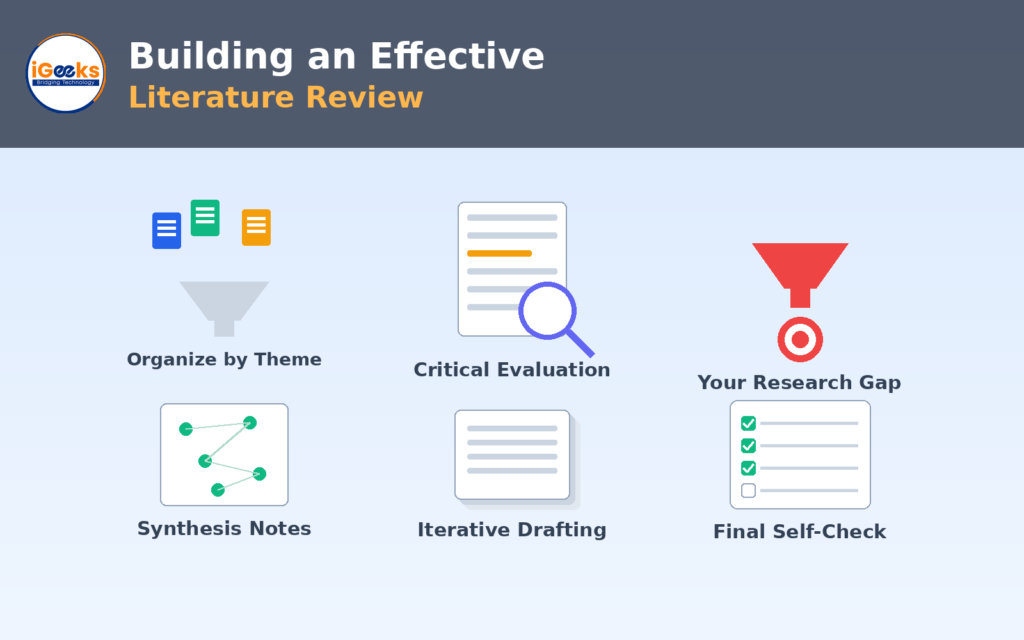
2. Organize Sources by Theme, Not Just by Author
One of the most common structural mistakes is writing a literature review as a list: “Smith (2019) found X. Jones (2020) found Y. Patel (2021) found Z.” This reads as a summary, not an argument.
Instead, organize your review around themes, debates, or concepts:
- Group sources that address similar questions or use similar frameworks
- Identify where sources agree, disagree, or build on each other
- Structure your review around these themes, weaving in multiple sources per theme rather than one source per paragraph
This shift — from author-by-author to theme-by-theme — is often what separates a descriptive summary from a genuine academic argument.
3. Take Notes With Synthesis in Mind From the Start
How you take notes while reading directly affects how easily you can write later. For each source, consider capturing:
- The core argument or finding, in your own words
- The methodology used, and any limitations relevant to your research
- How it connects to other sources you’ve read (agreement, contradiction, extension)
- A specific note on how it relates to your own research question
Capturing connections as you read — rather than trying to reconstruct them later — saves significant time when it comes to writing.
4. Critically Evaluate, Don’t Just Summarize
A strong literature review doesn’t just report what studies found — it evaluates them. For key sources, consider:
- Is the methodology appropriate for the research question being asked?
- Is the sample size or context a limitation on how broadly the findings apply?
- Are there contradictions with other studies, and if so, why might that be?
- Has the field’s understanding of this topic evolved over time, and how?
This critical layer is what demonstrates genuine academic engagement, rather than simply reporting findings at face value.
5. Build Toward Your Research Gap Explicitly
Every section of your literature review should, in some way, build toward your eventual research question. As you write, keep asking:
- What does this section tell us that’s already known?
- What does it reveal that’s still unclear, contested, or unexplored?
- How does this connect to the specific gap my research addresses?
By the end of your literature review, a reader should have a clear sense of exactly what’s missing from current knowledge — and see your research question as a logical next step, not a surprising pivot.
6. Manage the Volume Without Losing Depth
Many scholars either try to cite everything they’ve read (leading to a shallow, list-like review) or narrow too aggressively (missing important context). A more balanced approach:
- Prioritize depth on directly relevant, high-quality sources over breadth across tangentially related ones
- Use recent review articles or meta-analyses (where available) to efficiently understand a field’s overall landscape
- Reserve extensive discussion for studies that most directly inform your research questions or methodology
7. Write Iteratively, Not All at Once
Literature reviews are rarely written in one pass. A more sustainable approach:
- Draft a rough thematic outline before writing full paragraphs
- Write a first pass focused on getting ideas down, then revise for flow and argument strength
- Revisit and refine your literature review as your research develops — new relevant studies may emerge, and your own findings may reshape which existing debates matter most
Common Literature Review Mistakes to Avoid
- Reading indefinitely without writing — set a rough reading cutoff for each theme, then start drafting
- Structuring by source instead of by theme — leads to a list, not an argument
- Uncritical summarizing — presenting every study’s findings as equally valid without evaluation
- Losing sight of the research gap — an interesting review that doesn’t clearly lead to your specific study
- Citation overload — including sources for the sake of a long reference list rather than genuine relevance
A Quick Self-Check Before Finalizing
- Is my review organized by theme rather than by individual source?
- Have I critically evaluated key studies, not just summarized them?
- Does the review clearly build toward the specific gap my research addresses?
- Would a reader unfamiliar with my field understand both what’s known and what’s missing?
- Have I balanced depth on core sources with appropriate breadth across the field?
Get Expert Support With Your Literature Review
Building a literature review that genuinely argues for your research — rather than simply summarizing what’s been published — is a distinct skill from reading itself. If you’d like guidance structuring your review, synthesizing sources thematically, or clearly articulating your research gap, we’re here to help.
Explore our PhD Thesis Help services in Bangalore: 👉 www.makefinalyearproject.com/phd-thesis-help-bangalore.aspx
Have a question? Reach out directly on WhatsApp: 📲 +91 70192 80372
A well-built literature review doesn’t just show what you’ve read — it makes the case for why your research matters.