
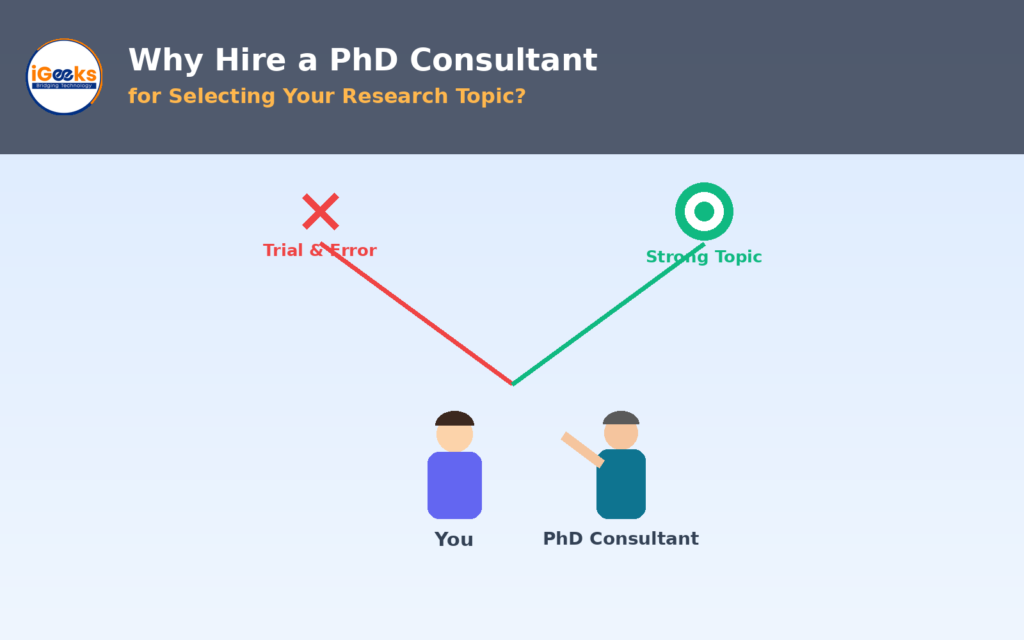
Choosing a research topic is arguably the single most consequential decision of a PhD — everything that follows, from your proposal to your final viva, builds on it. Yet most scholars approach this decision with surprisingly little structured support, relying on trial and error, scattered advice, or whatever direction feels intuitively “interesting” at the time. A PhD consultant brings structure, experience, and an outside perspective to a decision that’s genuinely difficult to make well alone.
Here’s why that support matters more than most scholars initially expect.
The Cost of Getting Your Topic Wrong
A poorly chosen topic doesn’t just create early friction — it creates compounding problems throughout the entire PhD:
- Too broad, and you’ll spend years trying to meaningfully narrow it, often mid-research
- Too narrow, and you may struggle to demonstrate sufficient contribution or find enough literature to build on
- Not genuinely novel, and you risk discovering — sometimes late — that the research gap you identified isn’t actually a gap
- Not feasible, and you may face major obstacles in data access, ethical approval, or timeline once you’re already committed
Many scholars who face major setbacks mid-PhD trace the root cause back to their original topic selection — a decision made under time pressure, without a systematic way to evaluate it.
1. A Consultant Brings Pattern Recognition You Don’t Have Yet
At the start of a PhD, you genuinely don’t yet know what a strong versus weak topic looks like — that judgment develops through experience most scholars are only beginning to build. A consultant who has guided many scholars through this process has seen recurring patterns:
- Which types of topics tend to run into feasibility problems
- Which research gaps are genuinely underexplored versus already well covered
- Which topic framings tend to produce a clear, defensible contribution versus a vague one
This pattern recognition is difficult to develop on your own, precisely because you’re encountering these decisions for the first time.
2. An Outside Perspective Counters Your Own Blind Spots
Scholars often gravitate toward topics based on personal interest, a specific paper that inspired them, or a professor’s suggestion — without necessarily stepping back to evaluate feasibility or genuine novelty objectively. A consultant, without emotional investment in a particular direction, can ask harder, more useful questions:
- Is this topic actually researchable within your timeline and resources?
- Is the “gap” you’ve identified real, or has it already been addressed under different terminology?
- Does this topic align with your actual long-term interests, or does it just sound impressive?
3. Faster Iteration Toward a Strong Topic
Left alone, narrowing a topic often happens slowly — through months of reading, false starts, and conversations with a supervisor who may only meet periodically. A consultant can accelerate this process by:
- Quickly assessing multiple potential topic directions against feasibility and novelty criteria
- Pointing you toward relevant existing literature faster, so you can see what’s already been done
- Helping refine a broad interest into a specific, researchable question in weeks rather than months
This time saved early in a PhD often has an outsized effect on the entire timeline that follows.
4. Alignment With Committee and Institutional Expectations
Different universities, departments, and committees have different — sometimes unwritten — expectations about what counts as a strong, approvable topic. A consultant familiar with your specific academic context can help you:
- Frame your topic in language and structure your committee will find convincing
- Avoid common reasons proposals get sent back for revision at the topic stage
- Understand realistic scope expectations specific to your field and institution
5. Balancing Feasibility With Ambition
A good topic sits in a specific sweet spot: ambitious enough to represent a genuine contribution, but feasible enough to complete within your program’s timeline and resource constraints. Scholars often lean too far in one direction — either overly cautious topics that don’t excite a committee, or overly ambitious ones that aren’t realistically achievable. A consultant helps calibrate this balance based on experience with what’s actually been completed successfully by others.
6. Reducing the Emotional Weight of an Overwhelming Decision
Choosing a research direction that you’ll spend years on carries real psychological weight — and that pressure alone can lead scholars to either freeze indecisively or commit too quickly just to move forward. Having a structured process and expert guidance reduces this pressure considerably, turning an overwhelming open-ended decision into a manageable, systematic one.
What Good Topic Selection Support Actually Looks Like
Effective consultant support for topic selection typically includes:
- Structured discussions to identify your genuine interests and strengths, not just borrowed ideas
- A systematic review of potential gaps in current literature relevant to your interests
- Feasibility assessment covering timeline, data access, and resource requirements
- Iterative refinement — narrowing from a broad area to a specific, researchable question
- Alignment checks against your specific university’s expectations and requirements
A Decision Worth Getting Right
Your research topic shapes years of your academic life — the data you’ll work with, the literature you’ll engage with, and ultimately, the contribution you’ll be known for. Getting expert support at this stage isn’t about outsourcing your thinking; it’s about making a well-informed decision with the benefit of experience you haven’t had the chance to build yet.
Explore our PhD Thesis Help services in Bangalore, including topic selection support: 👉 www.makefinalyearproject.com/phd-thesis-help-bangalore.aspx
Not sure if your topic idea is strong enough? Reach out directly on WhatsApp: 📲 +91 70192 80372
The right topic, chosen well, makes every stage that follows considerably more manageable.