

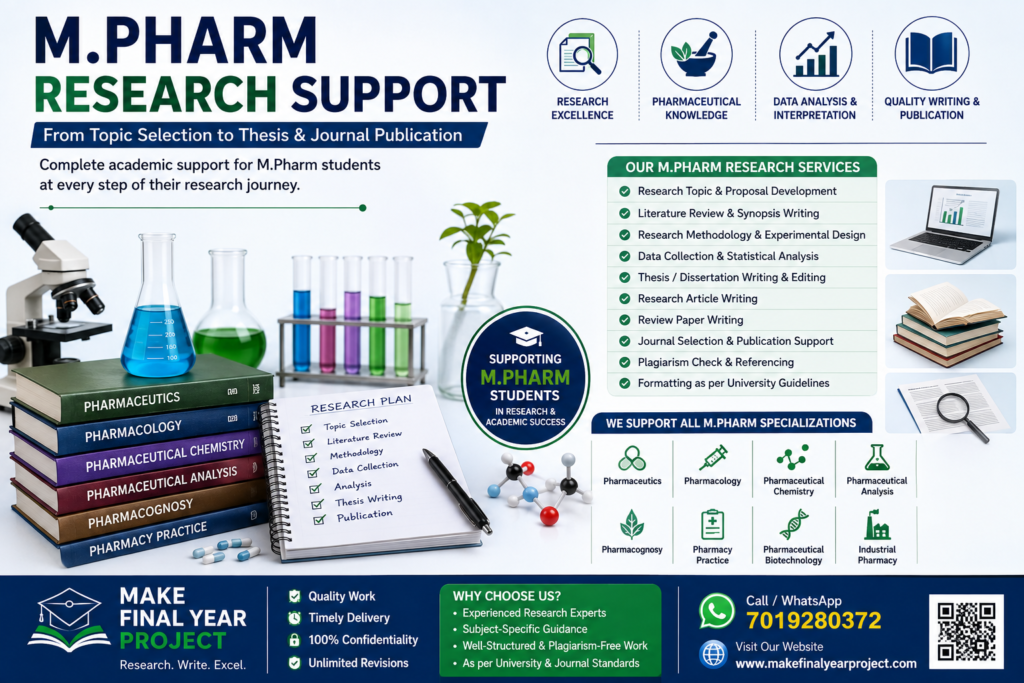
M.Pharm Research Project: From Topic Selection to Thesis and Journal Publication
For M.Pharm students, the research project is one of the most important parts of postgraduate study. A successful project requires more than selecting a topic and collecting data. Students need to develop a clear research question, review existing evidence, follow an appropriate methodology, analyze results and present the work professionally.
Whether you are working on Pharmaceutics, Pharmacology, Pharmaceutical Chemistry, Pharmaceutical Analysis, Pharmacognosy or Pharmacy Practice, a systematic research workflow can make the process much easier.
1. Start With the Right Research Topic
A good M.Pharm topic should be:
- Relevant to pharmaceutical science
- Supported by sufficient scientific literature
- Specific rather than excessively broad
- Feasible with available laboratory facilities
- Appropriate for the available time and resources
- Capable of producing meaningful results
Before finalizing a topic, students should examine previous research and identify a specific research gap.
A useful progression is:
Existing Research → Research Gap → Research Question → Aim → Objectives
2. Conduct a Structured Literature Review
The literature review provides the scientific foundation for the M.Pharm project.
Students should examine relevant:
- Research articles
- Review papers
- Systematic reviews
- Pharmaceutical databases
- Clinical or regulatory literature where relevant
- Recent developments in the selected field
A good literature review should not simply summarize one paper after another.
Instead, it should compare studies and identify:
What is known? What is uncertain? What limitations exist? What needs further investigation?
3. Prepare the Research Proposal or Synopsis
Once the research problem has been identified, the proposal should clearly explain how the study will address it.
A typical M.Pharm proposal may include:
Research Title
A concise description of the proposed study.
Background
Scientific context and importance of the topic.
Research Gap
What previous studies have not adequately addressed.
Aim and Objectives
Specific outcomes the research intends to achieve.
Methodology
The proposed experimental or research approach.
Expected Outcomes
Potential scientific or pharmaceutical significance.
References
Relevant sources supporting the proposal.
The final structure should follow the requirements of the student’s university and department.
4. Choose an Appropriate Research Methodology
Methodology depends heavily on the M.Pharm specialization and research question.
For example, a Pharmaceutics project may involve:
- Formulation development
- Optimization
- Drug-release studies
- Stability studies
- Characterization
A Pharmaceutical Analysis project may involve:
- Analytical method development
- Method validation
- Instrumental analysis
- Assay determination
A Pharmacology project may involve appropriate experimental or observational approaches depending on the research question and applicable ethical requirements.
The methodology should be scientifically justified and documented carefully.
5. Maintain Proper Research Documentation
Students should maintain organized records throughout the project.
Keep track of:
- Experimental procedures
- Observations
- Raw data
- Calculations
- Instrument results
- Statistical analysis
- Literature references
- Changes made during the project
Good documentation makes thesis preparation substantially easier and helps maintain research integrity.
6. Statistical Analysis of M.Pharm Research Data
Many M.Pharm projects generate quantitative experimental data.
Depending on the research design, appropriate statistical approaches may include:
- Descriptive statistics
- t-tests
- ANOVA
- Correlation
- Regression
- Non-parametric tests
- Experimental-design methods
The correct method depends on the research question, experimental design, variables and assumptions.
Statistical analysis should not be selected simply because it is commonly used. It should be scientifically appropriate for the study.
7. Write the M.Pharm Thesis Systematically
A typical thesis structure may include:
Chapter 1 – Introduction
Background, rationale, research problem and objectives.
Chapter 2 – Review of Literature
Critical presentation of relevant previous research.
Chapter 3 – Materials and Methods
Detailed description of materials, instruments and methodology.
Chapter 4 – Results
Presentation of experimental findings using appropriate tables, graphs and figures.
Chapter 5 – Discussion
Interpretation of results and comparison with previous studies.
Chapter 6 – Summary & Conclusion
Key findings and appropriate conclusions.
References
Complete citations of the sources used.
The actual chapter structure should always be checked against the relevant university guidelines.
8. Convert the M.Pharm Thesis Into a Research Article
A completed thesis can potentially provide the foundation for a research manuscript.
However, a thesis and journal article are not the same document.
A journal manuscript generally requires:
- A concise title
- Structured abstract
- Focused introduction
- Condensed methodology
- Key results
- Scientific discussion
- Conclusion
- Journal-specific references
The manuscript should be prepared according to the author guidelines of the selected journal.
9. Review Paper Writing for M.Pharm Students
Students may also prepare review papers on emerging pharmaceutical topics.
A strong review paper should:
- Define a focused topic
- Search relevant literature
- Organize studies into meaningful themes
- Compare findings
- Identify limitations
- Highlight research gaps
- Discuss future directions
Possible areas include:
Novel Drug Delivery Systems | Nanotechnology | Pharmacovigilance | AI in Drug Discovery | Personalized Medicine | Pharmaceutical Biotechnology | Clinical Pharmacy | Advanced Formulation Technologies
10. Avoid Common M.Pharm Research Mistakes
Some common problems include:
❌ Choosing a topic without checking feasibility
❌ Using outdated literature exclusively
❌ Poorly defined objectives
❌ Inadequate research documentation
❌ Selecting inappropriate statistical tests
❌ Copying content from published papers
❌ Inconsistent references
❌ Waiting until the final month to write the thesis
❌ Ignoring university formatting requirements
A better strategy is to develop the thesis alongside the research project, rather than writing everything at the end.
11. Maintain Academic and Research Integrity
M.Pharm students should ensure that their research remains authentic and ethically conducted.
This includes:
- Proper citation of sources
- Accurate reporting of results
- Appropriate authorship
- Responsible handling of research data
- Appropriate attribution of figures and tables
- Ethical approval where required
- Avoiding fabrication and falsification
- Following university and journal requirements
Similarity reports should be interpreted carefully; a similarity percentage alone does not automatically establish plagiarism.
Complete M.Pharm Research Support
Students may need support at different stages of their academic journey:
📚 Research Topic & Proposal
📖 Literature Review
📝 Synopsis & Thesis Support
📊 Statistical Analysis
🔬 Research Article Preparation
📄 Review Paper Writing
✍️ Thesis Editing & Formatting
📑 Manuscript Preparation
📤 Journal Selection & Submission Support
Who Can Benefit?
M.Pharm – Pharmaceutics | Pharmacology | Pharmaceutical Chemistry | Pharmaceutical Analysis | Pharmacognosy | Pharmacy Practice | Pharmaceutical Biotechnology | Industrial Pharmacy
Need M.Pharm Research Support?
MakeFinalYearProject.com provides academic research support for M.Pharm students throughout the research-writing process.
📲 Call / WhatsApp: 7019280372
🌐 www.makefinalyearproject.com
M.Pharm Thesis | Research Article | Review Paper | Research Proposal | Literature Review | Statistical Analysis | Manuscript Preparation | Thesis Editing
Start your research with a clear question, build it on reliable evidence, and present the findings with academic integrity.