

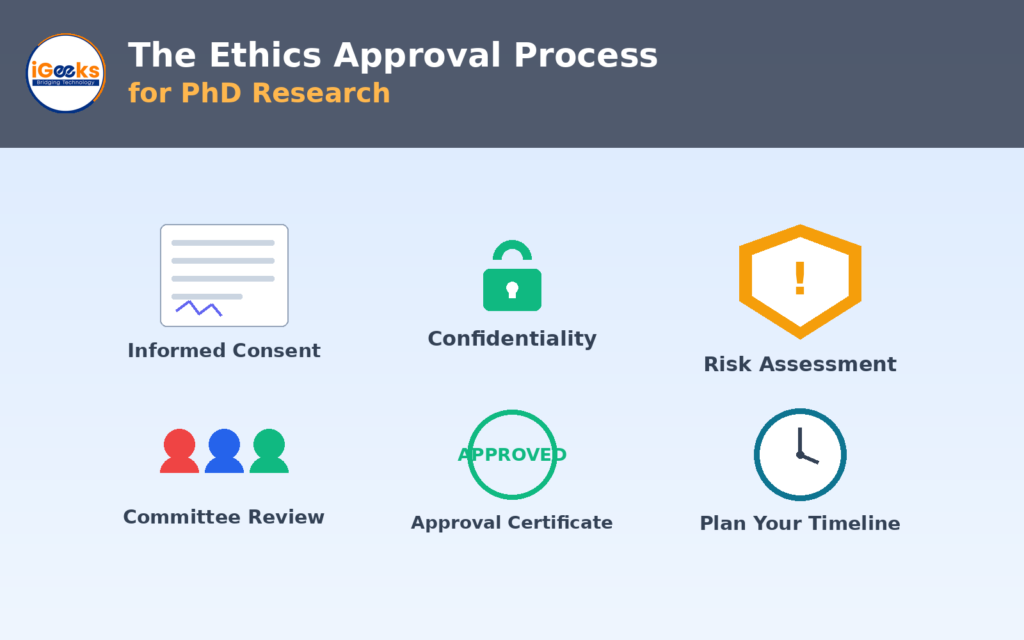
Ethics approval is one of those steps in a PhD journey that often catches scholars off guard — not because it’s conceptually difficult, but because most research training focuses on methodology and analysis, leaving the actual approval process feeling unfamiliar and bureaucratic. Yet for research involving human participants, sensitive data, or certain institutional resources, ethics approval is a mandatory checkpoint that can significantly affect your timeline if not planned for early.
Here’s a practical guide to understanding and navigating the ethics approval process.
Why Ethics Approval Exists
Institutional Ethics Committees (also called Institutional Review Boards or Research Ethics Committees) exist to protect the rights, safety, and wellbeing of anyone involved in your research — participants, data subjects, and in some cases, the researcher themselves. Their review typically ensures that:
- Participants are fully informed about what the research involves
- Consent is given freely, without pressure or coercion
- Risks to participants are minimized and clearly justified against research benefits
- Sensitive data is collected, stored, and used responsibly
- Vulnerable populations receive additional protections
Ethics approval isn’t a bureaucratic hurdle designed to slow you down — it’s a safeguard that protects both your participants and your research’s credibility.
When You Need Ethics Approval
Most universities require ethics approval for research involving:
- Human participants (surveys, interviews, focus groups, experiments)
- Vulnerable populations (children, patients, prisoners, elderly individuals, or economically disadvantaged groups)
- Sensitive personal data (health information, financial details, identity-related data)
- Animal subjects, in relevant scientific fields
- Deception or withholding full information from participants during a study
- Secondary data involving identifiable individuals, even if you didn’t collect it yourself
Note: Purely theoretical, secondary-data (fully anonymized), or desk-based research may not require full ethics review, but this should always be confirmed with your institution rather than assumed.
The Typical Ethics Approval Process
While specific procedures vary by university, most ethics approval processes follow a similar structure:
1. Determine the Level of Review Required
Many institutions use a tiered system:
- Exempt/minimal risk — simple, low-risk studies that may require only a basic declaration
- Expedited review — moderate-risk studies reviewed by a subset of the committee, often faster
- Full committee review — higher-risk studies requiring review by the full ethics board
2. Prepare Your Ethics Application
This typically includes:
- A clear description of your research objectives and methodology
- Details of your participant recruitment process
- A copy of your informed consent form and information sheet
- An explanation of how data will be collected, stored, and eventually disposed of or archived
- A risk assessment, including how potential harms will be minimized
- Details of any incentives offered to participants
3. Submit and Await Committee Review
Processing times vary significantly — from a few weeks for expedited review to several months for full committee review, especially if your proposal requires revisions.
4. Respond to Committee Feedback
It’s common to receive requests for clarification or changes on your first submission. This might include:
- Simplifying language in your consent forms for better participant understanding
- Adding additional safeguards for vulnerable groups
- Clarifying data storage and confidentiality procedures
5. Receive Approval and Begin Data Collection
Once approved, you’ll typically receive a formal approval letter or certificate — keep this documented, as journals and your thesis examiners may request proof of ethics approval later.
Building a Strong Informed Consent Process
Informed consent is central to most ethics applications. A strong consent process typically includes:
- Plain language — avoiding academic jargon so participants genuinely understand what they’re agreeing to
- Clear purpose statement — what the research is about and why it’s being conducted
- Voluntary participation — explicitly stating participants can withdraw at any time without penalty
- Confidentiality assurances — how their data will be protected and anonymized
- Contact information — for both the researcher and the ethics committee, in case of concerns
Common Reasons Ethics Applications Get Delayed
- Vague or overly broad research descriptions — reviewers can’t assess risk without specifics
- Incomplete consent forms — missing withdrawal rights, confidentiality details, or contact information
- Unclear data storage plans — especially for sensitive or identifiable data
- Insufficient protections for vulnerable populations — requiring additional safeguards not initially included
- Mismatched methodology and ethics documents — inconsistencies between your research proposal and ethics application
Planning Your Timeline Around Ethics Approval
Because approval timelines can be unpredictable, build buffer time into your research schedule:
- Submit your ethics application as early as your research design allows — ideally right after your proposal is finalized
- Anticipate at least one round of revisions, even for well-prepared applications
- Avoid scheduling data collection immediately after your expected approval date — build in a buffer for delays
- If your research design changes significantly after approval, check whether you need to submit an amendment before proceeding
A Quick Pre-Submission Checklist
Before submitting your ethics application, confirm:
- Your research description is specific and matches your actual methodology
- Your consent form is written in plain, accessible language
- You’ve clearly explained how you’ll protect participant confidentiality
- You’ve addressed any additional protections needed for vulnerable groups
- Your data storage and disposal plan is clearly outlined
- All required institutional forms and signatures are included
Navigate Your Ethics Process With Confidence
The ethics approval process is a critical checkpoint, not just a formality — but it doesn’t have to derail your research timeline if planned for early and prepared thoroughly. If you’d like guidance on preparing your ethics application, structuring your consent documents, or aligning your methodology with ethical requirements, we’re here to help.
Explore our PhD Thesis Help services in Bangalore: 👉 www.makefinalyearproject.com/phd-thesis-help-bangalore.aspx
Have a question? Reach out directly on WhatsApp: 📲 +91 70192 80372
Getting ethics approval right the first time means more time for the research that matters most — yours.