

Your research proposal is the first real test of your PhD journey — often before you’ve even been admitted. It’s the document that convinces a committee your research question is worth pursuing, that you have a credible plan to answer it, and that you’re capable of carrying it through. A strong proposal doesn’t just help you get admitted; it becomes the foundation your entire thesis builds on.
Here’s a practical guide to writing a research proposal that stands out.
What a Research Proposal Actually Needs to Do
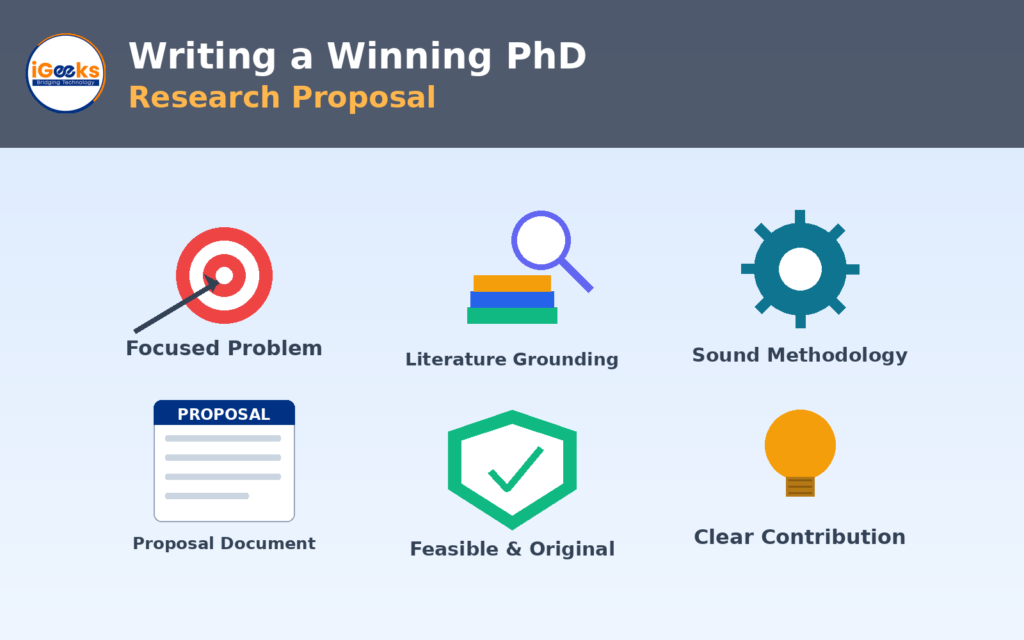
Before writing, it helps to understand what reviewers are really evaluating. A strong proposal must demonstrate:
- A clear, focused research problem — not too broad, not too narrow
- Awareness of existing research — showing you understand the field, not just your idea
- A credible methodology — a realistic plan for how you’ll actually answer your question
- Feasibility — that the research can genuinely be completed within a PhD timeline
- Original contribution — a clear sense of what’s new or different about your approach
Reviewers aren’t just assessing your idea — they’re assessing whether you can execute it.
1. Start With a Focused Research Problem
The most common weakness in proposals is a research problem that’s too broad or too vague. “Studying the impact of social media on society” isn’t researchable — it’s a topic area, not a research problem.
Strengthen your problem statement by asking:
- What specific gap or issue am I addressing?
- Why does this matter — academically, practically, or both?
- Can this realistically be investigated within 3-5 years?
A focused problem might look like: “Examining how short-form video content affects attention spans among university students in urban India” — specific population, specific phenomenon, specific context.
2. Ground Your Proposal in Existing Literature
Your proposal needs a concise literature review — not a comprehensive one (that comes later in your actual thesis), but enough to show:
- You know the key theories, models, or debates relevant to your topic
- You understand what’s already been studied and what hasn’t
- Your research fills a specific, identifiable gap
Aim for depth over breadth here — a focused discussion of 15-20 highly relevant sources is more convincing than a shallow list of 50.
3. Define Clear Research Questions or Hypotheses
Your research questions should flow directly from your problem statement and literature gap. Strong research questions are:
- Specific — clearly defined variables, population, or scope
- Answerable — realistically investigable with available methods and resources
- Aligned — directly connected to the gap you identified in the literature
Avoid research questions that are really multiple questions combined, or ones so broad they could generate an entirely different thesis depending on interpretation.
4. Choose and Justify Your Methodology
This is where many proposals lose credibility — not because the method is wrong, but because it isn’t justified. For each methodological choice, briefly explain why it fits your specific research questions:
- Research design — qualitative, quantitative, or mixed methods, and why
- Sampling approach — who or what you’ll study, and how you’ll select them
- Data collection methods — surveys, interviews, experiments, secondary data, etc.
- Analysis approach — how you’ll process and interpret the data you collect
Reviewers want to see that your methodology is the right tool for your specific questions — not simply the method you’re most comfortable with.
5. Address Feasibility Directly
A brilliant research idea that can’t realistically be completed isn’t a strong proposal. Proactively address:
- Timeline — a realistic breakdown of major phases (literature review, data collection, analysis, writing)
- Resource access — do you have access to the data, participants, or sites you need?
- Ethical considerations — especially for research involving human subjects, sensitive data, or vulnerable populations
Including a simple timeline table often strengthens a proposal significantly, showing reviewers you’ve thought concretely about execution, not just ideas.
6. Clearly State Your Expected Contribution
Reviewers want to know: why does this research matter? Address this from multiple angles:
- Theoretical contribution — how does this add to or challenge existing theory?
- Practical contribution — who benefits from this research, and how?
- Contextual contribution — does this fill a gap specific to a region, industry, or population not previously studied?
A proposal that clearly articulates its contribution — even modestly — is far more convincing than one that only describes what will be done without explaining why it matters.
7. Keep Structure and Language Tight
Most institutions specify a proposal structure (problem statement, literature review, objectives, methodology, timeline, references) and a word or page limit. Beyond following that format:
- Use clear, direct academic language — avoid unnecessary jargon
- Ensure each section logically leads to the next — the literature review should justify your questions, which should justify your methodology
- Proofread carefully; a proposal with grammatical errors or inconsistent formatting undermines credibility regardless of the idea’s strength
Common Mistakes That Weaken Proposals
- Overly ambitious scope — trying to answer too many questions in one PhD
- Weak connection between literature review and research questions — the gap identified doesn’t clearly lead to what’s being proposed
- Vague methodology — describing what will be studied without explaining how
- Ignoring feasibility — no realistic discussion of timeline, access, or resources
- Generic contribution statements — claiming significance without explaining specifically why or to whom
A Quick Proposal Self-Check
Before submitting, ask yourself:
- Is my research problem specific and clearly stated?
- Does my literature review directly justify my research questions?
- Is my methodology clearly explained and justified, not just named?
- Have I addressed feasibility — timeline, access, ethics?
- Have I clearly stated what my research contributes, and to whom?
Get Expert Guidance on Your Proposal
A strong proposal sets the tone for your entire PhD journey — and getting it right early saves significant time later. If you’d like support refining your research problem, structuring your proposal, or strengthening your methodology section, we’re here to help.
Explore our PhD Thesis Help services in Bangalore: 👉 www.makefinalyearproject.com/phd-thesis-help-bangalore.aspx
Have a question? Reach out directly on WhatsApp: 📲 +91 70192 80372
A well-built proposal isn’t just a formality — it’s the blueprint for a thesis you can complete with confidence.