

Publishing a research paper in a Q1 or Q2 journal is an important goal for many PhD scholars, research scholars, faculty members, postgraduate students, and academic researchers. However, publishing in a reputed journal requires more than completing a research study and submitting a manuscript.
Editors and reviewers evaluate several aspects of a paper, including originality, research gap, methodology, journal fit, literature review, data analysis, presentation, ethical compliance, and overall contribution.
Many manuscripts are rejected not because the research topic is unimportant, but because the paper has avoidable weaknesses.
Understanding these common mistakes can help researchers improve their manuscripts before submission and reduce the risk of desk rejection or rejection after peer review.
What Are Q1 and Q2 Journals?
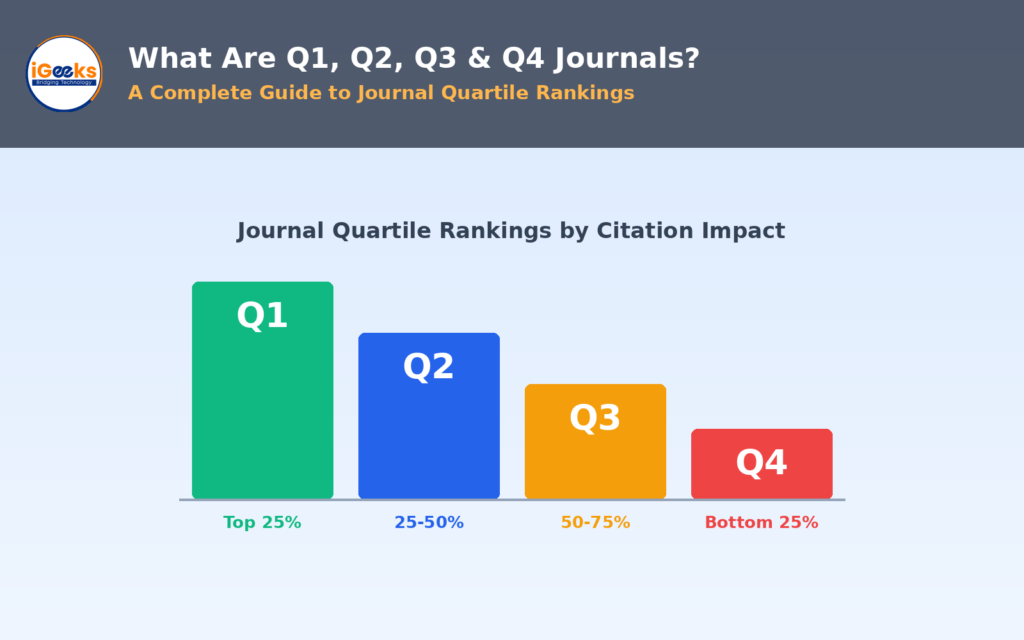
Q1 and Q2 are journal quartile classifications used within particular subject categories and ranking systems.
A commonly used interpretation is:
- Q1: Top 25% of journals in a category
- Q2: 25%–50%
- Q3: 50%–75%
- Q4: 75%–100%
For Scopus-related journal evaluation, researchers may encounter metrics such as CiteScore, CiteScore percentile, CiteScore quartile, SJR, and SNIP.
A journal’s quartile can vary according to the subject category and metric being considered. Therefore, researchers should verify the current journal information rather than relying on outdated lists or third-party claims.
Quartile is useful information, but it should not be the only factor used to evaluate a journal.
1. Choosing the Wrong Journal
One of the biggest mistakes researchers make is selecting a journal simply because it is Q1 or Q2.
A high-ranking journal is not automatically the right journal for every research paper.
For example, suppose your research focuses on:
“Machine Learning for Medical Image Diagnosis.”
A Q1 artificial intelligence journal may look attractive, but if the journal primarily publishes theoretical AI research and rarely publishes healthcare applications, your paper may not be a strong fit.
A Q2 medical-imaging journal could potentially be a better target if it regularly publishes research similar to yours.
Before submitting, check:
- Aims and scope
- Subject category
- Recent publications
- Article types
- Target audience
- Methodologies commonly published
- Editorial policies
Journal fit should be evaluated before quartile alone.
2. Weak or Unclear Research Gap
A paper can have a good topic but still have a weak research gap.
Editors and reviewers want to understand:
What problem remains unresolved?
Your introduction should clearly explain:
- What is already known?
- What has previous research established?
- What limitations exist?
- What remains unknown?
- What problem does your research address?
- What contribution does your study make?
A weak statement such as:
“Very few studies have investigated this topic.”
is usually not enough.
Explain what previous studies failed to address and why that limitation matters.
3. Lack of Originality
Q1/Q2 journals generally expect manuscripts to make a meaningful contribution to their field.
A paper may be rejected if it appears to:
- Repeat existing research
- Apply an established method without meaningful contribution
- Replicate previous work without sufficient justification
- Provide only minor modifications
- Offer limited theoretical or practical value
Before submission, ask:
What does my paper add that previous research does not already provide?
Your answer should be specific.
4. Making Exaggerated Novelty Claims
The opposite problem also occurs.
Some researchers describe ordinary modifications as:
- “Revolutionary”
- “Groundbreaking”
- “Completely novel”
- “World’s first”
without sufficient evidence.
Such claims can reduce reviewer confidence.
Instead, explain exactly what is different.
For example:
“This study extends existing X methodology by incorporating Y variable and evaluates its performance using Z dataset.”
Specificity is stronger than promotional language.
5. Poor Literature Review
A literature review should not simply be a collection of summaries.
A weak literature review might look like:
Author A studied X.
Author B studied Y.
Author C studied Z.
A stronger review synthesises the literature.
Compare:
- Methodologies
- Findings
- Datasets
- Theoretical frameworks
- Limitations
- Research contexts
- Contradictory findings
Then demonstrate how your study addresses an identifiable gap.
6. Using Outdated References
A paper may appear disconnected from current research if most of its references are old.
This does not mean every reference must be recent.
Foundational studies remain important.
However, researchers should generally include relevant recent literature where appropriate and demonstrate awareness of the current state of the field.
Before submission, ask:
“Does my literature review accurately represent the current research landscape?”
7. Weak Research Methodology
A strong research question cannot compensate for an inappropriate methodology.
Reviewers may question:
- Research design
- Sampling strategy
- Sample size
- Data collection
- Variables
- Measurement instruments
- Experimental setup
- Statistical methods
- Validation procedures
Your methodology should explain why particular methods were selected.
Do not simply write:
“SPSS was used for analysis.”
Explain:
- Which statistical tests were used
- Why they were appropriate
- What assumptions were considered
- How variables were measured
- How results were interpreted
8. Insufficient Sample Size or Data
Data quality can significantly influence the credibility of research.
Problems may include:
- Very small sample
- Poor sampling method
- Insufficient observations
- Unrepresentative dataset
- Missing data
- Unexplained exclusions
- Data-quality problems
If a limited sample is unavoidable, explain the reason and discuss its implications.
Do not hide limitations.
9. Inappropriate Statistical Analysis
A frequent reason for criticism is the use of statistical methods that do not match the research design.
Examples include:
- Using a t-test without checking assumptions
- Applying regression without appropriate diagnostics
- Using correlation to imply causation
- Reporting p-values without effect sizes where relevant
- Performing multiple tests without addressing multiplicity where appropriate
- Selecting statistical tests without methodological justification
The statistical method should be determined by:
Research Question + Data Type + Study Design + Statistical Assumptions
rather than by convenience.
10. Weak Validation in Machine-Learning Research
For AI and machine-learning papers, reviewers often expect robust evaluation.
Potential problems include:
- Very small datasets
- No meaningful baseline
- Data leakage
- Overfitting
- Inadequate train/test separation
- No cross-validation where appropriate
- Limited evaluation metrics
- No statistical comparison
- No external validation when it is important
- Insufficient reproducibility information
For classification research, researchers may need to consider metrics such as:
- Accuracy
- Precision
- Recall
- F1-score
- ROC-AUC
For regression:
- MAE
- MSE
- RMSE
- R²
The appropriate metrics depend on the research problem.
11. Not Comparing With Existing Methods
If you propose a new model, framework, algorithm, or methodology, reviewers will want to understand how it performs relative to existing approaches.
A common mistake is presenting:
“Our model achieves 95% accuracy.”
without answering:
“95% compared with what?”
Where appropriate, compare against:
- Established baseline methods
- Recent state-of-the-art approaches
- Alternative algorithms
- Existing theoretical frameworks
The comparison should be scientifically justified and reproducible.
12. Weak Results Section
A results section should clearly present the evidence generated by the research.
Common problems include:
- Missing statistical information
- Confusing tables
- Poor figures
- Unsupported claims
- Repeating the same information
- Reporting results selectively
- Not answering research objectives
Every major research objective should connect to appropriate results.
13. Confusing Results With Discussion
The Results section answers:
“What did we find?”
The Discussion answers:
“What do these findings mean?”
A good discussion should compare your findings with previous research and explain:
- Agreements
- Differences
- Possible reasons
- Theoretical implications
- Practical implications
- Research limitations
Simply repeating the results is not a strong discussion.
14. Overstating Conclusions
Your conclusion must be supported by your evidence.
Avoid statements such as:
“This model will completely solve healthcare diagnosis.”
when your experiment only tested a specific dataset.
Instead, use appropriately scoped conclusions.
For example:
“The findings indicate that the proposed model may improve classification performance under the evaluated experimental conditions.”
Scientific writing requires careful interpretation.
15. Ignoring Research Limitations
Some researchers try to make their study appear perfect.
This can have the opposite effect.
Every research project has limitations.
These might include:
- Sample size
- Geographic scope
- Dataset limitations
- Study duration
- Measurement constraints
- Model limitations
- Generalisability
- Experimental conditions
A thoughtful limitations section demonstrates awareness of the boundaries of your findings.
16. Poor Academic Writing
Even strong research can become difficult to evaluate when the manuscript is poorly written.
Common problems include:
- Grammar errors
- Long and confusing sentences
- Excessive jargon
- Repetition
- Inconsistent terminology
- Poor paragraph structure
- Unclear arguments
- Unsupported statements
The manuscript should be understandable to researchers in the journal’s target community.
17. Poorly Written Abstract
The abstract is one of the first sections editors and reviewers examine.
A weak abstract may fail to communicate:
- Research problem
- Objective
- Methodology
- Key results
- Main contribution
A good abstract should allow the reader to understand the essential research story without reading the entire paper.
18. Weak Title
Avoid titles that are:
- Too long
- Too vague
- Promotional
- Filled with unnecessary abbreviations
- Unrelated to the actual research contribution
A strong title should communicate the research topic accurately and efficiently.
19. Poor Figures and Tables
Figures and tables should help readers understand your research.
Common problems include:
- Low-resolution figures
- Tiny labels
- Inconsistent units
- Missing captions
- Duplicate information
- Unclear legends
- Inappropriate chart types
- Tables that are unnecessarily complicated
Before submission, check the journal’s specific figure and table requirements.
20. Ignoring Journal Formatting Requirements
Every journal has its own requirements.
These can include:
- Word count
- Abstract structure
- Reference style
- Figure format
- Table format
- Supplementary files
- Data availability statements
- Ethics declarations
- Author contribution statements
Failure to follow the journal’s submission instructions can create avoidable problems.
Always use the current author guidelines from the journal’s official website.
21. Poor Reference Management
Incorrect references can damage the credibility of a manuscript.
Check:
- Author names
- Publication year
- Journal name
- Volume
- Issue
- Page numbers
- DOI
- URLs where required
- Citation consistency
Also ensure that every important claim requiring a citation has appropriate supporting literature.
22. Citation Problems
Researchers should avoid:
- Excessive self-citation
- Irrelevant citations
- Citation manipulation
- Citing papers that do not actually support the statement
- Over-reliance on a small group of sources
Citations should serve the scholarly argument.
23. Plagiarism and Text Recycling
Plagiarism can lead to manuscript rejection and potentially serious academic consequences.
Do not copy:
- Text
- Figures
- Tables
- Ideas without attribution
- Data
- Research findings
Even when paraphrasing, the underlying source should be cited appropriately.
Researchers should also understand journal policies regarding text recycling and reuse of material from earlier publications.
24. Fabricated or Manipulated Data
This is one of the most serious research-ethics problems.
Never:
- Invent data
- Modify data to produce desired findings
- Remove inconvenient observations without justification
- Manipulate images
- Fabricate experiments
- Misrepresent statistical results
Research integrity is more important than publication.
25. Using AI Without Verification
AI tools can assist with:
- Language editing
- Grammar
- Structure
- Brainstorming
But AI-generated content can contain:
- Incorrect information
- Fabricated references
- Misleading claims
- Incorrect interpretation
- Non-existent citations
Researchers must verify all content.
If a journal requires disclosure of AI use, follow its policy.
Authors remain responsible for the final manuscript.
26. Submitting to Multiple Journals at the Same Time
Do not submit the same manuscript simultaneously to several journals.
This can create publication-ethics problems.
Use a structured process:
Journal A → Review/Decision → Revise if necessary → Journal B
unless a journal’s formal policies provide otherwise.
27. Ignoring Reviewer Comments
If your manuscript receives Major Revision, do not immediately assume that the paper has failed.
A revision request can provide an opportunity to improve the research.
Respond to every reviewer comment systematically.
A useful response table is:
| Reviewer Comment | Response | Manuscript Change |
|---|---|---|
| Comment 1 | Explanation | Section revised |
| Comment 2 | Additional analysis | Results updated |
| Comment 3 | Clarification | Discussion expanded |
Remain professional and evidence-based.
28. Arguing With Reviewers Emotionally
A reviewer may misunderstand something in your manuscript.
Do not respond:
“The reviewer is wrong.”
Instead:
“We appreciate the reviewer’s observation. To clarify this point, we have revised Section X and added…”
Professional responses increase the clarity of the revision process.
29. Ignoring Desk-Rejection Risk
A manuscript can be rejected before peer review.
Common reasons can include:
- Poor journal fit
- Insufficient novelty
- Weak presentation
- Failure to follow guidelines
- Ethical concerns
- Manuscript outside the journal’s scope
This is why pre-submission quality control is important.
30. Choosing a Journal Based Only on Q1/Q2 Status
This is perhaps the biggest strategic mistake.
Do not think:
Q1 = Good
Q2 = Bad
Instead evaluate:
Scope + Research Fit + Credibility + Metrics + Audience + Institutional Requirements + Ethics
A highly relevant Q2 journal may be more suitable than an unrelated Q1 journal.
How to Reduce the Risk of Q1/Q2 Rejection
Before submitting, use this checklist.
Research Quality
☐ Clear research problem
☐ Meaningful research gap
☐ Strong contribution
☐ Appropriate methodology
☐ Adequate data
☐ Appropriate analysis
☐ Robust validation
Literature
☐ Relevant recent studies
☐ Foundational literature
☐ Critical synthesis
☐ Clear research gap
Manuscript
☐ Strong title
☐ Clear abstract
☐ Logical introduction
☐ Strong methodology
☐ Clear results
☐ Meaningful discussion
☐ Appropriate conclusion
☐ Limitations included
Journal
☐ Scope match confirmed
☐ Recent papers reviewed
☐ Author guidelines followed
☐ Current journal information verified
☐ Publication charges checked
Ethics
☐ Original manuscript
☐ Proper citations
☐ No fabricated data
☐ Authorship confirmed
☐ Appropriate declarations completed
☐ Not submitted elsewhere
A 7-Step Pre-Submission Quality Check
Before submitting your paper to a Q1 or Q2 journal, follow this process.
Step 1: Research Audit
Review the research question, gap and contribution.
Step 2: Methodology Audit
Check the research design, data and analytical methods.
Step 3: Literature Audit
Update and critically review relevant literature.
Step 4: Journal Audit
Confirm scope, subject category, recent papers and author guidelines.
Step 5: Manuscript Audit
Check language, structure, tables, figures and references.
Step 6: Ethics Audit
Check originality, authorship, declarations and research integrity.
Step 7: Expert Review
Ask a supervisor, subject expert or experienced researcher to review the manuscript before submission.
What Should You Do If Your Q1/Q2 Paper Is Rejected?
Do not immediately abandon the research.
First identify the reason.
If the problem is journal fit:
Select a more appropriate journal.
If the problem is methodology:
Strengthen the research design or analysis.
If the problem is novelty:
Clarify or strengthen the research contribution.
If the problem is presentation:
Rewrite the manuscript.
If reviewers request additional analysis:
Conduct scientifically justified additional analysis.
If the paper receives major revisions:
Address every reviewer comment systematically.
A rejection can become a learning opportunity if the feedback is used constructively.
Final Thoughts
Getting rejected by a Q1 or Q2 journal does not necessarily mean that your research is poor.
A manuscript can be rejected because of:
Journal mismatch + Weak research gap + Methodological limitations + Poor presentation + Insufficient novelty + Inadequate analysis + Formatting problems + Ethical concerns
Many of these issues can be identified before submission.
The best strategy is therefore to treat journal publication as a structured process:
Strong Research → Clear Research Gap → Rigorous Methodology → Meaningful Contribution → Appropriate Journal → High-Quality Manuscript → Pre-Submission Review → Ethical Submission → Professional Peer-Review Response
Researchers should focus on producing credible and reproducible research rather than trying to manipulate metrics or guarantee acceptance.
Need Research Paper Writing & Publication Support?
Igeeks provides academic and research support for PhD scholars, research scholars, faculty members and postgraduate researchers.
Our Research Support Includes:
- Research Paper Writing
- Research Methodology Support
- Literature Review
- Statistical Analysis
- Data Analysis
- Manuscript Editing
- Academic Proofreading
- Journal Selection
- Scopus Publication Guidance
- Q1/Q2 Journal Targeting
- SCI Publication Support
- IEEE Paper Support
- Reviewer Comment Response
- Manuscript Revision
🌐 Research Paper Writing & Publication Services
https://www.makefinalyearproject.com/research-paper-writing-publication-bangalore.html
7019280372
Share your research topic, abstract/manuscript, research area and publication requirement to discuss suitable research and publication support.