

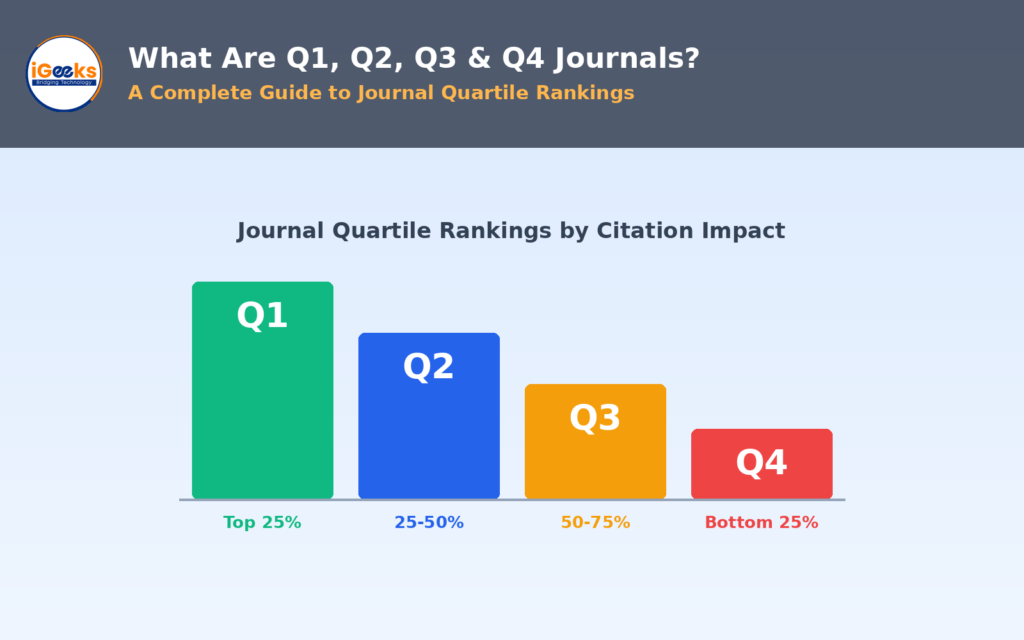
Publishing a research paper in a Q1 journal is a major goal for many PhD scholars, researchers, faculty members, and postgraduate students. Q1 journals are generally positioned in the highest quartile of a relevant subject category under a particular ranking or metric system.
However, getting published in a Q1 journal requires much more than selecting a journal with a high ranking and submitting a manuscript.
Q1 journals typically receive manuscripts from researchers around the world. Editors and reviewers evaluate factors such as research novelty, methodological quality, originality, relevance, clarity, journal fit, research ethics, and the quality of presentation.
The good news is that researchers can take a systematic approach to improve their chances.
This guide explains how to prepare your research, select the right Q1 journal, strengthen your manuscript, avoid common mistakes, and respond effectively to reviewers.
What Is a Q1 Journal?
Q1 generally refers to the first quartile of journals within a particular subject category according to a specific ranking or metric system.
For Scopus-related evaluation, researchers may encounter metrics such as:
- CiteScore
- CiteScore percentile
- CiteScore quartile
- SJR
- SNIP
A journal’s quartile can depend on its subject category and the metric/year being considered. Therefore, researchers should verify current information rather than relying on old screenshots, promotional claims, or third-party lists.
Journal metrics are useful indicators, but they should not be treated as a complete measurement of research quality. Elsevier recommends combining quantitative metrics with qualitative assessment and using more than one metric when evaluating journals.
1. Start With Strong Research
The most important factor in Q1 publication is not formatting.
It is the quality of the underlying research.
Before thinking about journal submission, ask:
- Is the research problem important?
- Is there a clear research gap?
- Is the methodology appropriate?
- Is the research contribution clearly demonstrated?
- Are the results reliable?
- Does the study provide something new?
- Are the conclusions supported by the evidence?
A beautifully written manuscript cannot compensate for weak research design.
2. Identify a Clear Research Gap
A strong Q1 manuscript should clearly answer:
What problem does this research solve that previous studies have not adequately addressed?
Your introduction should establish:
Existing Knowledge
What has already been studied?
Research Gap
What remains unresolved?
Research Problem
What specific problem are you addressing?
Research Objective
What exactly does your study attempt to achieve?
Contribution
What does your study add to the existing literature?
A weak research gap can make an otherwise technically strong paper appear incremental.
3. Make Your Research Contribution Explicit
One of the most important questions reviewers will ask is:
What is new about this research?
Your contribution might be:
- A new theoretical model
- A new algorithm
- A new methodology
- A new dataset
- A new experimental approach
- A new statistical analysis
- A new clinical finding
- A new engineering design
- A new business framework
- A new interdisciplinary application
Do not expect reviewers to identify your contribution themselves.
Explain it clearly.
For example:
“This study contributes a new machine-learning framework that improves…”
or:
“Unlike previous studies, this research evaluates…”
The contribution should be supported by evidence rather than exaggerated.
4. Choose the Right Q1 Journal
Journal selection is one of the most important steps in the publication process.
Elsevier states that finding the right journal can improve the chances of acceptance and recommends evaluating alignment between the manuscript and the journal’s scope, audience, and standards.
Before selecting a journal, examine:
- Aims and scope
- Subject category
- Recent publications
- Article types
- Target readership
- Editorial board
- Author guidelines
- Peer-review process
- Publication model
- Journal metrics
The best Q1 journal is not necessarily the journal with the highest metric.
It is the credible Q1 journal that is an excellent match for your research.
5. Read Recent Papers From Your Target Journal
This is one of the most overlooked steps.
Before submitting, read approximately 10–20 recent papers from your target journal, particularly papers related to your topic.
Study:
- Research questions
- Methodology
- Statistical analysis
- Writing style
- Article structure
- Figures
- Tables
- Reference patterns
- Discussion style
- Research contribution
Ask yourself:
“Would my paper look academically appropriate alongside these recent publications?”
If your manuscript appears significantly outside the journal’s current research focus, reconsider your target.
6. Match Your Manuscript to the Journal’s Scope
Do not select a Q1 journal merely because it is prestigious.
Your research should fit the journal’s:
Topic + Methodology + Audience + Article Type + Research Level
For example, a paper on healthcare machine learning might potentially fit:
- Artificial intelligence
- Medical imaging
- Healthcare informatics
- Biomedical engineering
- Clinical informatics
The appropriate journal depends on the actual research contribution.
A scope mismatch can lead to a desk rejection before peer review. Elsevier notes that editors initially assess factors such as suitability and scope before deciding whether a manuscript proceeds to peer review.
7. Follow the Author Guidelines Exactly
A strong research paper can still face problems if the submission does not follow journal requirements.
Check the journal’s current:
- Word limit
- Manuscript structure
- Abstract format
- Keyword requirements
- Reference style
- Figure specifications
- Table format
- Supplementary-material requirements
- Ethics statements
- Data availability requirements
- Conflict-of-interest declarations
- Author contribution requirements
Elsevier recommends consulting the target journal’s Guide for Authors for formatting, word limits, structure, and submission requirements.
Do not submit a generic manuscript to every journal.
Prepare the manuscript specifically for the selected journal.
8. Strengthen the Title
Your title is the first thing editors and reviewers see.
A good research title should be:
- Specific
- Concise
- Informative
- Technically accurate
- Relevant to the research
- Free from unnecessary promotional language
Weak Example
“A Novel and Highly Efficient Revolutionary AI Model for Healthcare”
Better Example
“A Deep Learning Framework for Early Detection of Diabetic Retinopathy Using Retinal Fundus Images”
The second title tells the reader what the study actually investigates.
9. Write a Strong Abstract
The abstract should communicate the entire research story efficiently.
A strong research abstract generally addresses:
Background
What is the problem?
Objective
What did the study attempt to investigate?
Methodology
How was the research conducted?
Results
What were the main findings?
Conclusion
What do the findings mean?
Contribution
Why does the study matter?
Avoid:
- Unnecessary background
- Unsupported claims
- Excessive abbreviations
- Citations unless specifically required
- Vague statements
The abstract should accurately represent the paper.
10. Make the Introduction Reviewer-Friendly
A strong introduction should create a logical progression:
Problem → Existing Research → Research Gap → Objective → Contribution
A useful structure is:
Paragraph 1
Introduce the broader problem.
Paragraph 2
Explain existing research.
Paragraph 3
Identify limitations in previous studies.
Paragraph 4
Define the research gap.
Paragraph 5
Introduce your research objective.
Paragraph 6
Explain the contribution of your study.
This structure helps reviewers understand why your research is necessary.
11. Build a Strong Literature Review
A Q1 literature review should not simply list previous papers.
Avoid writing:
Author A studied X.
Author B studied Y.
Author C studied Z.
Instead, synthesise the literature.
Compare:
- Research methods
- Datasets
- Findings
- Limitations
- Theoretical perspectives
- Contradictory findings
- Research gaps
A strong literature review demonstrates that you understand the development of the field.
12. Make Your Methodology Reproducible
Methodological transparency is essential.
Explain:
- Research design
- Data sources
- Sampling
- Variables
- Instruments
- Experimental conditions
- Algorithms
- Statistical methods
- Evaluation metrics
- Validation methods
For computational research, provide sufficient information about:
- Dataset
- Preprocessing
- Model architecture
- Hyperparameters
- Training process
- Evaluation metrics
- Baseline methods
For empirical research, explain the analytical procedures sufficiently for readers to understand how the results were produced.
13. Use Appropriate Statistical Analysis
If your research includes statistical analysis, the method should match your research design and data.
Depending on the study, this could include:
- Descriptive statistics
- Correlation analysis
- Regression
- ANOVA
- t-tests
- Chi-square tests
- Factor analysis
- Structural equation modelling
- Survival analysis
- Non-parametric methods
For machine-learning research, relevant evaluation may include:
- Accuracy
- Precision
- Recall
- F1-score
- AUC
- MAE
- RMSE
- R²
Do not use statistical tests simply because they are popular.
The analytical method should be justified by the research question and data.
14. Present Results Clearly
Your results section should answer:
What did the research actually find?
Use:
- Tables
- Figures
- Graphs
- Statistical results
- Experimental comparisons
Avoid repeating the same information in three different formats.
For example, if a table already provides the complete numerical results, the text should highlight the important findings rather than reproducing every number.
15. Separate Results From Discussion
A common problem in manuscripts is mixing results and interpretation without a clear structure.
Results
Explain what you found.
Discussion
Explain:
- Why the finding matters
- How it compares with previous research
- Why differences may exist
- What the theoretical implications are
- What the practical implications are
- What limitations exist
This distinction makes the research argument easier to follow.
16. Discuss Limitations Honestly
Do not try to make your study appear perfect.
Every research project has limitations.
These may include:
- Sample size
- Dataset limitations
- Geographic restrictions
- Measurement limitations
- Methodological constraints
- Computational limitations
- Generalisability
- Short study duration
A strong limitations section can demonstrate research maturity.
Do not hide weaknesses that reviewers are likely to identify themselves.
17. Improve Academic Writing
Q1 journals expect manuscripts to communicate complex research clearly.
Review your paper for:
- Grammar
- Sentence structure
- Technical terminology
- Logical transitions
- Repetition
- Ambiguous statements
- Unsupported claims
- Excessive jargon
A well-edited manuscript makes it easier for editors and reviewers to evaluate the research.
Elsevier notes that clear, concise and well-organised manuscripts help editors, reviewers and readers engage with the research.
18. Use References Strategically
Your references should demonstrate familiarity with the field.
Include:
- Recent relevant studies
- Foundational studies
- High-quality research
- Important competing approaches
- Relevant methodological papers
Do not add citations simply to increase the reference count.
Every important citation should have a purpose.
Also check:
- Citation accuracy
- DOI information
- Reference formatting
- Author names
- Publication year
- Journal details
19. Avoid Plagiarism
Originality is essential for scholarly publishing.
Never:
- Copy another researcher’s text
- Reuse substantial material without appropriate disclosure
- Present another person’s results as your own
- Manipulate research findings
- Fabricate data
Paraphrasing also requires appropriate citation when the underlying idea comes from another source.
Elsevier identifies plagiarism and unattributed copying or paraphrasing as violations of ethical publishing standards.
20. Use AI Tools Responsibly
AI tools can assist researchers with tasks such as:
- Language improvement
- Grammar checking
- Brainstorming
- Structural suggestions
- Readability improvement
However, researchers remain responsible for the manuscript’s content.
AI-generated text can contain:
- Incorrect facts
- Fabricated references
- Unsupported claims
- Misinterpretations
- Biased statements
If AI-assisted technologies are used, follow the specific journal’s disclosure and authorship policies.
Elsevier states that AI-assisted technologies should be used with human oversight and that authors should carefully review and edit AI-generated output.
21. Prepare a Strong Cover Letter
Your cover letter should briefly explain:
- Manuscript title
- Research problem
- Main contribution
- Why the paper fits the journal
- Article originality
- Confirmation of appropriate submission practices
Do not write a generic cover letter for every journal.
Explain specifically why your manuscript belongs in that journal.
22. Never Submit the Same Manuscript to Multiple Journals Simultaneously
A common mistake among inexperienced researchers is submitting one manuscript to several journals at the same time.
This can create serious publication-ethics problems.
Submit your manuscript to one journal at a time, unless the journal policies explicitly provide another mechanism.
Elsevier’s publication guidance also advises authors to submit to only one journal at a time.
23. Prepare for Peer Review
Q1 publication does not end with submission.
If the paper passes editorial screening, reviewers may examine:
- Novelty
- Methodology
- Literature
- Results
- Statistical analysis
- Interpretation
- Limitations
- Writing quality
- Research significance
Peer review is intended to assess whether research is original, methodologically sound and clearly communicated. Reviewer feedback can help strengthen the manuscript.
24. Respond to Reviewers Professionally
Receiving a “Major Revision” decision is not necessarily a failure.
It can be an opportunity to improve the paper.
Create a response document containing:
| Reviewer Comment | Author Response | Manuscript Change |
|---|---|---|
| Comment 1 | Explain response | Page/section changed |
| Comment 2 | Explain response | New analysis added |
| Comment 3 | Explain response | Text revised |
For every reviewer comment:
- Thank the reviewer.
- Understand the issue.
- Respond directly.
- Explain the change.
- Identify where the manuscript was modified.
Do not respond emotionally.
25. Do Additional Analysis When Necessary
Sometimes reviewers may ask for:
- Additional experiments
- Statistical tests
- Robustness checks
- Comparison with baseline models
- Additional literature
- Sensitivity analysis
- Additional datasets
If the request is scientifically justified, address it carefully.
If you disagree, provide a respectful evidence-based explanation.
26. Improve the Paper After Rejection
A rejection does not necessarily mean the research is worthless.
Analyse the decision.
Determine whether the problem was:
- Journal mismatch
- Weak novelty
- Methodological issue
- Poor writing
- Insufficient literature
- Inadequate analysis
- Weak presentation
- Lack of theoretical contribution
Then improve the manuscript before submitting to another appropriate journal.
Do not simply change the journal name and resubmit the same paper without addressing substantive weaknesses.
27. Create a Q1 Submission Checklist
Before submitting, ask:
Research
☐ Is the research question clear?
☐ Is the research gap meaningful?
☐ Is the contribution clearly stated?
☐ Is the methodology rigorous?
☐ Are the results reliable?
Manuscript
☐ Is the title clear?
☐ Is the abstract strong?
☐ Is the introduction logical?
☐ Is the literature review current and relevant?
☐ Are the figures and tables clear?
☐ Are limitations discussed?
☐ Is the conclusion supported by the findings?
Journal
☐ Does the paper fit the scope?
☐ Have I read recent papers?
☐ Are the article types compatible?
☐ Have I checked the author guidelines?
☐ Have I verified current journal information?
Ethics
☐ Is the research original?
☐ Are all sources cited?
☐ Are authorship contributions appropriate?
☐ Is the manuscript submitted to only one journal?
☐ Are AI-use and disclosure requirements followed?
28. What Editors Look for in a Strong Manuscript
Although editorial processes vary by journal, a strong submission should make it easy for an editor to answer:
Is this research relevant to our journal?
Is it original?
Is the methodology sound?
Is the contribution significant?
Is the paper clearly written?
Does it meet our publication requirements?
If the answer to these questions is consistently positive, your manuscript is better positioned for peer review.
29. A Practical Q1 Publication Strategy
Use this workflow:
Phase 1 — Research
Identify the research gap and contribution.
↓
Phase 2 — Methodology
Develop a rigorous and defensible research methodology.
↓
Phase 3 — Analysis
Conduct appropriate statistical or computational analysis.
↓
Phase 4 — Manuscript
Write a clear, structured and evidence-based paper.
↓
Phase 5 — Journal Selection
Identify Q1 journals with strong scope alignment.
↓
Phase 6 — Journal Matching
Read recent papers and compare your manuscript with the journal’s research.
↓
Phase 7 — Formatting
Follow the journal’s current author guidelines.
↓
Phase 8 — Pre-Submission Review
Obtain feedback from supervisors, colleagues or subject experts.
↓
Phase 9 — Submission
Submit through the journal’s official submission system.
↓
Phase 10 — Peer Review
Respond carefully to reviewer comments and revise the manuscript.
This approach is far more effective than simply searching for a Q1 journal and submitting immediately.
Why Q1 Journal Selection Should Be Evidence-Based
Researchers sometimes choose journals based solely on:
- Q1 ranking
- CiteScore
- Impact Factor
- Publisher reputation
These indicators are useful, but they should not be the only criteria.
Elsevier recommends using both qualitative and quantitative information and more than one research metric when evaluating journal impact.
Consider:
Research Fit + Journal Scope + Credibility + Metrics + Audience + Ethics + Institutional Requirements
rather than:
Q1 = Automatically Best
Can Anyone Guarantee Q1 Publication?
No legitimate publication process can guarantee acceptance in a Q1 journal.
The final decision belongs to the journal’s editorial team and peer reviewers.
Be cautious about services advertising:
- Guaranteed Q1 acceptance
- Guaranteed publication
- Guaranteed acceptance in 7 days
- Guaranteed reviewer approval
- Guaranteed Scopus publication
A responsible research-support provider should help improve the manuscript and publication strategy—not promise an editorial outcome it does not control.
How Professional Research Support Can Help
Researchers may require support at different stages of the publication process.
Professional research support can include:
- Research topic refinement
- Research gap identification
- Literature review support
- Research methodology guidance
- Statistical analysis
- Manuscript writing support
- Academic editing
- Proofreading
- Journal selection
- Journal comparison
- Q1 journal targeting
- Manuscript formatting
- Cover-letter preparation
- Reviewer-response guidance
- Revision support
The researcher should remain responsible for the research, data, conclusions, authorship and final manuscript.
Final Thoughts
Getting published in a Q1 journal is challenging, but researchers can improve their chances through systematic preparation.
The most important strategy is not simply to find a Q1 label.
Instead:
Conduct strong research.
Identify a meaningful research gap.
Demonstrate a clear contribution.
Use rigorous methodology.
Select a journal that genuinely fits your research.
Follow the journal’s guidelines.
Prepare a clear manuscript.
Respond professionally to reviewers.
Maintain research and publication ethics.
Journal selection and manuscript preparation are closely connected. Elsevier’s current publishing guidance highlights preparation, journal selection, submission, peer review, revision and publication as interconnected stages of the publication process.
A Q1 publication should therefore be treated as the outcome of high-quality research + appropriate journal selection + strong manuscript preparation + rigorous peer review, rather than something that can be purchased or guaranteed.
Need Research Paper Writing & Q1 Publication Support?
Igeeks provides research and academic publication support for:
- PhD Scholars
- Research Scholars
- Faculty Members
- M.Tech Researchers
- MBA Researchers
- Medical Researchers
- Engineering Researchers
- Computer Science Researchers
Our Research Support Includes
Research Paper Writing | Literature Review | Research Methodology | Statistical Analysis | Manuscript Editing | Journal Selection | Scopus Publication Guidance | SCI Publication Support | IEEE Paper Support | Reviewer Response Guidance
🌐 Research Paper Writing & Publication Services
https://www.makefinalyearproject.com/research-paper-writing-publication-bangalore.html
7019280372
Share your research topic, abstract/manuscript, research area and target journal requirement to discuss suitable research and publication support.