

Moving from publishing in a Q3 journal to targeting a Q1 journal is not simply a matter of choosing a higher-ranked journal.
It requires improving the overall quality, originality, methodological rigor, presentation, research contribution, and publication strategy of your work.
Many researchers already have valuable research but struggle to move toward more competitive journals because their manuscripts do not clearly demonstrate novelty, strong methodology, current literature, or broader significance.
The good news is that publication potential can often be improved systematically.
This guide explains how researchers can transform a Q3-level manuscript into a stronger manuscript suitable for consideration by more competitive Q1 journals.
What Does Moving From Q3 to Q1 Actually Mean?
Journal quartiles generally classify journals within specific subject categories and ranking systems.
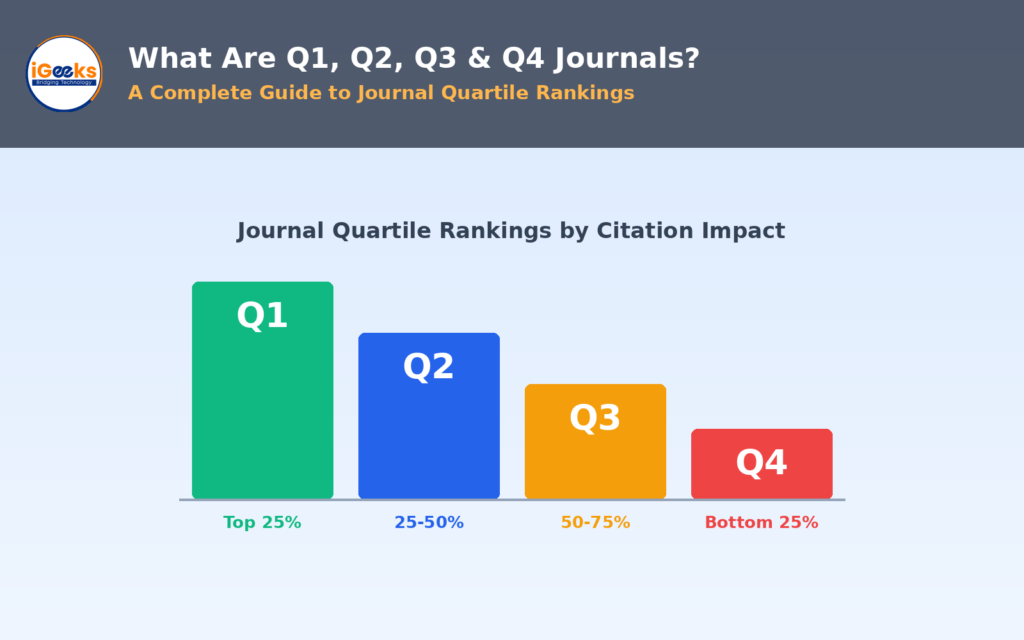
A simplified classification is:
- Q1: Top 25%
- Q2: 25%–50%
- Q3: 50%–75%
- Q4: 75%–100%
However, quartiles can differ according to the database, subject category, metric, and year.
Moving from Q3 to Q1 should therefore not be viewed as simply “changing the journal.”
Instead, the objective should be:
Improve the research and manuscript so that it can compete for publication in stronger journals.
Q3 vs Q1: What Changes?
A Q1-targeted manuscript generally needs to demonstrate stronger performance across several dimensions.
| Area | Typical Q3-Level Approach | Stronger Q1-Targeted Approach |
|---|---|---|
| Research gap | General | Specific and significant |
| Novelty | Limited | Clearly demonstrated |
| Literature | Descriptive | Critical and current |
| Methodology | Basic | Rigorous and justified |
| Analysis | Standard | Robust and appropriate |
| Results | Limited interpretation | Detailed evidence |
| Discussion | Descriptive | Critical comparison |
| Contribution | Narrow | Clearly articulated |
| Presentation | Adequate | Publication-ready |
| Journal selection | Metric-driven | Scope and research-fit driven |
This does not mean every Q3 paper is weak or every Q1 paper is superior in every respect. Quartiles describe journals within ranking systems; they do not directly assign a quality score to an individual article.
1. Start by Auditing Your Existing Paper
Before rewriting the manuscript, conduct a detailed research audit.
Review:
- Title
- Abstract
- Introduction
- Research gap
- Objectives
- Literature review
- Methodology
- Data
- Analysis
- Results
- Discussion
- Limitations
- Conclusion
- References
- Figures
- Tables
Ask:
Research Question
Is the research question important enough for the target journal?
Novelty
What is genuinely new?
Methodology
Can the methodology withstand detailed peer review?
Contribution
Why should researchers in this field care about the findings?
Evidence
Do the results adequately support the conclusions?
This audit identifies the areas that require improvement.
2. Strengthen the Research Gap
One of the biggest differences between a basic manuscript and a competitive manuscript is the quality of the research gap.
A weak gap might say:
“Few researchers have studied this topic.”
A stronger gap explains:
- What previous studies have established
- What they have not established
- Why the limitation exists
- Why the unresolved issue matters
- How your study addresses it
Use this structure:
Existing Knowledge → Limitation → Unresolved Problem → Research Gap → Your Solution
Your research gap should lead naturally to your research objectives.
3. Increase the Novelty of the Study
A paper targeting a highly competitive journal should clearly demonstrate its contribution.
Novelty can come from:
- New methodology
- New theoretical framework
- New dataset
- New application
- New algorithm
- New experimental design
- New population
- New geographical context with meaningful implications
- New empirical evidence
- New interdisciplinary integration
However, simply applying an existing method to a different dataset may not automatically constitute strong novelty.
Explain why the difference matters.
4. Move Beyond a “Basic Application” Study
A common research pattern is:
Existing Algorithm + New Dataset = New Paper
This may have publication potential, but the contribution needs to be justified.
To strengthen the work, consider whether you can provide:
- Comparative evaluation
- Ablation analysis
- Robustness testing
- Explainability
- Error analysis
- External validation
- Theoretical interpretation
- Practical implications
The objective is to move from:
“We applied method X.”
to:
“We demonstrate why method X performs differently under conditions Y and identify the implications for Z.”
5. Upgrade the Literature Review
A Q1-targeted literature review should demonstrate command of the research field.
Do not merely describe previous papers.
Instead, synthesise them around:
- Research themes
- Methodological approaches
- Contradictory findings
- Limitations
- Emerging trends
- Theoretical perspectives
- Unresolved problems
Include relevant recent research while retaining important foundational studies.
Your literature review should eventually answer:
“Why is this study necessary now?”
6. Analyse the Latest Research
Before targeting a Q1 journal, examine recent publications from the field.
Look at papers from approximately the last several years, with particular attention to the most recent relevant studies.
Identify:
- Frequently used methodologies
- Current datasets
- Emerging research questions
- New theoretical frameworks
- Current evaluation metrics
- Important unresolved debates
This can reveal whether your proposed contribution is still sufficiently novel.
7. Upgrade Your Methodology
Methodological rigor is critical.
Review:
Research Design
Is the study design appropriate?
Sampling
Is the sampling strategy defensible?
Data
Is the dataset adequate and properly described?
Variables
Are variables clearly operationalised?
Analysis
Are analytical methods appropriate?
Validation
Have findings been sufficiently validated?
Reproducibility
Could another researcher understand how the analysis was performed?
A Q1 strategy should focus on improving the research itself, not merely improving its language.
8. Strengthen Statistical Analysis
If your paper uses quantitative data, reassess the statistical methodology.
Depending on the research question, this could involve:
- Descriptive statistics
- Hypothesis testing
- Regression analysis
- ANOVA
- Correlation
- Multivariate analysis
- Factor analysis
- Structural equation modelling
- Non-parametric analysis
- Survival analysis
Where appropriate, consider:
- Confidence intervals
- Effect sizes
- Assumption checks
- Robustness tests
- Sensitivity analysis
Do not add statistical techniques simply to make the paper appear more sophisticated.
Every analysis should have a methodological justification.
9. Strengthen Machine-Learning Research
For AI and machine-learning papers, Q1-targeted manuscripts should pay particular attention to evaluation quality.
Consider:
- Appropriate train/validation/test separation
- Cross-validation where appropriate
- Data leakage prevention
- Baseline comparisons
- Hyperparameter methodology
- Ablation studies
- Error analysis
- Multiple evaluation metrics
- Statistical significance where appropriate
- Reproducibility
For classification tasks, metrics may include:
- Accuracy
- Precision
- Recall
- F1-score
- ROC-AUC
For regression tasks:
- MAE
- MSE
- RMSE
- R²
The appropriate metrics depend on the specific research problem.
10. Compare Against Strong Baselines
If your paper proposes a new model or method, demonstrate how it performs compared with appropriate existing approaches.
A strong comparison might include:
Proposed Method vs Baseline 1 vs Baseline 2 vs Recent Method
Explain:
- Why each baseline was selected
- How the experiments were standardised
- Which metrics were used
- Whether the differences are meaningful
This is much stronger than reporting only the performance of your proposed approach.
11. Add Robustness and Sensitivity Analysis
A valuable way to strengthen empirical research is to test whether the main findings remain stable under reasonable changes.
Depending on your study, consider:
- Alternative model specifications
- Different parameter settings
- Different samples
- Different datasets
- Alternative statistical methods
- Different assumptions
Robustness analysis helps demonstrate that your conclusion is not dependent on one narrow analytical choice.
12. Improve the Results Section
Do not simply report numbers.
Explain the important findings.
For every major result, consider:
What happened?
How large was the effect?
Was it statistically or practically meaningful?
Does it answer the research question?
How does it compare with previous studies?
This creates a stronger connection between your analysis and your contribution.
13. Completely Strengthen the Discussion
A weak discussion says:
“Our findings are similar to previous studies.”
A stronger discussion asks:
- Why are they similar?
- Why are they different?
- What explains the differences?
- What does this contribute theoretically?
- What does this mean in practice?
- Under what conditions do the findings apply?
Your discussion should interpret the findings rather than repeat the Results section.
14. Clearly State Theoretical Contributions
Q1 journals often publish research that contributes meaningfully to theory, depending on the journal and field.
Ask:
What does this research change in our understanding of the subject?
Possible contributions include:
- Extending an existing theory
- Challenging an assumption
- Connecting two theoretical perspectives
- Developing a conceptual framework
- Identifying a new relationship
- Explaining an inconsistent finding
If your research is primarily applied, clearly explain its empirical or practical contribution instead.
15. Strengthen Practical Contributions
Explain how the research can be used.
For example:
Healthcare
Could the findings improve clinical decision-making?
Business
Could organizations use the framework for better decisions?
Engineering
Could the method improve system performance?
Education
Could institutions apply the findings to improve learning?
Artificial Intelligence
Could the model improve prediction, efficiency, reliability or interpretability?
Avoid generic statements such as:
“This research will benefit society.”
Explain precisely who benefits and how.
16. Improve Figures and Tables
High-quality presentation can significantly improve readability.
Check:
- Resolution
- Font size
- Labels
- Captions
- Units
- Legends
- Consistency
- Figure numbering
- Table formatting
Every figure should communicate something important.
Avoid decorative graphs that do not contribute to the research argument.
17. Rewrite the Title
Compare:
Basic
“Machine Learning for Disease Prediction”
More Specific
“An Explainable Machine-Learning Framework for Early Disease Risk Prediction Using Multimodal Clinical Data”
The second title communicates:
- Method
- Purpose
- Application
- Data characteristics
Do not add technical terms simply for SEO or appearance. The title must accurately represent the study.
18. Rewrite the Abstract
Your abstract should communicate:
Problem → Objective → Method → Results → Contribution
Include quantitative results where appropriate.
Instead of:
“The proposed method performed better.”
Consider:
“The proposed model achieved an F1-score of X, outperforming the selected baseline methods under the evaluated conditions.”
Only report numbers that are actually supported by your research.
19. Improve the Conclusion
A strong conclusion should not introduce new findings.
It should summarise:
- Main finding
- Contribution
- Implications
- Limitations
- Future research
Avoid exaggerating the scope of your findings.
20. Upgrade Your References
Review your reference list carefully.
Check whether you have included:
- Recent high-quality studies
- Foundational research
- Relevant systematic reviews
- Important competing approaches
- Recent methodological developments
Avoid irrelevant citations merely because they come from prestigious journals.
Citation quality matters more than journal name alone.
21. Improve Research Reproducibility
Where appropriate, provide sufficient information about:
- Data
- Methods
- Algorithms
- Parameters
- Experimental setup
- Statistical procedures
- Evaluation metrics
If data or code can legitimately be shared, follow the target journal’s data/code-sharing policies.
Reproducibility can strengthen the credibility of computational and empirical research.
22. Conduct an Ethics Audit
Before submitting to a more competitive journal, check:
- Research ethics approval
- Informed consent where applicable
- Data privacy
- Conflicts of interest
- Funding disclosure
- Authorship
- Data availability
- AI-use disclosure where required
- Plagiarism
- Image integrity
Do not treat publication ethics as a formatting exercise.
23. Improve Academic Language
A Q1-targeted paper should be clear and precise.
Look for:
- Grammar problems
- Repeated statements
- Ambiguous claims
- Excessive passive voice
- Unnecessary jargon
- Weak transitions
- Inconsistent terminology
Academic editing should improve clarity without changing the scientific meaning.
24. Choose a Q1 Journal Based on Research Fit
Once the manuscript has been strengthened, select the target journal.
Evaluate:
Scope
Does the journal publish research like yours?
Audience
Who reads the journal?
Recent Publications
Are similar papers being published?
Article Type
Does your manuscript match the journal’s accepted article categories?
Editorial Standards
What types of research does the journal typically publish?
Metrics
What are the current relevant journal metrics and quartile classifications?
The goal is not:
“Find the highest Q1 journal.”
The goal is:
“Find the most appropriate credible Q1 journal for this research.”
25. Study 10–20 Recent Papers From the Target Journal
This is an excellent pre-submission exercise.
Create a comparison table:
| Feature | Your Paper | Recent Journal Papers |
|---|---|---|
| Research topic | ||
| Research gap | ||
| Methodology | ||
| Dataset | ||
| Analysis | ||
| Novelty | ||
| Contribution | ||
| Figures | ||
| References |
This reveals where your manuscript may be weaker.
26. Rewrite the Manuscript for the Target Journal
Do not simply replace the journal name in your cover letter.
Adapt:
- Introduction
- Literature review
- Terminology
- Article structure
- Discussion
- References
- Formatting
to the target journal’s audience and requirements.
The manuscript should look like a natural contribution to that journal.
27. Prepare a Strong Cover Letter
Your cover letter should explain:
- What the study investigates
- Why the study matters
- What is novel
- Why it fits the journal
- Why the journal’s readers may find it valuable
Avoid exaggerated claims.
28. Conduct a Pre-Submission Peer Review
Before submission, have the paper reviewed by someone knowledgeable about your field.
Ask them specifically:
- Is the research gap convincing?
- Is the novelty clear?
- Is the methodology rigorous?
- Are the results adequately supported?
- Is the journal appropriate?
- What would cause rejection?
This can reveal problems that authors often miss.
29. Learn From Previous Rejections
If your manuscript has previously been rejected by a Q3 or Q2 journal, use the reviewer reports.
Create three categories:
Must Fix
Major methodological or scientific issues.
Should Fix
Presentation, literature and analysis improvements.
Optional
Minor improvements.
Address substantive reviewer criticism before targeting a more competitive journal.
30. Do Not Confuse Q1 Targeting With Guaranteed Q1 Acceptance
Improving a paper increases its publication potential.
It does not guarantee acceptance.
No legitimate research-support provider can guarantee:
- Q1 acceptance
- Peer-review approval
- Publication within a fixed number of days
- Specific reviewer decisions
The final decision belongs to the journal’s editorial and peer-review process.
A Practical Q3-to-Q1 Upgrade Framework
Use this framework to systematically improve your paper.
Level 1 — Research Gap
Q3 Approach: General problem
↓
Q1 Target: Specific, meaningful unresolved problem
Level 2 — Literature
Q3 Approach: Summary of previous studies
↓
Q1 Target: Critical synthesis and research positioning
Level 3 — Methodology
Q3 Approach: Standard method
↓
Q1 Target: Rigorous, justified and reproducible methodology
Level 4 — Analysis
Q3 Approach: Basic analysis
↓
Q1 Target: Appropriate analysis + validation + robustness
Level 5 — Results
Q3 Approach: Report findings
↓
Q1 Target: Demonstrate and interpret meaningful findings
Level 6 — Contribution
Q3 Approach: State that the study is useful
↓
Q1 Target: Clearly demonstrate theoretical, empirical or practical contribution
Level 7 — Journal Selection
Q3 Approach: Choose a journal based mainly on quartile
↓
Q1 Target: Choose based on scope, audience, research fit, credibility and current metrics
90-Day Q3-to-Q1 Manuscript Improvement Plan
Days 1–15: Research Audit
Review:
- Research question
- Research gap
- Novelty
- Objectives
- Methodology
- Data
- Results
- Contribution
Identify the five biggest weaknesses.
Days 16–30: Literature Upgrade
- Update relevant literature
- Identify recent research
- Strengthen research gap
- Improve theoretical positioning
- Remove irrelevant references
Days 31–45: Methodology Upgrade
- Reassess research design
- Validate data
- Review statistical methods
- Improve experimental design
- Add appropriate validation
Days 46–60: Analysis Upgrade
- Conduct additional justified analysis
- Compare against appropriate baselines
- Perform robustness checks
- Improve tables and figures
- Review statistical interpretation
Days 61–70: Results & Discussion
- Rewrite Results
- Strengthen Discussion
- Compare findings with literature
- Explain theoretical implications
- Explain practical implications
- Strengthen limitations
Days 71–80: Manuscript Editing
Review:
- Title
- Abstract
- Introduction
- Methodology
- Results
- Discussion
- Conclusion
- References
Conduct language and technical editing.
Days 81–85: Journal Selection
Evaluate several appropriate journals.
Check:
- Scope
- Recent publications
- Article type
- Current journal information
- Editorial policies
- Publication model
- Institutional requirements
Days 86–90: Final Submission Preparation
Complete:
- Formatting
- Figures
- Tables
- References
- Cover letter
- Declarations
- Ethics statements
- Data availability statement where applicable
- Final quality check
Then submit through the journal’s official submission system.
Q3 to Q1 Checklist
Research
☐ Strong research problem
☐ Clear research gap
☐ Meaningful novelty
☐ Strong contribution
Literature
☐ Current literature
☐ Critical synthesis
☐ Relevant foundational studies
☐ Clear research positioning
Methodology
☐ Appropriate research design
☐ Adequate data
☐ Justified methodology
☐ Reproducible procedures
Analysis
☐ Appropriate statistical methods
☐ Robust validation
☐ Baseline comparisons
☐ Sensitivity/robustness analysis where appropriate
Manuscript
☐ Strong title
☐ Structured abstract
☐ Clear introduction
☐ Strong discussion
☐ Appropriate conclusion
☐ Clear limitations
Journal
☐ Strong scope match
☐ Recent similar papers reviewed
☐ Current journal information verified
☐ Author guidelines followed
Ethics
☐ Original research
☐ Proper citations
☐ Correct authorship
☐ Ethics approval where required
☐ No fabricated data
☐ AI policies followed
Final Thoughts
Moving from Q3 to Q1 publication is not primarily about changing the journal.
It is about raising the standard of the research and manuscript.
The transformation can be summarised as:
Basic Research Positioning → Strong Research Gap
Descriptive Literature Review → Critical Literature Synthesis
Standard Methodology → Rigorous Methodology
Basic Analysis → Robust Analysis
Reported Results → Interpreted Evidence
General Contribution → Demonstrated Contribution
Journal Based on Quartile → Journal Based on Research Fit
A Q1 target should therefore be approached as a research-quality upgrade project.
There is no guarantee that a revised manuscript will be accepted by a Q1 journal. However, strengthening the research question, novelty, methodology, analysis, discussion, presentation, and journal fit can substantially improve the manuscript’s competitiveness.
Need Research Paper Writing & Publication Support?
Igeeks provides research and academic support for:
- PhD Scholars
- Research Scholars
- Faculty Members
- M.Tech Researchers
- MBA Researchers
- Medical Researchers
- Engineering Researchers
- Computer Science Researchers
Research Support Services
Research Paper Writing | Literature Review | Research Methodology | Statistical Analysis | Data Analysis | Manuscript Editing | Academic Proofreading | Journal Selection | Scopus Publication Guidance | Q1/Q2 Journal Targeting | SCI Publication Support | IEEE Paper Support | Reviewer Response Guidance
Research Paper Writing & Publication Services
https://www.makefinalyearproject.com/research-paper-writing-publication-bangalore.html
7019280372
Share your research topic, abstract/manuscript, research area, previous reviewer comments, and publication requirement to identify areas that can be strengthened before submission.