

Introduction
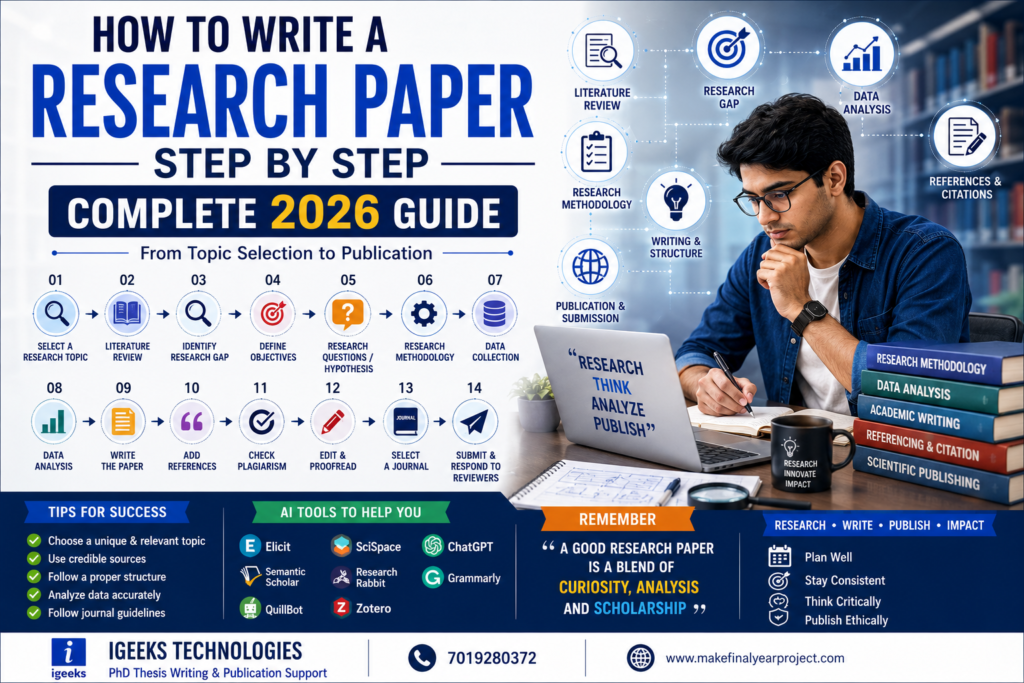
Writing a research paper is one of the most important academic tasks for undergraduate, postgraduate, PhD scholars, and researchers. Whether you are preparing a journal article, conference paper, dissertation chapter, or academic assignment, a well-structured research paper demonstrates your ability to investigate a problem, analyze data, and present findings scientifically.
Many students struggle with selecting a topic, conducting a literature review, organizing references, and writing according to journal guidelines. This comprehensive 2026 guide explains the entire research paper writing process step by step.
What is a Research Paper?
A research paper is an academic document that presents original research, analysis, interpretation, or findings on a specific topic. It is based on systematic investigation and supported by evidence collected through experiments, surveys, case studies, or literature reviews.
Types of Research Papers
- Original Research Papers
- Review Papers
- Survey Papers
- Case Study Papers
- Systematic Literature Reviews
- Conference Papers
- Journal Articles
Step 1: Select a Research Topic
Choosing the right research topic is the foundation of a successful paper.
Characteristics of a Good Research Topic
- Relevant to your field
- Unique and innovative
- Researchable within available resources
- Supported by sufficient literature
- Addresses a real-world problem
Example Topics
Computer Science
- AI-Based Healthcare Prediction Systems
- Cybersecurity Threat Detection Using Machine Learning
Management
- Impact of Artificial Intelligence on Consumer Behavior
Medical Sciences
- Effectiveness of Telemedicine in Rural Healthcare
Step 2: Conduct Literature Review
A literature review helps understand previous studies and identify research gaps.
Sources for Literature Review
- Google Scholar
- Scopus
- Web of Science
- IEEE Xplore
- Springer
- Elsevier ScienceDirect
- PubMed
Objectives
- Understand existing research
- Identify limitations in previous studies
- Find research gaps
- Build theoretical foundation
AI Tools for Literature Review
- Elicit AI
- Semantic Scholar
- Research Rabbit
- Consensus
- SciSpace
Step 3: Identify the Research Gap
A research gap refers to an unanswered question or limitation in existing studies.
Ways to Find Research Gaps
- Analyze limitations of published papers
- Compare conflicting findings
- Explore emerging technologies
- Investigate under-researched populations
Example
Existing studies predict heart disease using clinical data.
Research Gap:
Limited studies combine wearable sensor data with AI algorithms for real-time prediction.
Step 4: Define Research Objectives
Research objectives clearly state what the study aims to achieve.
Example
Objective 1:
Develop a machine learning model for disease prediction.
Objective 2:
Evaluate model accuracy using real-world datasets.
Objective 3:
Compare results with existing approaches.
Step 5: Formulate Research Questions or Hypotheses
Research Questions
- What factors influence online consumer purchasing behavior?
- How accurate is the proposed prediction model?
Hypothesis Example
H1: Artificial intelligence significantly improves disease prediction accuracy.
H0: Artificial intelligence does not significantly improve disease prediction accuracy.
Step 6: Design Research Methodology
Research methodology explains how the study will be conducted.
Quantitative Research
- Surveys
- Experiments
- Statistical Analysis
Qualitative Research
- Interviews
- Focus Groups
- Observations
Mixed Method Research
Combination of quantitative and qualitative approaches.
Step 7: Collect Data
Data collection depends on research objectives.
Primary Data
- Questionnaires
- Interviews
- Surveys
- Experiments
Secondary Data
- Published Journals
- Government Reports
- Company Records
- Online Databases
Tools Used
- Google Forms
- SurveyMonkey
- Qualtrics
- SPSS
- Excel
Step 8: Analyze Data
Data analysis converts raw information into meaningful findings.
Quantitative Analysis Tools
- SPSS
- R Programming
- Python
- Excel
- MATLAB
Qualitative Analysis Tools
- NVivo
- Atlas.ti
Common Statistical Tests
- Descriptive Statistics
- Correlation Analysis
- Regression Analysis
- ANOVA
- Chi-Square Test
- T-Test
Step 9: Write the Research Paper
Most journals follow the IMRAD structure.
Title
Create a concise and informative title.
Example:
Artificial Intelligence-Based Heart Disease Prediction Using Machine Learning Algorithms
Abstract
The abstract summarizes:
- Research problem
- Objectives
- Methodology
- Results
- Conclusion
Recommended Length:
150–250 words
Introduction
Include:
- Background
- Problem Statement
- Research Gap
- Objectives
- Significance of Study
Literature Review
Discuss:
- Previous studies
- Existing methods
- Research limitations
- Gap identification
Methodology
Explain:
- Research Design
- Sample Size
- Data Collection Methods
- Statistical Tools
Results and Discussion
Present:
- Tables
- Graphs
- Statistical Findings
- Interpretation
Conclusion
Summarize:
- Key findings
- Contributions
- Future scope
Step 10: Add References
Proper referencing improves credibility and avoids plagiarism.
Popular Citation Styles
- APA
- IEEE
- MLA
- Harvard
- Chicago
- Vancouver
Citation Tools
- Zotero
- Mendeley
- EndNote
Step 11: Check Plagiarism
Most universities require plagiarism below prescribed limits.
Popular Plagiarism Checkers
- Turnitin
- iThenticate
- Grammarly Plagiarism Checker
Recommended Similarity:
Less than 10%
Step 12: Edit and Proofread
Review the paper for:
- Grammar
- Clarity
- Formatting
- Citations
- Reference Accuracy
Academic Editing Tools
- Grammarly
- Paperpal
- ChatGPT
- QuillBot
Step 13: Select a Journal
Choose journals based on:
- Research Domain
- Indexing
- Impact Factor
- Review Timeline
Popular Indexing Databases
- Scopus
- SCI
- Web of Science
- PubMed
Step 14: Submit and Respond to Reviewers
After submission:
- Address reviewer comments carefully
- Revise manuscript professionally
- Highlight changes made
- Submit revised version
Many papers are accepted after one or more rounds of revision.
Common Mistakes to Avoid
❌ Weak research problem
❌ Insufficient literature review
❌ Poor data analysis
❌ Improper citations
❌ High plagiarism
❌ Ignoring journal guidelines
❌ Unsupported conclusions
Research Paper Writing Support
Many students and researchers require expert assistance for:
- Topic Selection
- Research Proposal Writing
- Literature Review
- Data Analysis
- SPSS, R, Python Analysis
- Journal Paper Writing
- Scopus Publication Support
- PhD Thesis Writing
- Reviewer Comment Responses
For professional research paper and thesis support, visit:
https://www.makefinalyearproject.com/phd-thesis-help-bangalore.aspx
Frequently Asked Questions (FAQs)
1. How long does it take to write a research paper?
Depending on complexity, it may take from a few weeks to several months.
2. What is the ideal length of a research paper?
Most journal papers range from 4,000 to 8,000 words, while conference papers are often shorter.
3. Can AI help write a research paper?
AI tools can assist with literature review, editing, summarization, and brainstorming, but researchers must verify all content.
4. How many references should a research paper have?
Typically between 20 and 100 references depending on the field and paper type.
5. Which citation style is most commonly used?
APA, IEEE, and Harvard are among the most widely used citation styles.
6. What plagiarism percentage is acceptable?
Many universities prefer similarity below 10%, though requirements vary.
7. Which software is best for statistical analysis?
SPSS, R, Python, Excel, and MATLAB are commonly used.
8. How do I find a research gap?
Review recent literature, identify limitations, and explore unanswered questions.
9. Can undergraduate students publish research papers?
Yes. Many journals and conferences accept quality research from undergraduate students.
10. How can I publish my research paper in Scopus journals?
Choose an appropriate journal, follow author guidelines, prepare a quality manuscript, and address reviewer comments effectively.
Conclusion
Writing a research paper is a systematic process that begins with selecting a research topic and ends with publication. By following a structured approach—literature review, research gap identification, methodology design, data analysis, writing, plagiarism checking, and journal submission—students and researchers can significantly improve their chances of publication success. In 2026, combining academic expertise with AI-powered research tools can make research paper writing faster, more efficient, and more impactful.