

For many PhD scholars, publishing research papers in reputed journals is an important part of their academic journey. Researchers often hear terms such as Q1, Q2, Q3, Scopus, SCI, CiteScore, SJR, and SNIP when planning their publication strategy.
Among these, Q1 journals are often considered highly desirable because they occupy the top quartile of a relevant journal ranking category. Scopus provides journal metrics such as CiteScore, CiteScore percentile, CiteScore quartile, SJR, and SNIP to help researchers evaluate and compare publication venues.
However, an important question is:
Does every PhD scholar need to publish in a Q1 journal?
The answer is not necessarily.
A Q1 publication can be highly valuable, but a well-matched Q2 or Q3 journal may sometimes be a more sensible choice depending on the research topic, university requirements, article quality, journal scope, publication timeline, budget, and researcher’s career objectives.
This guide explains why Q1 publication matters and when choosing a Q2 or Q3 journal may be the smarter research strategy.
What Do Q1, Q2, Q3 and Q4 Mean?
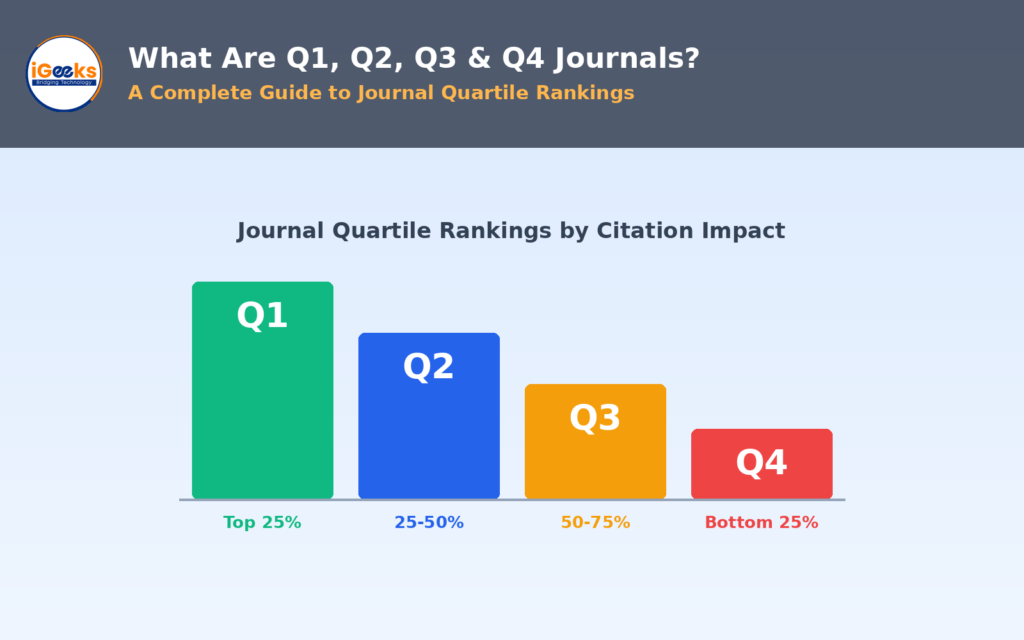
Journal quartiles divide journals within a particular subject category into four groups.
Generally:
- Q1: Top 25%
- Q2: 25%–50%
- Q3: 50%–75%
- Q4: 75%–100%
The exact ranking should always be checked against the relevant database, subject category, metric, and year.
Scopus provides CiteScore quartiles and percentile information for sources, while also providing other journal-level metrics such as SJR and SNIP.
Importantly, a journal can have different quartiles in different subject categories. Therefore, simply seeing “Q1” somewhere is not enough. Researchers should verify the specific category and current ranking relevant to their research.
Why Does Q1 Publication Matter for PhD Scholars?
1. It Can Strengthen Your Research Profile
Publishing in a highly ranked journal can strengthen a researcher’s publication profile.
A strong publication record may be useful when applying for:
- Academic positions
- Postdoctoral opportunities
- Research grants
- Research collaborations
- Fellowships
- International academic opportunities
However, the value of a publication should not be judged by quartile alone.
2. Greater Visibility for Your Research
High-quality journals can provide greater exposure to the research community.
Scopus provides author and article-level metrics that allow researchers to monitor citations, citation benchmarking, and other indicators of research influence.
Greater visibility can potentially lead to:
- More researchers discovering your work
- More citations
- Academic collaboration
- Invitations to research activities
- Greater recognition within your field
3. Stronger Evidence of Research Quality
A reputable journal with rigorous peer review can provide an external evaluation of your research.
The review process may identify:
- Methodological weaknesses
- Unsupported conclusions
- Literature gaps
- Statistical problems
- Presentation issues
- Interpretation problems
Addressing these issues can improve the final research paper.
4. Useful for Academic Career Development
For researchers pursuing academic careers, a strong publication record can contribute to their overall academic profile.
However, institutions differ in how they evaluate publications. Therefore, PhD scholars should check their university, department, supervisor, funding body, or recruitment requirements rather than assuming that Q1 is universally mandatory.
The UGC maintains current regulations and guidelines for Indian higher education, while individual universities may have additional PhD and publication requirements.
Does Every PhD Scholar Need a Q1 Publication?
No.
This is one of the most important points researchers should understand.
The appropriate publication target depends on the specific PhD programme and institutional requirements.
For example, one university may require publication in a particular indexed journal, while another may have its own requirements concerning Scopus, Web of Science, quartiles, or approved journal lists.
Therefore, before selecting a Q1 journal, ask:
What exactly does my university require?
Check:
- PhD regulations
- University research guidelines
- Department requirements
- Supervisor’s recommendations
- Thesis submission requirements
- Fellowship requirements
- Institutional publication policies
Do not spend significant time or money targeting a Q1 journal if your programme does not require it and another reputable journal provides a better fit for your research.
When Is Q1 the Right Choice?
Q1 can be an excellent target when several conditions are satisfied.
Your Research Has Strong Novelty
If your study provides a significant new:
- Method
- Algorithm
- Theory
- Framework
- Dataset
- Experimental result
- Clinical finding
- Business model
- Research insight
then a high-ranking journal may be an appropriate target.
Your Methodology Is Strong
A Q1 submission typically needs a well-designed methodology.
The research should clearly explain:
- Research design
- Data sources
- Sample selection
- Variables
- Experimental setup
- Statistical methods
- Evaluation criteria
- Limitations
Your Manuscript Fits the Journal
A strong paper submitted to the wrong journal can still receive a rejection.
Before targeting a Q1 journal, check:
- Aims and scope
- Recent publications
- Article types
- Methodological preferences
- Subject category
- Editorial policies
You Have a Long-Term Academic Goal
Q1 publication can be particularly attractive for researchers aiming to build an internationally visible publication profile.
It may be relevant when targeting:
- Postdoctoral positions
- Research-intensive academic careers
- International collaborations
- Competitive research funding
- High-level research projects
When Can Q2 Be a Smarter Choice?
Q2 journals should not be treated simply as “second-best” journals.
A reputable Q2 journal can be an excellent publication venue when it provides a stronger fit for the actual research paper.
Consider Q2 when:
The Journal Has Excellent Scope Fit
Suppose your paper is highly specialised and a Q2 journal publishes a substantial amount of research in exactly your niche.
That may be preferable to a Q1 journal with only a broad connection to your subject.
Your Research Is Solid but Highly Specialised
A specialised research contribution may have greater relevance and visibility within an appropriate Q2 journal.
Your University Accepts Q2
If your institutional requirement accepts Q2 publications, there may be little reason to pursue a substantially more difficult Q1 target solely for prestige.
The Q2 Journal Has the Right Audience
The purpose of research publication is not only to obtain a quartile label.
You want the researchers who can understand, use, cite, and build upon your work to find it.
When Can Q3 Be the Smarter Choice?
Q3 can also be an appropriate choice depending on the research and institutional requirements.
For example, a Q3 journal may be sensible when:
- The journal has an excellent subject fit.
- Your university accepts the journal.
- The journal has legitimate peer-review procedures.
- The research is appropriate for its readership.
- The publication model suits your requirements.
- You are building your early publication record.
- The research is valuable but not aimed at a highly competitive journal.
The important distinction is:
Choose a legitimate, relevant Q3 journal—not simply any journal claiming to be indexed.
Q1 vs Q2 vs Q3: Which Should You Choose?
| Factor | Q1 | Q2 | Q3 |
|---|---|---|---|
| Relative ranking | Highest quartile | Second quartile | Third quartile |
| Competition | Usually high | Moderate–high | Variable |
| Scope fit | Essential | Essential | Essential |
| Research expectations | Often very high | High | Varies |
| Potential visibility | Often strong | Strong | Variable |
| Publication difficulty | Often higher | Moderate–high | Variable |
| Suitable for PhD? | Yes | Yes | Yes, if permitted |
| University requirement | Must verify | Must verify | Must verify |
| Best strategy | Strong/high-impact research | Strong specialised research | Appropriate, legitimate research venue |
The correct choice depends on the research, not just the quartile.
Don’t Confuse Quartile With Research Quality
Quartile is a useful indicator, but it is not a complete measure of research quality.
Elsevier specifically recommends using both qualitative and quantitative information when evaluating research and using more than one metric rather than relying on a single measure.
Researchers should therefore consider:
- Journal scope
- Peer-review quality
- Editorial board
- Citation metrics
- SJR
- SNIP
- CiteScore
- CiteScore percentile
- Recent publications
- Publication ethics
- Indexing status
- Research audience
What Are CiteScore, SJR and SNIP?
CiteScore
CiteScore is a Scopus-based journal metric used to evaluate citation impact. Scopus provides CiteScore, percentile, rank, quartile, and other related indicators.
SJR
SCImago Journal Rank is a prestige-oriented metric that weights citations according to the field, quality, and reputation of the citing source.
SNIP
Source-Normalized Impact per Paper accounts for differences in citation behaviour between subject fields, making it useful when comparing journals across disciplines.
A responsible journal-selection strategy should consider multiple indicators rather than choosing a journal because of one number.
Why Journal-Research Fit Matters More Than Quartile Alone
Imagine you have two options:
Journal A
Q1
Broad subject scope
Very high competition
Limited recent publications related to your specific topic
Journal B
Q2
Highly specialised subject scope
Many recent papers similar to your methodology
Strong readership in your research area
Which is better?
There is no universal answer.
For some researchers, Journal A may be the appropriate target. For others, Journal B may offer a substantially better research fit.
This is why scope matching should be one of the first steps in journal selection.
How to Decide Your Publication Strategy
Use this simple decision process.
Step 1: Check University Requirements
Find out exactly what your PhD programme requires.
Step 2: Define Your Research Contribution
Identify the novelty and significance of your research.
Step 3: Identify Appropriate Journals
Create a shortlist of Q1, Q2, and Q3 journals relevant to your topic.
Step 4: Compare Journal Metrics
Review:
- Quartile
- Percentile
- CiteScore
- SJR
- SNIP
- Citation trends
Step 5: Read Recent Papers
Look at 5–10 recent papers from each shortlisted journal.
Step 6: Compare Scope
Determine how closely your manuscript matches the journal.
Step 7: Check Publication Policies
Review:
- Peer review
- APCs
- Open access
- Ethics policies
- Submission requirements
Step 8: Select the Best Target
Choose the journal that offers the strongest combination of:
Research Fit + Quality + Credibility + Institutional Acceptance + Practicality
A Smart PhD Publication Strategy
Instead of thinking:
“I must publish only in Q1.”
Think:
“I need to publish my strongest research in the most appropriate reputable journals for my academic objectives.”
A PhD publication strategy could potentially include:
Paper 1 → Strong Q2/Q3 journal
Paper 2 → Strong Q2/Q1 target
Paper 3 → Q1 target for the strongest research contribution
This can be more strategic than forcing every paper into a Q1 journal.
The exact strategy should depend on your university requirements and research objectives.
Common Mistakes PhD Scholars Make
Mistake 1: Chasing Q1 Without Checking Scope
A Q1 journal outside your research area may be a poor target.
Mistake 2: Assuming Q1 Means Guaranteed Career Success
Publication metrics are only one component of an academic profile.
Mistake 3: Ignoring University Requirements
Your institution’s rules should be checked first.
Mistake 4: Looking at Old Quartile Information
Journal rankings and metrics change.
Always verify current information.
Mistake 5: Selecting a Journal Based Only on CiteScore
Use multiple metrics and qualitative information.
Mistake 6: Trusting Guaranteed Publication Claims
Legitimate journals conduct independent editorial and peer-review processes. No ethical service can guarantee acceptance simply because a manuscript is submitted.
Mistake 7: Ignoring Publication Ethics
Researchers should avoid:
- Fabricated data
- Duplicate publication
- Plagiarism
- Manipulated images
- Improper authorship
- Simultaneous submissions
- Citation manipulation
How Professional Research Support Can Help
Researchers may seek professional academic support for:
- Research topic refinement
- Literature review
- Research methodology
- Statistical analysis
- Manuscript structure
- Academic language editing
- Reference formatting
- Journal selection
- Journal comparison
- Manuscript formatting
- Reviewer-response guidance
- Publication strategy
The purpose should be to strengthen the researcher’s own work while maintaining appropriate authorship, originality, and academic-integrity standards.
Q1, Q2 or Q3: A Practical Decision Matrix
Before selecting your journal, score each candidate from 1–5.
| Factor | Weight |
|---|---|
| Scope match | 30% |
| Research quality fit | 20% |
| Institutional acceptance | 15% |
| Peer-review credibility | 10% |
| Journal metrics | 10% |
| Target readership | 5% |
| Publication cost | 5% |
| Practical timeline | 5% |
This approach prevents the quartile from becoming the only factor in your decision.
Final Takeaway
Q1 publication matters—but it is not automatically the right target for every PhD paper.
A Q1 journal can provide a strong publication target for high-quality, novel research and can contribute to a researcher’s academic visibility and publication profile.
However, a reputable Q2 or Q3 journal can sometimes be the smarter choice when it provides better scope alignment, appropriate readership, reasonable publication conditions, and satisfies the researcher’s institutional requirements.
The smartest publication strategy is therefore:
Don’t chase the highest quartile blindly. Choose the right journal for the right research.
Always verify the current journal metrics, quartile, subject category, indexing status, and institutional requirements before submission. Scopus provides source-level metrics and ranking information that researchers can use for this evaluation.
Need Research Paper and Journal Publication Support?
Researchers and PhD scholars can seek guidance with:
- Research Paper Writing
- Literature Review
- Research Methodology
- Statistical Analysis
- Manuscript Editing
- Journal Selection
- Scopus Publication Support
- SCI Publication Support
- IEEE Paper Support
- Reviewer Comment Response
- Journal Formatting
🌐 Research Paper Writing & Publication Services
Igeeks Technologies:
https://www.makefinalyearproject.com/research-paper-writing-publication-bangalore.html
7019280372
Share your research topic, abstract/manuscript, subject area, university publication requirement, and target journal category to discuss suitable research and publication support.