

For PhD scholars, research professionals, faculty members, and postgraduate students, selecting the right journal is one of the most important decisions in the publication process.
Researchers frequently compare Q1 vs Q2 vs Q3 journals when deciding where to submit their research papers. Q1 journals are often considered highly competitive and prestigious, while Q2 and Q3 journals may provide excellent opportunities for research that has a strong subject fit but may not necessarily need the most competitive publication venue.
But is Q1 always better than Q2? Is Q2 better than Q3? And should every PhD scholar target a Q1 journal?
The answer is more nuanced than simply choosing the highest quartile.
A suitable journal should be evaluated based on research quality, scope, subject category, peer-review practices, indexing status, readership, publication requirements, and institutional expectations.
Scopus provides journal-level indicators such as CiteScore, CiteScore percentile and quartile, SJR, and SNIP that researchers can use when comparing journals. Elsevier also recommends using both qualitative and quantitative information rather than relying on a single metric.
What Are Q1, Q2, Q3 and Q4 Journals?
Journal quartiles are used to position journals within a particular subject category.
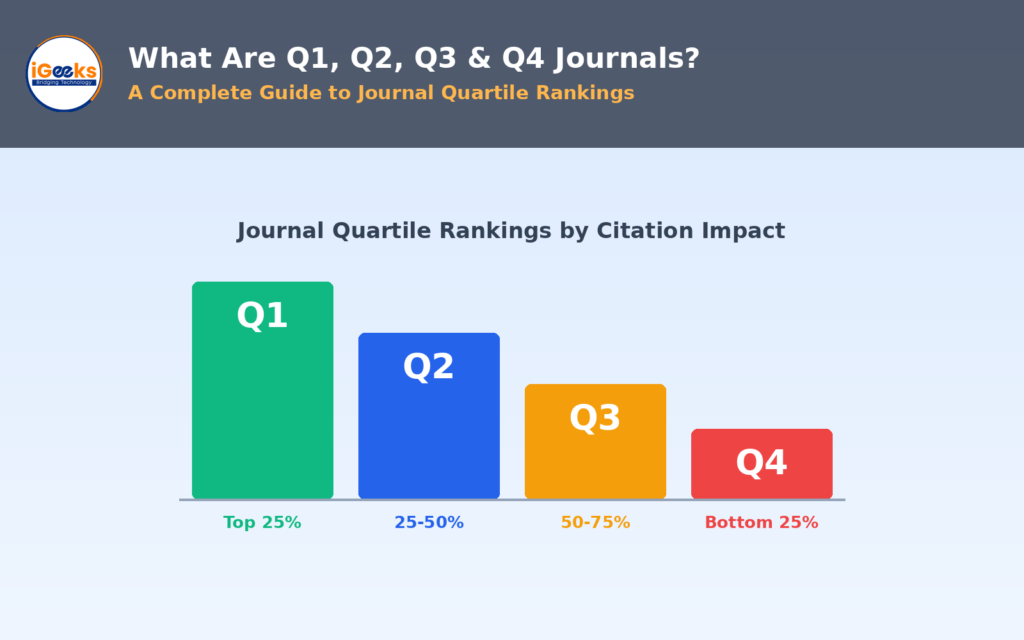
In a commonly used quartile framework:
- Q1: Top 25%
- Q2: 25%–50%
- Q3: 50%–75%
- Q4: 75%–100%
The exact quartile depends on the ranking system, metric, year, and subject category being considered.
For Scopus, researchers can use the Sources platform to review CiteScore-related rankings and quartiles. Scopus titles may also belong to more than one subject area, meaning a journal’s position can vary between categories.
Therefore, when someone says that a journal is “Q1,” always ask:
Q1 in which subject category, according to which metric, and for which year?
Q1 vs Q2 vs Q3: Quick Comparison
| Factor | Q1 Journal | Q2 Journal | Q3 Journal |
|---|---|---|---|
| Relative position | Top quartile | Second quartile | Third quartile |
| Competition | Usually high | Moderate to high | Varies |
| Research expectations | Often very high | High | Varies by journal |
| Scope fit | Extremely important | Extremely important | Extremely important |
| Visibility | Often strong | Often strong | Varies |
| Acceptance difficulty | Often higher | Moderate to high | Varies |
| PhD suitability | Yes | Yes | Yes, if institution permits |
| Best for | Strong, high-impact research | Strong specialised research | Relevant and credible research |
| Institutional acceptance | Must verify | Must verify | Must verify |
The table is a general comparison, not a universal rule. Individual journals can differ substantially within the same quartile.
What Is a Q1 Journal?
A Q1 journal is generally a journal placed in the highest quartile within a relevant subject category under the ranking system being used.
Q1 journals can be attractive to researchers because they are positioned relatively highly among journals in their category.
They may be particularly relevant for:
- High-impact research
- Highly novel research
- International research visibility
- Competitive academic profiles
- Research-intensive careers
- Postdoctoral applications
- Competitive research collaborations
However, Q1 status alone does not prove that a particular journal is the best destination for a particular paper.
A Q1 journal with poor scope alignment can be a worse choice than a Q2 journal that publishes research very similar to yours.
What Is a Q2 Journal?
A Q2 journal generally falls within the second quartile of its relevant category.
Q2 journals can be an excellent choice for researchers who want reputable publication venues while prioritising strong research-topic alignment.
Q2 may be particularly suitable when:
- Your research has a focused contribution.
- The journal regularly publishes similar research.
- Your university accepts Q2 publications.
- The journal has a strong readership in your field.
- The manuscript fits the journal’s aims and scope.
- You want to target a credible journal without automatically pursuing the most competitive option.
Q2 should not be viewed simply as a “lower-quality Q1.”
The right question is:
Which journal provides the strongest fit for my research objectives?
What Is a Q3 Journal?
A Q3 journal generally falls within the third quartile of its relevant subject category.
A reputable Q3 journal may be appropriate for research that fits its scope and meets the journal’s quality requirements.
Q3 may be worth considering when:
- The journal has a strong subject fit.
- Your university or institution accepts it.
- The journal follows a legitimate peer-review process.
- The readership matches your research.
- The publication model fits your requirements.
- You are developing your publication record.
- The research is specialised and better suited to that journal’s audience.
The important point is to distinguish a legitimate Q3 journal from an unsuitable or questionable publication venue.
Q1 vs Q2 vs Q3: Which Is Better?
There is no universal answer.
The “best” journal depends on your research.
Consider this example:
Journal A — Q1
- Broad scope
- Extremely competitive
- Few recent papers related to your specific topic
Journal B — Q2
- Highly relevant scope
- Many recent papers using similar methodology
- Strong audience for your research
Journal C — Q3
- Very specialised scope
- Directly relevant readership
- Accepted by your institution
In this situation, Journal B or even Journal C could potentially be a more strategic choice than Journal A, depending on your objectives.
Quartile should therefore be one factor—not the only factor—in journal selection.
Why Research-Journal Fit Matters
One of the most common reasons for manuscript rejection is a mismatch between the research and the journal’s scope.
Before selecting a journal, examine:
- Aims and scope
- Subject categories
- Recent publications
- Article types
- Research methodologies commonly published
- Target readership
- Editorial policies
Read several recent papers from the journal.
Ask yourself:
“Does my research belong in this journal?”
If the answer is yes, the journal may be worth considering.
Q1 vs Q2 vs Q3 for PhD Scholars
PhD scholars often need to balance several competing priorities.
These may include:
- University publication requirements
- Supervisor expectations
- Research quality
- Publication budget
- Publication timeline
- Career objectives
- Research visibility
- Journal credibility
When Q1 May Be the Best Choice
Targeting Q1 can make sense when:
- Your research has strong novelty.
- The methodology is rigorous.
- The manuscript is mature.
- The research contribution is significant.
- The journal has excellent scope alignment.
- Your university or career goals make Q1 particularly valuable.
When Q2 May Be the Smarter Choice
Q2 can be a strong option when:
- Your research is specialised.
- The journal has an excellent scope match.
- Your institution accepts Q2.
- The target audience is highly relevant.
- The manuscript is strong but not necessarily suited to the most competitive Q1 venues.
When Q3 May Be the Smarter Choice
Q3 can be appropriate when:
- The journal is reputable.
- The research fits its scope closely.
- Your institution accepts it.
- The audience is relevant.
- The journal provides an appropriate publication platform for your research.
Don’t Select a Journal Based Only on Quartile
This is one of the most important principles in journal selection.
Elsevier recommends responsible use of research metrics, including combining qualitative assessment with quantitative metrics and using more than one metric rather than relying on a single indicator.
Researchers should therefore examine multiple factors.
1. CiteScore
CiteScore is a Scopus journal-level metric used to assess citation impact. Scopus provides CiteScore and related indicators such as percentile, rank, and quartile.
2. SJR
SCImago Journal Rank is a prestige-oriented metric that considers the value of citations based on the field, quality, and reputation of the citing source.
3. SNIP
Source-Normalized Impact per Paper considers differences in citation practices between disciplines and provides contextual information about citation impact.
4. Journal Scope
Your research should fit the journal’s subject area and aims.
5. Recent Publications
Check whether the journal is currently publishing research similar to yours.
6. Peer-Review Process
Look for clear information about editorial and peer-review procedures.
7. Publication Ethics
Review the journal’s policies on:
- Plagiarism
- Authorship
- Conflicts of interest
- Corrections
- Retractions
- Research integrity
8. Publication Charges
Check whether the journal has:
- APCs
- Open-access fees
- Submission charges
- Other publication costs
Charges vary by journal and publishing model, so always check the official journal website.
How to Choose Between Q1, Q2 and Q3
Use the following process.
Step 1: Understand Your Research
Identify:
- Research topic
- Research problem
- Research gap
- Research methodology
- Main contribution
- Keywords
Step 2: Check Your Institutional Requirements
Before targeting a journal, check:
- University PhD regulations
- Department requirements
- Supervisor recommendations
- Thesis submission requirements
- Fellowship requirements
- Research-grant conditions
Your university may specify a particular indexing database, journal category, or publication standard.
Step 3: Create a Journal Shortlist
Identify approximately 5–10 potentially suitable journals.
Include a mixture of:
- Q1
- Q2
- Q3
if appropriate for your research and institutional requirements.
Step 4: Compare the Journals
Create a journal comparison table.
| Criteria | Journal A | Journal B | Journal C |
|---|---|---|---|
| Quartile | Q1 | Q2 | Q3 |
| Scope match | High | Very High | High |
| Recent similar papers | Few | Many | Many |
| Peer-review information | Clear | Clear | Clear |
| Publication cost | Check | Check | Check |
| Target audience | Broad | Highly relevant | Specialised |
| Institutional acceptance | Verify | Verify | Verify |
Step 5: Read Recent Research Papers
Read at least several recent papers from each shortlisted journal.
Compare:
- Writing style
- Research methodology
- Statistical methods
- Figures
- Tables
- Reference style
- Paper length
- Research contribution
Step 6: Verify Current Journal Information
Journal metrics and rankings can change.
Before submission, verify:
- Current indexing
- Current quartile
- Current subject category
- Current metrics
- Publisher information
- Author guidelines
- Publication charges
Scopus provides free access through Scopus Preview to journal rankings and other measures, making it useful for preliminary journal verification.
Q1 vs Q2 vs Q3: A Practical Decision Framework
You can score each journal from 1 to 5.
| Factor | Suggested Importance |
|---|---|
| Scope match | Very High |
| Research quality fit | Very High |
| Institutional acceptance | Very High |
| Peer-review credibility | High |
| Research audience | High |
| Current indexing | High |
| Journal metrics | Medium |
| Publication cost | Medium |
| Publication timeline | Medium |
This approach ensures that your decision is based on the complete publication strategy rather than the quartile alone.
What Should You Prioritise?
A useful priority order is:
1. Research-journal fit
↓
2. Journal credibility and indexing
↓
3. Institutional requirements
↓
4. Peer-review and publication ethics
↓
5. Relevant journal metrics
↓
6. Publication cost and practical considerations
↓
7. Quartile
This does not mean quartile is unimportant. It means quartile should be interpreted in context.
Common Mistakes When Choosing Q1, Q2 or Q3 Journals
Mistake 1: Choosing Only Q1
Not every paper needs a Q1 journal.
Mistake 2: Ignoring Scope
A high-ranking journal outside your research area is not necessarily a good target.
Mistake 3: Using Outdated Metrics
Always verify current information.
Mistake 4: Ignoring Subject Categories
A journal can be classified in multiple subject areas. Its ranking can therefore vary by category.
Mistake 5: Focusing Only on CiteScore
Use multiple metrics and qualitative evaluation.
Mistake 6: Believing Guaranteed Publication Claims
Legitimate journals make independent editorial and peer-review decisions. No ethical publication-support provider can guarantee acceptance.
Mistake 7: Ignoring Publication Ethics
Researchers should avoid:
- Plagiarism
- Fabricated data
- Duplicate publication
- Improper authorship
- Simultaneous submission
- Citation manipulation
Q1 vs Q2 vs Q3: Which One Should You Finally Choose?
Use this simple guideline:
Choose Q1 when:
Your research is highly novel + your manuscript is strong + the journal has excellent scope fit + your institutional/career objectives justify the target.
Choose Q2 when:
Your research has a strong contribution + the journal has excellent subject alignment + Q2 meets your institutional objectives.
Choose Q3 when:
The journal is credible + your research fits its scope + the journal is accepted by your institution + its readership is relevant.
The goal should not be:
“Publish at the highest quartile at any cost.”
The goal should be:
“Publish strong research in the most appropriate credible journal for my research and academic objectives.”
Final Thoughts
The debate around Q1 vs Q2 vs Q3 journals is often oversimplified.
Q1 journals can offer highly competitive publication opportunities and may be valuable for researchers seeking strong academic visibility. Q2 journals can provide excellent opportunities for high-quality and specialised research. Q3 journals can also be appropriate when they are credible, relevant, and accepted by the researcher’s institution.
There is no single quartile that is automatically right for every research paper.
The best journal is the one that combines:
Strong Research Fit + Credibility + Appropriate Indexing + Relevant Audience + Institutional Acceptance + Suitable Publication Conditions.
Use journal metrics as evidence, not as the entire decision. Scopus provides CiteScore, SJR, SNIP and other indicators, while Elsevier recommends combining quantitative metrics with qualitative assessment.
Need Research Paper Writing and Publication Support?
Igeeks provides academic research support for researchers and PhD scholars, including:
- Research Paper Writing
- Research Methodology Support
- Literature Review
- Statistical Analysis
- Manuscript Editing
- Research Paper Formatting
- Journal Selection Support
- Scopus Publication Guidance
- SCI Publication Support
- IEEE Paper Support
- Reviewer Comment Response Guidance
- Publication Preparation
🌐 Research Paper Writing & Publication Services
Igeeks Technologies:
https://www.makefinalyearproject.com/research-paper-writing-publication-bangalore.html
7019280372
Share your research topic, abstract/manuscript, research area, university publication requirement, and preferred journal category to discuss suitable research and publication support.