

Publishing a research paper in a high-quality journal is an important objective for PhD scholars, faculty members, postgraduate students, and researchers. However, one of the biggest challenges is not simply writing the paper—it is identifying a journal that genuinely matches the research topic, methodology, quality, and publication requirements.
Many researchers search for a Q1 journal because Q1 generally refers to journals placed in the top quartile of a relevant subject category. However, choosing a journal only because it is labelled Q1 can be a mistake. A journal may have different rankings across subject categories, and journal metrics and classifications can change over time. Scopus itself notes that a source can have different quartiles in different subject areas.
This guide explains how to find, evaluate, and choose a suitable Q1 journal for your research paper.
What Is a Q1 Journal?
A journal quartile is generally used to indicate its relative position within a specific subject category.
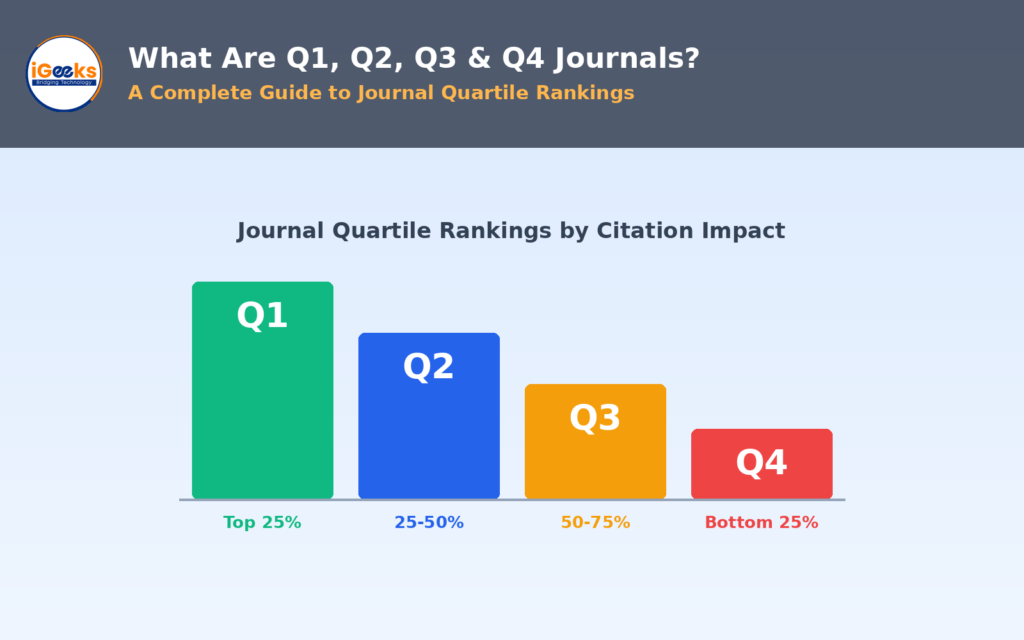
In the Scopus Sources system, journals can be filtered using CiteScore quartiles. A Quartile 1 (Q1) source falls within the top 25% of comparable sources in the selected subject area. Scopus defines Q1 as titles in the 99th–75th percentile range for the relevant category.
However, researchers should remember that:
- A journal may belong to multiple subject categories.
- Its quartile can differ between categories.
- Metrics can change from year to year.
- Subject classifications may also change over time.
Therefore, always verify the specific category, metric year, and current journal status relevant to your university or research requirement.
Why Is Choosing the Right Journal Important?
Selecting an unsuitable journal can result in:
- Immediate desk rejection
- Long publication delays
- Multiple rounds of revision
- Scope mismatch
- Unnecessary publication costs
- Rejection after significant waiting time
The best journal is not automatically the one with the highest metric. The right journal should have a strong connection with your:
- Research topic
- Research methodology
- Subject area
- Type of article
- Target audience
- Institutional requirements
A well-matched journal gives your manuscript a more appropriate editorial and scholarly context.
Step 1: Understand Your Research Paper
Before searching for a journal, clearly define your research.
Ask yourself:
- What is my main research problem?
- What is the key contribution of my study?
- Which academic discipline does my research belong to?
- Is the study theoretical, experimental, empirical, qualitative, or quantitative?
- Who is the intended research audience?
- What makes the study relevant or novel?
Create a short journal-matching profile containing:
Research area:
Example: Artificial Intelligence in Healthcare
Methodology:
Machine learning and clinical data analysis
Key contribution:
A new model, framework, experiment, analysis, or research finding
Keywords:
List 5–10 highly relevant research keywords.
This profile will make journal searching more focused.
Step 2: Search for Relevant Journals in Scopus Sources
One of the most useful starting points is the Scopus Sources feature.
Scopus allows researchers to search and filter sources by:
- Subject area
- Journal title
- Publisher
- ISSN
- Source type
- Open-access status
- CiteScore-related criteria and quartiles
A practical process
- Open the Scopus Sources database.
- Search using your subject area or relevant journal keywords.
- Select Journals as the source type.
- Review relevant subject categories.
- Filter for the appropriate quartile where available.
- Create a shortlist of journals related to your manuscript.
Do not select a journal simply because it has the Q1 label. Read the journal’s scope carefully.
Step 3: Check the Journal Scope Carefully
This is one of the most important steps.
Visit the journal’s official website and review:
- Aims and scope
- Topics covered
- Article types accepted
- Recently published papers
- Editorial board
- Author guidelines
Then ask:
“Would my research paper look relevant alongside the articles currently published in this journal?”
If the answer is no, the journal may not be a good fit—even if it has a strong metric.
Step 4: Analyse Recently Published Papers
Before submitting your manuscript, read several recent papers from the target journal.
Look for:
- Similar research topics
- Similar methodology
- Similar datasets or experiments
- Expected paper length
- Writing style
- Number and type of references
- Level of technical depth
- Types of results presented
This helps you understand whether your research is aligned with the journal’s expectations.
Step 5: Check the Q1 Status in the Correct Category
A journal can perform differently across subject areas.
For example, a journal may have a Q1 ranking in one category and a different quartile in another. Scopus explicitly notes that source titles can have different quartiles depending on the subject area being considered.
When verifying a journal, record:
- Journal name
- ISSN
- Publisher
- Subject category
- Metric name
- Metric year
- Percentile
- Quartile
- Source URL
This creates a clear verification record.
Step 6: Compare Multiple Journals
Do not stop after finding one possible journal.
Create a shortlist of approximately 5–10 suitable journals.
Compare them based on:
| Evaluation Factor | What to Check |
|---|---|
| Scope | Does your research fit? |
| Subject Category | Is it relevant to your field? |
| Quartile | Check the relevant category and year |
| Recent Articles | Does the journal publish similar work? |
| Publisher | Is the publisher established and transparent? |
| Peer Review | Is the process clearly described? |
| Open Access | Is it optional or required? |
| Publication Charges | Are all fees clearly disclosed? |
| Article Type | Does the journal accept your paper type? |
| Author Guidelines | Can you meet the requirements? |
Scopus also provides tools and metrics that can be used to compare multiple sources.
Step 7: Understand Journal Metrics
Researchers should avoid relying on a single metric.
Scopus provides several journal-level metrics, including:
CiteScore
CiteScore is a citation-impact metric for serial publications. It can be used alongside other information when evaluating and comparing journals.
SJR
SCImago Journal Rank is a prestige-oriented metric that considers the value and reputation associated with citations.
SNIP
Source-Normalized Impact per Paper is designed to account for differences in citation patterns across subject fields.
The best approach is to combine:
Quantitative metrics + journal scope + recent publications + publisher information + qualitative evaluation.
Elsevier itself recommends using both qualitative and quantitative inputs and using more than one metric when making research-assessment decisions.
Step 8: Check the Publisher and Journal Website
Always investigate the publisher before submission.
Check whether the journal website clearly provides:
- Publisher information
- Editorial board
- Peer-review process
- Publication ethics
- Author guidelines
- Publication fees
- Contact details
- Retraction and correction policies
Be cautious when you encounter:
- Guaranteed acceptance claims
- Unrealistic promises
- Pressure to submit immediately
- Unclear publication charges
- Poorly maintained journal websites
- Suspiciously broad journal scopes
- Requests for payment before normal editorial procedures are explained
A legitimate peer-reviewed journal cannot ethically guarantee that every manuscript will be accepted.
Step 9: Check Publication Charges
Before submitting your manuscript, determine whether the journal charges:
- Article Processing Charges (APCs)
- Open-access fees
- Submission fees
- Colour figure charges
- Additional publication charges
Never assume that a Q1 journal is free or paid.
Always check the official journal website for current pricing and publication policies.
Step 10: Review the Author Guidelines
Many manuscripts are rejected or returned for technical corrections because authors fail to follow the journal’s instructions.
Check:
- Manuscript template
- Word limit
- Abstract requirements
- Reference style
- Figure requirements
- Table formatting
- Ethics declarations
- Conflict-of-interest statements
- Data availability statements
- Supplementary material requirements
Prepare your manuscript according to the selected journal’s current author guidelines.
Step 11: Create a Journal Selection Matrix
A simple journal-selection matrix can help you make an objective decision.
| Journal | Scope Match | Category | Quartile | Recent Similar Papers | Fees | Overall Suitability |
|---|---|---|---|---|---|---|
| Journal A | High | Relevant | Verify | Yes | Check | High |
| Journal B | Medium | Relevant | Verify | Few | Check | Medium |
| Journal C | High | Relevant | Verify | Yes | Check | High |
This prevents researchers from selecting a journal based only on one metric.
Common Mistakes When Choosing a Q1 Journal
1. Choosing Based Only on the Q1 Label
A Q1 label does not automatically mean the journal is suitable for your manuscript.
Always prioritise scope match.
2. Checking an Old Ranking
Journal metrics and classifications can change.
Always check the current information required by your institution or publication objective.
3. Ignoring the Subject Category
A journal can have different rankings in different categories. Verify the exact category relevant to your research.
4. Not Reading Recent Articles
Recent publications show what the journal is actively interested in publishing.
5. Ignoring Publication Costs
Check all charges before submission.
6. Believing Guaranteed Acceptance Promises
No legitimate publication-support provider can guarantee acceptance in an independent peer-reviewed journal.
7. Submitting to Multiple Journals Simultaneously
Unless explicitly permitted by the relevant journals, simultaneous submission can violate publication policies. Check the target journal’s requirements before submitting elsewhere.
How Professional Research Publication Support Can Help
Journal selection can be time-consuming, particularly when researchers have multiple possible journals and complex institutional requirements.
Research publication support can assist with:
- Research topic assessment
- Manuscript structure
- Literature review guidance
- Methodology review
- Statistical analysis support
- Research paper editing
- Language improvement
- Reference formatting
- Journal scope matching
- Journal shortlist preparation
- Manuscript formatting
- Submission-document preparation
- Understanding reviewer comments
- Revision and response guidance
The purpose of publication support should be to help researchers improve the presentation and submission readiness of their work while maintaining research integrity and appropriate authorship practices.
Our Process for Q1 Journal Selection Support
Step 1: Review Your Research
Share your research topic, abstract, keywords, or manuscript.
Step 2: Identify the Research Area
The study is analysed to identify its most relevant discipline and subject categories.
Step 3: Prepare a Journal Shortlist
Potential journals are shortlisted based on:
- Research scope
- Subject relevance
- Article type
- Current metrics
- Indexing information
- Publication model
- Author requirements
Step 4: Compare the Journals
The shortlisted journals are compared to identify the strongest potential fit.
Step 5: Verify Before Submission
The researcher should verify the journal’s current information on the official publisher and relevant indexing/metrics platforms before making a final submission decision.
Step 6: Prepare the Manuscript
The manuscript can be reviewed and formatted according to the selected journal’s author instructions.
Why Choose Research Publication Support?
Preparing a research paper for journal submission requires attention to both academic quality and technical requirements.
Researchers may benefit from guidance with:
- Manuscript development
- Technical editing
- Journal selection
- Formatting
- Research presentation
- Statistical interpretation
- Reference management
- Submission preparation
- Reviewer-response guidance
Frequently Asked Questions
What is a Q1 journal?
A Q1 journal generally refers to a journal positioned in the top quartile of a particular subject category according to the relevant ranking or metric system.
Is every Q1 journal suitable for my research paper?
No. Your manuscript should closely match the journal’s scope, subject area, article type, and recently published research.
Can a journal have different quartiles?
Yes. A source can have different quartiles across different subject categories, so the relevant category must be checked carefully.
How do I check whether a journal is currently indexed?
Use authoritative indexing databases and the journal’s official publisher information. For Scopus-related checks, the Scopus Sources feature allows users to search source titles and review associated information and metrics.
Can publication support guarantee Q1 journal acceptance?
No. Acceptance depends on editorial evaluation, peer review, research quality, novelty, methodological soundness, and journal suitability.
How many journals should I shortlist?
A practical starting point is to identify around 5–10 relevant journals, then compare them carefully before selecting the strongest fit.
Get Research Paper Writing and Journal Publication Support
Finding the right Q1 journal requires more than checking a ranking. A successful journal-selection strategy should combine scope matching, category verification, current metrics, publisher evaluation, recent article analysis, publication costs, and author requirements.
A carefully selected journal can reduce the risk of scope mismatch and help researchers submit their work to a publication that is genuinely relevant to their research.
For support with research paper development, editing, formatting, journal selection, and publication guidance, visit:
🌐 Research Paper Writing & Publication Services
Research Paper Writing & Publication Support
WhatsApp: 7019280372
Share your research topic, abstract or manuscript, research area, and target publication requirement to discuss suitable research and publication support.