

Ask any PhD scholar or faculty member what “Q1 journal” means, and you’ll get a confident answer — but ask them to explain exactly how that ranking is calculated, and the explanation often gets vague. Quartile rankings have become one of the most important — and most misunderstood — benchmarks in academic publishing, directly affecting everything from PhD submission eligibility to faculty promotions and funding applications. Understanding exactly what Q1 through Q4 actually mean helps you target your research strategically, rather than guessing.
Here’s a complete, practical explanation of journal quartile rankings.
What “Quartile Ranking” Actually Means
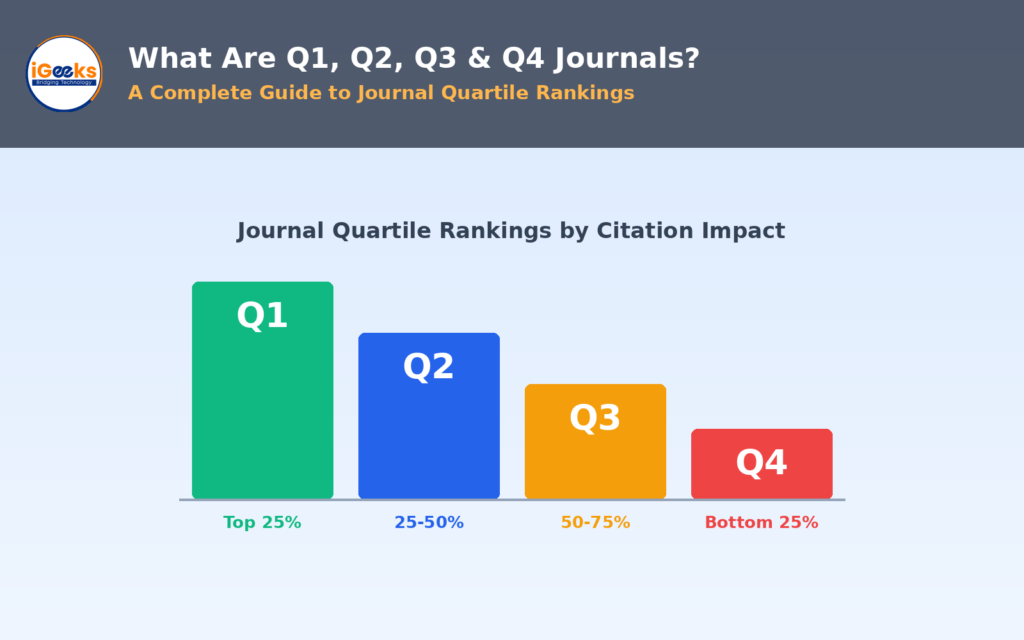
Journal quartile rankings divide all journals within a specific subject category into four equal groups, ranked by a citation-based performance metric — typically the journal’s impact factor or, most commonly, its SJR (SCImago Journal Rank) score.
- Q1 — the top 25% of journals in a subject category
- Q2 — the next 25% (25th–50th percentile)
- Q3 — the next 25% (50th–75th percentile)
- Q4 — the bottom 25% (75th–100th percentile)
Critically, this ranking is category-specific, not universal — a journal’s quartile depends on which subject category it’s being compared within, and many journals are classified under multiple categories, sometimes landing in different quartiles for each.
Where Quartile Rankings Actually Come From
Scimago Journal Rank (SJR)
The most commonly referenced source for quartile rankings, freely accessible via the Scimago Journal & Country Rank website. SJR is derived from Scopus data and weights citations based on the prestige of the citing journal, not just raw citation counts.
Journal Citation Reports (JCR) / Web of Science
Clarivate’s Journal Citation Reports also assigns quartile rankings, based on Journal Impact Factor (JIF) within Web of Science’s indexed journals. A journal’s Scimago quartile and its JCR quartile can sometimes differ, since they draw on different databases and metrics.
It’s worth checking which specific ranking system your university or department requires, since “Q1” can technically refer to either system depending on context.
Why Quartile Matters So Much in Academic Practice
PhD Submission Requirements
Many universities — including a growing number in India — require scholars to publish in at least a Q1 or Q2 journal before thesis submission, making quartile a direct, practical gatekeeper for graduation timelines.
Faculty Evaluation and Promotion
Academic hiring, tenure, and promotion committees frequently weight publications by quartile, treating Q1 publications as significantly more valuable than equivalent output in lower-ranked journals.
Research Funding Applications
Grant committees often use an applicant’s publication quartile history as a proxy for research quality and track record when evaluating funding proposals.
Perceived Research Credibility
Rightly or wrongly, quartile ranking has become a widely used (if imperfect) shorthand for a journal’s overall rigor, visibility, and academic standing within its field.
What Quartile Ranking Does NOT Tell You
Quartile is a useful signal, but it has real limitations worth understanding:
- It doesn’t measure the quality of any single paper — a mediocre paper can appear in a Q1 journal, and an excellent paper can appear in a Q3 journal
- It’s category-dependent — a journal ranked Q1 in a narrow subject category isn’t necessarily equivalent in prestige to a Q1 journal in a broad, highly competitive field
- It can shift year to year — journals move between quartiles as citation patterns change, so rankings should always be checked against the current year’s data
- It doesn’t account for open-access predatory journals, some of which have found ways to inflate their apparent standing — quartile ranking should be checked alongside a journal’s legitimacy, not as a substitute for it
How to Check a Journal’s Quartile Ranking
- Visit the Scimago Journal & Country Rank website (scimagojr.com)
- Search for your target journal by name
- Review its quartile ranking across each subject category it’s classified under (a journal may be Q1 in one category and Q2 in another)
- Cross-check against Web of Science / JCR if your institution specifically requires that ranking system
- Confirm the ranking reflects the most recent available year, since positions can shift
Choosing the Right Quartile Target for Your Research
Rather than automatically aiming for Q1 regardless of fit, consider:
- Your university’s specific minimum requirement — often Q1 or Q2, but this varies by institution and program
- Your research’s genuine novelty and rigor — an honest assessment of whether your work is likely to compete successfully at the Q1 level
- Your timeline — Q1 journals often have longer, more competitive review processes; if you’re working against a hard submission deadline, a well-matched Q2 journal may be the more strategic choice
- Subject category considerations — some fields have far fewer Q1 options than others, making Q2 genuinely competitive and respectable within that specific category
Get Expert Help With Journal Selection and Publication
Understanding quartile rankings is only the first step — matching your specific research to the right journal, and preparing a manuscript that genuinely competes at that level, is where expert guidance makes a real difference.
Explore our research paper writing and publication services in Bangalore: 👉 www.makefinalyearproject.com/research-paper-writing-publication-bangalore.html
Have a question about which quartile fits your research? Reach out directly on WhatsApp: 📲 +91 7019280372
Choosing the right journal isn’t just about prestige — it’s about giving your research the best realistic chance of being published, and being seen.