

For PhD scholars, publishing research in a reputed journal can be an important part of building an academic and research career. During the PhD journey, researchers frequently hear terms such as Q1, Q2, Q3, Scopus, CiteScore, SJR, SNIP, SCI, and Web of Science.
Among these, Q1 journals are often viewed as highly desirable because they occupy the highest quartile within a particular journal-ranking category. However, an important question remains:
Does every PhD scholar need to publish in a Q1 journal?
Not necessarily.
A Q1 journal can be an excellent target for strong, novel research, but a reputable Q2 or Q3 journal may sometimes be a more appropriate choice depending on the research topic, journal scope, institutional requirements, research maturity, budget, and publication strategy.
The smartest approach is not simply to chase the highest quartile. Instead, researchers should identify the most credible and relevant journal for their particular research.
What Does Q1 Mean in Academic Publishing?
Q1 generally refers to the first quartile of journals within a particular subject category under a particular ranking or metric system.
In the Scopus environment, researchers can review journal-level metrics including CiteScore, CiteScore percentile, CiteScore quartile, SJR, and SNIP.
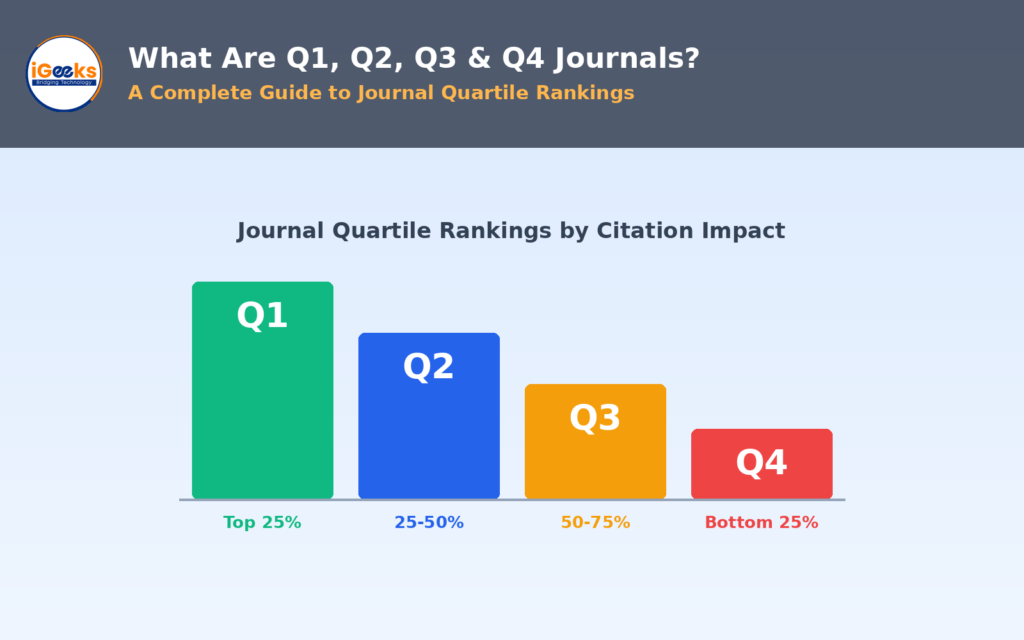
A commonly used interpretation is:
- Q1: Top 25%
- Q2: 25%–50%
- Q3: 50%–75%
- Q4: 75%–100%
However, researchers should not assume that a journal has one universal quartile.
A journal can be associated with multiple subject categories, and its ranking can differ between categories. Scopus provides subject-area filtering and quartile information through its Sources platform.
Therefore, when someone says:
“This is a Q1 journal.”
you should ask:
Q1 according to which metric, subject category, and year?
Why Does Q1 Publication Matter for PhD Scholars?
1. It Can Strengthen Your Academic Profile
Publishing in a reputable, highly ranked journal can contribute to a researcher’s academic profile.
A strong publication record can be relevant when applying for:
- Academic positions
- Postdoctoral opportunities
- Research fellowships
- Research collaborations
- Grants
- International research opportunities
- Faculty positions
- Research-intensive roles
However, Q1 status should be viewed as one component of an academic profile rather than a guarantee of career success.
2. Q1 Journals Can Provide Strong Research Visibility
Researchers publish papers so that their work can be discovered, read, evaluated, cited, and used by other researchers.
Scopus provides article-level and author-level metrics that can help researchers understand citation activity and research influence.
Publishing in a well-regarded journal can potentially help your research reach:
- International researchers
- Academic institutions
- Industry researchers
- Research collaborators
- Policymakers
- Other scholars working in your field
The actual visibility of a paper, however, depends on many factors, including the research topic, quality, discoverability, relevance, and subsequent engagement by the research community.
3. Q1 Publication Can Demonstrate Strong Research Competitiveness
High-quality journals generally receive submissions from researchers around the world.
A competitive publication process may involve detailed editorial assessment and peer review.
Reviewers can evaluate:
- Research novelty
- Research methodology
- Literature review
- Statistical analysis
- Experimental design
- Results
- Discussion
- Conclusions
- Limitations
- Overall contribution
This process can help researchers identify weaknesses and improve their manuscript.
4. Q1 Publications Can Support Long-Term Research Goals
A PhD is not simply about completing a thesis. For many researchers, it is the beginning of a longer research career.
A strong publication strategy may be useful for researchers planning to pursue:
- Postdoctoral research
- University teaching
- Research positions
- International collaborations
- Research grants
- Academic leadership
- Industry research
- Further doctoral or interdisciplinary research
A Q1 publication may be particularly valuable when the research is strong enough to compete successfully in a highly selective journal.
Does Every PhD Scholar Need a Q1 Publication?
No.
This is one of the most important points PhD scholars should understand.
Publication requirements differ between:
- Universities
- Departments
- Countries
- PhD programmes
- Funding bodies
- Research institutions
Some programmes may require publication in a particular indexed journal or category, while others may specify different publication requirements.
Therefore, before targeting Q1, Q2, or Q3, researchers should first check their:
- University PhD regulations
- Department guidelines
- Supervisor’s recommendations
- Thesis submission requirements
- Fellowship requirements
- Institutional publication policy
Do not assume that Q1 is mandatory unless your institution specifically requires it.
When Is Q1 the Right Choice?
Q1 can be a strong target when your research has several of the following characteristics.
Strong Research Novelty
Your study introduces something genuinely valuable, such as:
- A new methodology
- A new algorithm
- A new theoretical framework
- A new dataset
- A new experimental finding
- A new clinical insight
- A new engineering solution
- A new business or management model
Strong Methodology
The research methodology should be rigorous and clearly explained.
Depending on the discipline, this may include:
- Appropriate sampling
- Valid datasets
- Experimental design
- Statistical analysis
- Model validation
- Reproducibility
- Appropriate controls
- Clear evaluation criteria
Strong Manuscript
The paper should have:
- A clear research question
- Strong literature review
- Well-defined research gap
- Appropriate methodology
- Reliable results
- Logical discussion
- Clear contribution
- Appropriate references
Strong Journal Fit
Your research should closely match the journal’s:
- Aims
- Scope
- Subject category
- Target audience
- Article type
- Recent publications
Elsevier’s journal-selection guidance specifically recommends evaluating the match between the manuscript and the journal’s scope, audience, standards, and recently published articles.
When Can Q2 Be the Smarter Choice?
A Q2 journal should not automatically be considered inferior to Q1.
A strong Q2 journal can be an excellent publication venue when it has:
- Excellent subject relevance
- Strong readership
- Relevant recent publications
- Credible peer review
- Appropriate indexing
- Acceptable publication policies
- Alignment with your university requirements
For example, imagine that your research focuses on a very specialised topic.
You find:
Journal A – Q1
- Very broad scope
- Limited papers on your specific topic
- Extremely competitive
Journal B – Q2
- Highly specialised scope
- Publishes many papers in your exact research area
- Strong readership for your topic
Journal B may potentially provide a better research fit.
The objective should be to identify the right scholarly audience, not simply the highest quartile.
When Can Q3 Be the Smarter Choice?
A legitimate Q3 journal may also be an appropriate option.
Q3 may make sense when:
- The journal closely matches your research.
- Your university accepts Q3.
- The journal follows a legitimate peer-review process.
- The journal has an established editorial structure.
- Your target readers regularly use the journal.
- Your research contribution is appropriate for the journal.
- The publication conditions fit your requirements.
Q3 should not be selected simply because it appears easier to publish in.
The journal should still be evaluated carefully for:
- Indexing
- Scope
- Publisher
- Editorial board
- Peer review
- Publication ethics
- Recent articles
- Journal metrics
Scopus maintains selection and ongoing re-evaluation processes for indexed content, reflecting its focus on content quality and journal standards.
Q1 vs Q2 vs Q3 for PhD Scholars
| Factor | Q1 | Q2 | Q3 |
|---|---|---|---|
| Relative quartile | Highest | Second | Third |
| Competition | Usually high | Moderate–high | Varies |
| Research expectations | Often high | High | Varies |
| Scope fit | Critical | Critical | Critical |
| Visibility | Potentially strong | Potentially strong | Varies |
| PhD suitability | Yes | Yes | Yes, if permitted |
| Best use | Strong/high-impact research | Strong specialised research | Relevant, credible research |
| Institutional acceptance | Verify | Verify | Verify |
| Metrics | Evaluate | Evaluate | Evaluate |
These are general guidelines. Individual journals can differ considerably within the same quartile.
Why Journal-Research Fit Is More Important Than Quartile Alone
Imagine that your research paper is about:
“Deep Learning for Early Detection of Diabetic Retinopathy.”
You discover:
Journal A
Q1, broad artificial intelligence scope.
Journal B
Q2, highly focused medical imaging and healthcare AI scope.
Journal C
Q3, specialised ophthalmology technology scope.
Which should you select?
There is no automatic answer.
You should examine:
- Recent publications
- Research methodology
- Target audience
- Article types
- Journal scope
- Editorial standards
- Publication policies
- Institutional requirements
The Q1 label is important information, but it should not replace journal-fit analysis.
Don’t Judge Journal Quality Using One Metric
Researchers sometimes make the mistake of selecting a journal based entirely on:
- Q1 status
- CiteScore
- Impact Factor
- SJR
- SNIP
These indicators can be useful, but they should be interpreted in context.
Elsevier recommends using both qualitative and quantitative inputs and using more than one research metric when assessing research impact.
Important Journal Metrics PhD Scholars Should Understand
CiteScore
CiteScore is a family of Scopus-based journal metrics used to evaluate publication influence.
Scopus provides CiteScore, percentile, rank, and quartile information for sources.
SJR
SCImago Journal Rank is a prestige-oriented journal metric that considers the value of citations according to the field, quality, and reputation of the citing source.
SNIP
Source-Normalized Impact per Paper accounts for differences in citation behaviour between disciplines.
Researchers should use these indicators as part of a broader evaluation rather than treating one number as a complete measure of research quality.
How to Decide Between Q1, Q2 and Q3
Follow a structured journal-selection process.
Step 1: Understand Your University Requirement
First determine:
What does your PhD programme actually require?
Check the official regulations before choosing a journal.
Step 2: Define Your Research Contribution
Identify:
- Research problem
- Research gap
- Objectives
- Methodology
- Main findings
- Novelty
- Research contribution
Step 3: Identify Potential Journals
Create a list of potentially relevant journals.
You can consider:
- Q1 journals
- Q2 journals
- Q3 journals
provided they meet your research and institutional requirements.
Step 4: Check the Journal Scope
Read:
- Aims and scope
- Subject categories
- Article types
- Recent papers
- Editorial information
Elsevier’s journal-selection resources specifically recommend examining the journal’s aims and scope and checking whether the journal regularly publishes research similar to your paper.
Step 5: Read Recent Papers
Read at least several recent papers from each shortlisted journal.
Compare:
- Methodology
- Research depth
- Article structure
- Statistical methods
- Figures
- Tables
- References
- Discussion style
Ask:
“Is my paper comparable in scope and quality to the research this journal currently publishes?”
Step 6: Check Current Metrics
Record:
- CiteScore
- CiteScore percentile
- Quartile
- SJR
- SNIP
- Subject category
- Metric year
Do not rely on screenshots, old promotional material, or third-party claims without verification.
Scopus provides access to journal rankings and other metrics through Scopus Preview.
Step 7: Verify Publication Ethics
Check whether the journal clearly provides information about:
- Peer review
- Editorial board
- Publication ethics
- Plagiarism
- Corrections
- Retractions
- Conflicts of interest
- Author responsibilities
Be cautious of journals or services that advertise:
- Guaranteed acceptance
- Guaranteed Q1 publication
- Extremely short peer-review periods
- Unrealistic publication guarantees
No legitimate publication service can ethically guarantee acceptance in an independent peer-reviewed journal.
Step 8: Check Publication Fees
Before submission, investigate:
- Article Processing Charges
- Open-access fees
- Submission fees
- Other publication charges
Do not assume that Q1 means expensive or that Q3 means inexpensive.
Publication charges depend on the journal and its publishing model.
A Smart Publication Strategy for PhD Scholars
Instead of thinking:
“Every paper must be Q1.”
A more strategic approach is:
“Every paper should be submitted to the most appropriate credible journal for its research contribution and academic objective.”
For example, a researcher may develop a publication portfolio such as:
Paper 1 → Strong Q2 target
Paper 2 → Q1 target
Paper 3 → Specialised Q2/Q3 target
The appropriate strategy depends entirely on institutional requirements and the quality and subject matter of each manuscript.
Q1 Publication: Advantages and Limitations
Advantages
- Potentially strong academic visibility
- Competitive research environment
- Opportunity to reach a broad research community
- Potential contribution to a stronger publication profile
- Potential relevance for research-intensive careers
Limitations
- Highly competitive
- Strong manuscript expectations
- Potentially longer revision processes
- Scope mismatch can result in rejection
- Publication costs may apply
- Acceptance cannot be guaranteed
Q2 Publication: Advantages and Limitations
Advantages
- Can provide strong subject alignment
- Often suitable for specialised research
- May satisfy institutional requirements
- Can provide access to an appropriate scholarly audience
Limitations
- Still competitive
- May not satisfy institutions requiring Q1 specifically
- Metrics vary between journals
- Scope and quality still need careful evaluation
Q3 Publication: Advantages and Limitations
Advantages
- Can be suitable for specialised research
- May satisfy certain institutional requirements
- Potentially strong scope alignment
- Can contribute to a researcher’s publication record
Limitations
- May not meet institutions requiring Q1/Q2
- Visibility varies
- Journal quality must still be carefully evaluated
- Quartile alone does not establish credibility
Common Mistakes PhD Scholars Should Avoid
1. Chasing Q1 Without Checking Scope
A Q1 journal outside your research field is not necessarily a good target.
2. Ignoring University Requirements
Always check your official PhD regulations first.
3. Using Outdated Quartile Information
Journal metrics and classifications can change.
Verify current information before submission.
4. Checking Only One Metric
Use multiple metrics and qualitative information.
5. Ignoring Recent Articles
Recent papers provide useful evidence of the journal’s current research focus.
6. Selecting a Journal Based on Guaranteed Acceptance
Acceptance should remain an independent editorial and peer-review decision.
7. Ignoring Publication Ethics
Researchers should avoid:
- Plagiarism
- Fabricated data
- Duplicate publication
- Improper authorship
- Simultaneous submissions
- Citation manipulation
Q1, Q2 or Q3: Which One Should You Choose?
Use this simple framework:
Choose Q1 when:
Your research is highly novel + the manuscript is strong + the journal is an excellent fit + your academic objectives justify a highly competitive target.
Choose Q2 when:
Your research is strong and specialised + the journal has excellent scope alignment + Q2 satisfies your institutional requirements.
Choose Q3 when:
The journal is credible + the scope is highly relevant + your institution accepts it + the journal provides an appropriate audience for your research.
The correct answer is therefore not:
“Q1 is always best.”
The better answer is:
“Choose the highest-quality credible journal that is genuinely appropriate for your research and your academic requirements.”
Final Thoughts
Q1 publication can be highly valuable for PhD scholars, particularly when the research has strong novelty, rigorous methodology, meaningful contribution, and a good fit with a competitive journal.
However, Q2 and Q3 journals should not automatically be dismissed.
A strong Q2 journal can be a smarter choice than an unsuitable Q1 journal. Similarly, a reputable Q3 journal may be appropriate when it closely matches the research and satisfies institutional requirements.
The most effective publication strategy combines:
Research Quality + Journal Fit + Credibility + Indexing + Institutional Requirements + Relevant Metrics + Publication Ethics
rather than focusing exclusively on the quartile.
Scopus provides multiple journal-level metrics, including CiteScore, SJR and SNIP, while Elsevier recommends combining quantitative metrics with qualitative assessment.
Need Research Paper Writing & Publication Support?
PhD scholars and researchers can seek academic support for:
- Research Paper Writing
- Research Methodology
- Literature Review
- Statistical Analysis
- Manuscript Editing
- Research Paper Formatting
- Journal Selection
- Scopus Publication Guidance
- SCI Publication Support
- IEEE Paper Support
- Reviewer Comment Response
- Manuscript Revision
🌐 Research Paper Writing & Publication Services
Igeeks Technologies:
https://www.makefinalyearproject.com/research-paper-writing-publication-bangalore.html
7019280372
Share your research topic, abstract/manuscript, research area, university publication requirement, and preferred journal category to discuss suitable research and publication support.